From the postcard to the minimalist.

But what about the photography, I hear you ask.

A photographer for many years now, the novelty for me of going out with the camera just for fun has long since worn off. Over time my photographic activities have become more focussed on a particular project, and since returning from Mallorca that project has been to add to my collection of possible postcards for future years. The most successful of such visits this summer was the classic location of Llyn Mymbyr, west of Capel Curig, at the end of May.

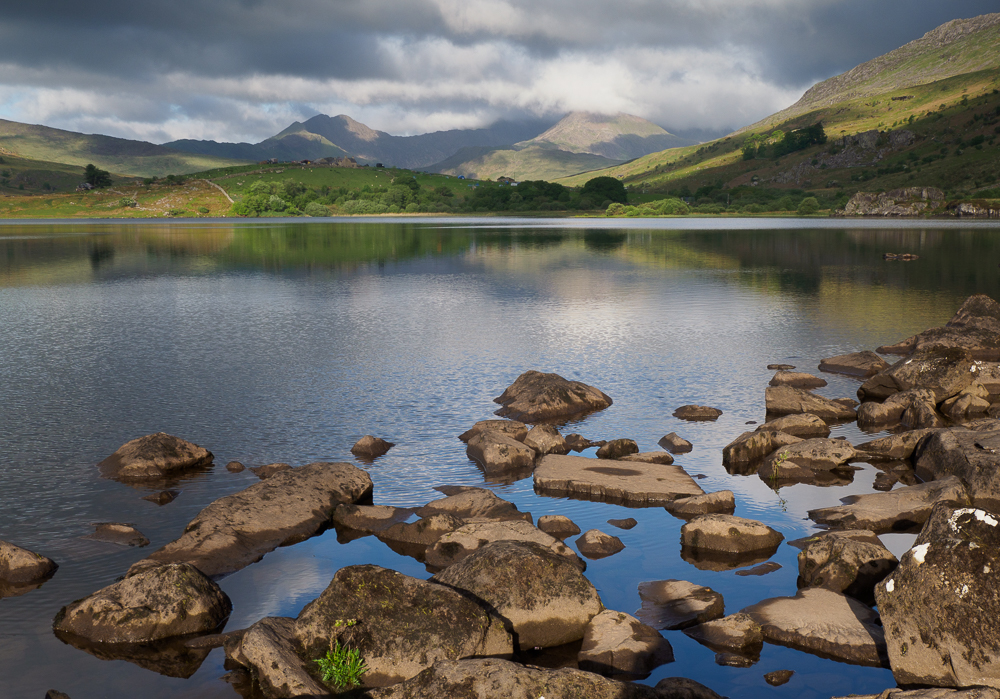
From the east end of the lake one can gaze across placid (or more likely choppy) waters towards the Snowdon Horseshoe. Halfway along, debris – brought down from the mountains by a long since disappeared torrent – almost cuts the lake in two, giving the lake its alternative name of Llynnau Mymbyr (Mymbyr Lakes). It is easy to walk to the channel joining the two waterbodies , giving views to Snowdon in one direction and back towards Capel Curig to the other. Being so close to the road the location is very popular with photographers, but it would also be well worth a decent walk to get there.

I had a feeling that something special might happen, and it did – eventually. The first morning was good, some nice light, good clouds and decent reflections. But perhaps I should have woken earlier……….. I may have missed the best conditions. I had business elsewhere during the day but returned for the evening. Again, conditions were good but not too exciting. As it was Bank Holiday weekend the campsite at the west end of the lake was busy with cars and motorhomes which provided an irritating mid-ground in front of the Horseshoe. Only in a wide-angle view would any of these images these be useable. I took my tripod around to the far side of the lake for a better angle and used a ND filter and long exposures for a different “look”, but the results were not quite what I was hoping for.

From the postcard……

The following morning I woke early and conditions looked great: blue sky overhead but fog at ground level. I walked down to the lakeside and even at 5.40 a.m I wasn’t the first photographer around. In one of my first pictures you can see a figure crouched in the reeds by the water’s edge.

….to the minimalist

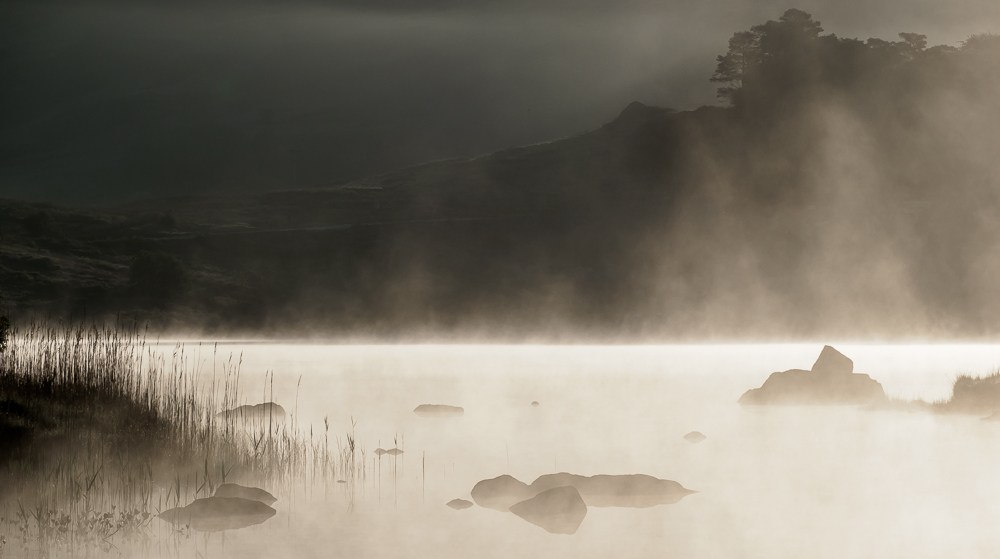
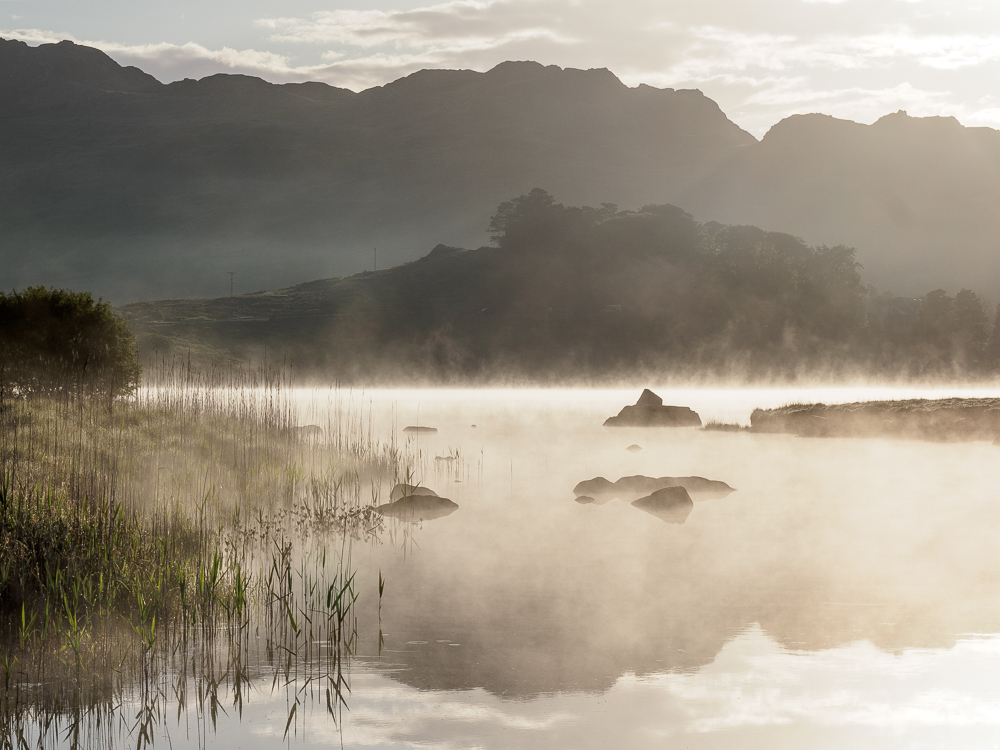
What a morning it was! The sun was already above the horizon, backlighting every feature of the landscape to the east. Mist was rising gently from the still waters of the lake. If these conditions happen at all, they are usually short-lived, but I was able to spend a good hour taking pictures in quite a relaxed fashion. I used a whole range of focal lengths from 25mm to 400 mm using both my main lenses, and got a tremendous selection of images….. if I say so myself…… ranging from the “postcard” to the minimalist.

It was the landscape photographer’s dream morning, and I was elated. But what of the other guy who appears in my first pictures? Within ten minutes he had gone. Shortly later I heard the sound of a drone flying above the lake and by the time I returned to my van in the layby his van had disappeared. I wonder how many locations he was visiting that morning, and how satisfying each one was?

To read more Tales from Wild Wales as they are published, please click the Follow button.

Raptor nut (Part 1)

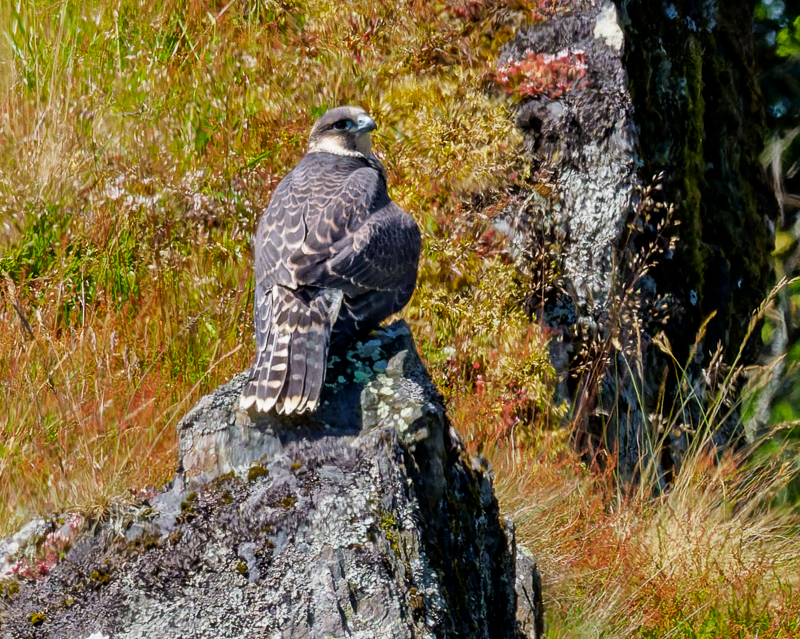
Juvenile peregrine. I got the impression this was a male.

There’s always been something special for me about birds of prey. In my “youth” (ok, I was about 30) I did several summer contracts for the RSPB which usually involved raptors and I seemed to identify with them. I spent more time with peregrines than any other species and I still seem to have an affinity with them. But I also spent many weeks with white-tailed and golden eagles on Mull, and with various species in Wales, Scotland and England. Not to mention gyr falcons and peregrines in Greenland! So you could say that since then I’ve been a bit of a raptor nut. I’d rather spend four hours watching a peregrine eyrie – even if virtually nothing happens – than four hours counting waders on an estuary.

Over the last two springs and summers I’ve been keeping my eye on several raptor eyries – from a distance, of course. It started in early 2021, during lockdown, when I discovered a pair of peregrines on a cliff within cycling distance of my home. This was exciting for me because until then I was under the impression that inland peregrine eyries had long since been abandoned in Ceredigion. I followed them through to mid-summer and saw at least one juvenile in the vicinity of the cliff. On an early visit this year I saw both adults visiting the same ledge together, which bade well for the current breeding season.

This year, following a tip-off, I found another pair nesting in an old raven nest on another cliff even closer to home. By that time the three youngsters were already well-developed and on my second visit it looked like two of them might jump and flap off the nest at any moment. One can only imagine the sense of excitement and trepidation that these young birds experience as they prepare to take their first flight. I had found a comfortable perch for myself on the opposite side of the gorge where my presence didn’t seem to worry their parents. On my third visit, a few days ago, as I approached the gorge on foot , I saw that two of the now fledged youngsters were actually using the my own perch for themselves! So I hung back and let events take their natural course. There was plenty of activity as the juveniles raced around after each other and their parents, screaming raucously. There’s nothing more stimulating to the senses than peregrines at full throttle!

I began to make plans to return to the site with my picnic chair and pop-up hide, but the truth is that I am getting very poor results from my current photographic equipment, and I don’t know why. (The image above is very much the exception.) I’ve ruled out my long lens (a Panasonic 100-400 zoom), so it looks like the problem lies with the body – an Olympus EM1 mk 2, which is now almost three years old. I’m wondering if the “in-body image stabilisation” (IBIS) is faulty or whether my settings have become corrupted in some way. Unfortunately I am a bit of a technophobe so all this is rather a challenge. But needless to say, and incredibly frustratingly, any attempt at long range bird photography is having to take a back seat for now.

In summer 2020 – again following a tip-off from a friend – I heard that merlins were nesting in a dramatic, cliff-enclosed cwm a little further away. I was not familiar with this species, so I visited the site, and was excited to see a female merlin flash by on the walk in. It all seemed very promising. Reaching the cwm I noticed several small raptors perched on erratic rocks on the grassy hillsides around the lake. I decided they were merlins but then noticed that, in the air, one of them seemed to be hovering like a kestrel. And then…….. oh….. that one’s hovering like a kestrel as well……….. Eventually the penny dropped. They were kestrels. It was all a bit puzzling. I read “The Merlins of the Welsh Marches” , by David Orton, and that whetted my appetite even more for merlin experiences.

Cliff-nesting merlins are unusual; merlins nesting anywhere in Ceredigion are unusual. In fact, merlins in Ceredigion are unusual, full stop! But last summer I managed to locate this pair’s nest on a heathery ledge part way up a low cliff above the lake. I visited the cwm several times with a few trusted friends and we all enjoyed some exciting raptor action. They are such lively, feisty little birds, especially the tiny, blue-grey male, that in a sense they almost put peregrines to shame. I visited the cwm again this spring and noticed that the merlin pair were present and showing an interest in a section of cliff high, high above the lake. Would they be nesting there this year?

To read more Tales from Wild Wales as they are published, please click the Follow button.

Peregrinations (part one).

Female dipper at Aberaeron

Over the last few weeks I’ve been exploring parts of the Ceredigion coast with the aid of an excellent bus service. I leave my van in the out-of-town-supermarket car park in Aberystwyth and hop on the bus. It’s a relaxing way to arrive at your destination, and stepping out of the bus in New Quay or Aberaeron on a sunny morning can feel like being on holiday!

I’ve never had much success photographing dippers, but there is a pair on the river at Aberaeron which is semi-accustomed to the presence of walkers passing by. I spent one morning there recently where I was able to photograph both birds at close range. The male has an unpleasant growth on his right ankle but that doesn’t seem to have affected his ability to supply his mate (and possibly youngsters) with larvae from the river bed. The female is a very fine specimen indeed.

I wouldn’t like anyone to think that I come back from a visit like this with memory cards full of perfectly composed, focussed and exposed images of birds like this. Quite the contrary. I’m often frustrated at the results I manage to achieve and I really don’t understand why some appear so mushy – especially those taken with my long zoom lens. Is it equipment failure or user error? I’d love to know. But I usually manage something to be proud of.

Checking me out …… peregrine near Aberaeron

After another visit I walked along one stretch of coast to the north of Aberaeron before catching the bus back home. It was delightful on a warm spring afternoon to be out in the fresh air with birds singing and the first wild flowers in bloom. Walking above some sheer cliffs I suddenly saw what I had been hoping for – a dark shape appearing above the waves and very obviously checking me out as it flew past. A peregrine! It repeated the maneouvre several times before disappearing back out of sight. Photographing fast-moving birds birds in flight has never been my forte but I was as prepared as I could be for this eventuality. Following the bird as it flew back-and-forth a few times, I attempted to keep it in focus, and I largely succeeded. I think the main reason for my success on this occasion was that the birds stands out so clearly against the background. There is very little chance that the autofocus will be confused. But it was still an anxious time until I opened the files up on the PC!

To read more Tales of Wild Wales as they are published, please click the Follow button

Firestarter.

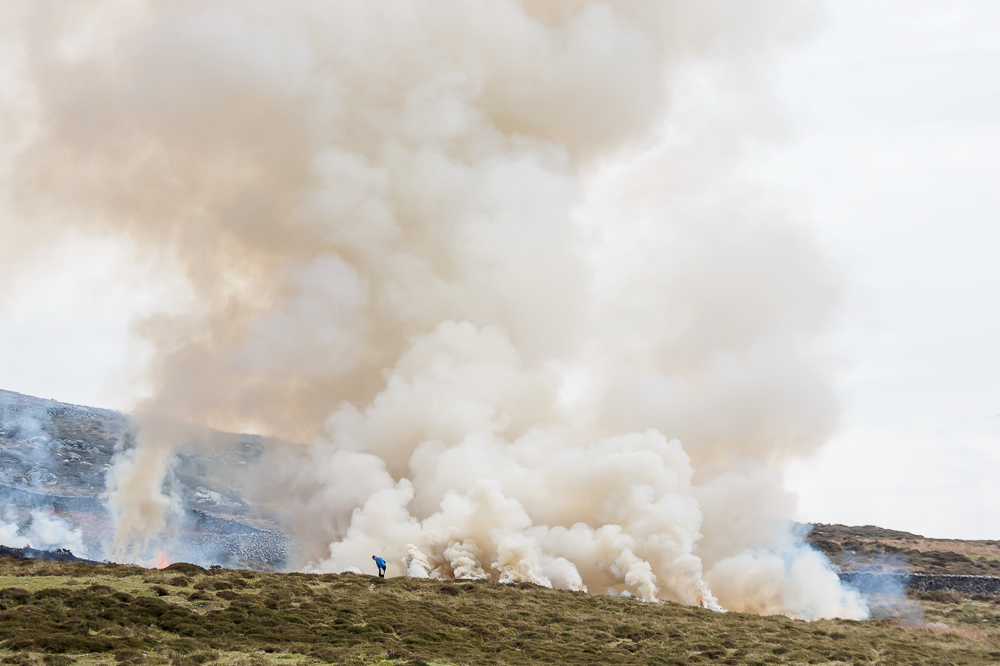
Conflagration on Mynydd Mawr, with the village of Y Fron in the foreground.

Apparently this time of year is widely known as the burning season. This year, in particular, after ten days of continuous sunshine and desiccating southeasterly winds our natural vegetation is now tinder dry.

Last Wednesday morning I set off into north Wales on the last of this winter’s postcard delivery trips. I didn’t have a very full timetable of calls so by lunchtime I was in Porthmadog. I decided to have a leisurely sandwich and birdwatch by the artificial tidal lagoon on the edge of the town. As the water was high few birds were to be seen there but there was a nice selection of waders on Traeth Mawr nearby. Turning back towards the van I noticed a pall of smoke drifting over from the north. I phoned a good friend who lives in Nantlle, about ten miles in that direction as the crow flies. He was very concerned about a fire in the hills nearby that he believed had been set by a farmer the previous evening. It had been burning out of control ever since. I wondered if the smoke I had seen was the product of that fire.

After a final call in Beddgelert I continued northwards. A huge mass of smoke was rising vertically in the still air from the summit of Mynydd Mawr, and then drifting northwards. The mountain looked like an active volcano. But it didn’t really fit the description of the fire I had heard about. Turning westwards at Rhyd Ddu towards Nantlle, the fire was to my right whereas the fire he had described would have been on my left. Entering the village I could see a few wisps of smoke rising from the crags and moorland south of Llyn Nantlle while the main fire was now raging behind me. There were two separate fires.

Mynydd Mawr from Nantlle

My friend – an ecologist by training and with many years of professional experience – was outraged to see the second fire. He had just returned from Argentina where he had had a bout of Covid, and probably wasn’t in the best frame of mind to see both sides of his beloved Nantlle valley being consumed in a conflagration! We walked a short distance to get a better view of it. It was his opinion that both fires had been set by the respective landowners/farmers. Upland vegetation is burnt like this to kill the older, more woody stems of heather, producing more younger shoots, and more grass; in other words better grazing for sheep. But over long periods of time repeated burning and grazing prevents heather from regenerating and results in upland vegetation being restricted to coarse grasses that can resist fire but have little wildlife value. It is one of the reasons why there is now so little heather moorland in Wales.

Mynydd Mawr again……

I was anxious to get more photographs of the fire so headed off in the van towards the village of Y Fron, at a higher altitude than Nantlle. Cresting the brow of a hill the fire in all its destructive reality was visible – see the main photograph above. Four fire engines were present and I had a quick chat with one of the firemen. It was while they were attempting to tackle the original fire to the south of Nantlle that they noticed this second fire take hold. “Whatever can you do about it?” I asked. He spread both arms in front of him, fingers on both hands conspicuously crossed. He said it could have been started by bored teenagers or careless walkers, but I think we both knew who the culprit was. He said that farmers are allowed to perform controlled burns but that they “sometimes got out of hand”. I spent a few more minutes taking photographs before leaving the area.

Near Pant Glas……

I spent the night in the van on the open shoreline of Foryd Bay ; it is one of my favourite places in Wales. But around breakfast time another pall of smoke began rising into the sky to the south. I had enough time to investigate the source of the smoke and fairly quickly located it near the hamlet of Pant Glas. I parked up and walked towards the fire; a figure was visible, moving around near the base of the flames. Through my binoculars I could see him carrying some kind of fire-lighting implement that every so often he would dip into a plastic container of brown liquid. This was a job for my long telephoto lens! I could see he was slowly, methodically and calmly lighting fires in the dry vegetation, without a care in the world. He was completely oblivious to my presence and I took a whole series of photographs. I don’t know how far this fire spread but the BBC Wales News website referred to a wildfire “at Pant Glas” on that day.

Firestarter………

Normally farmers can ignore the guidelines for “controlled” burning because they know no-one will ever see them. The most unprincipled can light destructive fires in the expectation that they WILL rapidly get out of control and be all but impossible to extinguish. But the expenses involved in the Fire Service attending these wildfires, including the cost of helicopter hire, are, unfairly, borne by the public purse. I have sent a batch of photos like the one above to North Wales police, and I believe that the identity of the man lighting this fire would be identifiable from them. How seriously the authorities will take them is another matter, because all too often unscrupulous farmers are given the benefit of the doubt.

Update : A petition asking the Welsh Government to ban so-called “controlled” burning has been started; please click on the link below to sign it.

https://petitions.senedd.wales/petitions/245129

To read more Tales from Wild Wales as they are published please click on the Follow button

Something of value.

During a thirty year career photographing the landscape and more than a decade ago adding wildlife to my repertoire, I’ve also been maintaining a bit of a sideline.

Dead seabirds (mostly common scoter), Freshwater East, Pembrokeshire. February 1996. I spent a couple of days in Pembrokeshire after the Sea Empress oil tanker ran aground. Some of the photographs appeared on TV at the time.

While out in the landscape I’ve sometimes come across quirky, incongruous or downright ugly scenes which tell us more about our relationship with the landscape than most of my (or anybody’s) actual “traditional” landscapes do. As an early example, in the early days of Fuji Velvia (the late 1980’s) , I remember taking a picture of a pile of bright blue plastic pipes close to a reservoir in the wilds of the Ceredigion uplands; it’s probably still in a filing cabinet somewhere. At first I called these images “human landscapes” although I don’t feel that that description now does them all justice. Many are informed by my environmental concerns in a broad sense and some actually say more about us than the landscape. Some ask more questions than give answers.

Near Bangor, Gwynedd. July 2019. An exception to the rule: having seen this phone mast from the driver’s seat of my van, I revisited it some months later and searched out the best spot to photograph it from.

Throughout my life in photography I’ve been a big fan of the brilliant Joe Cornish and his contemporaries as well as the almost unique world-view of the late Fay Godwin; both have their place in the world of outdoor photography. Fay Godwin, it seems to me, began her photographic career specialising in traditional black-and-white landscapes. But as her consciousness developed about the damage we are inflicting on nature, so her images became more closely aligned to her environmental concerns. She disliked the description of “landscape photographer” that people gave her, despite the fact that she worked mainly in the landscape; she preferred the term “documentary”. I understand exactly what she meant; it’s unfortunate that in the photographic world the term landscape means only one sort of landscape.

Near Trefenter, Ceredigion. March 2021

Going back to my own human landscapes, I’ve often been able to sneak them into my books and exhibitions while no-one was looking. I can imagine that many viewers’ reactions would be along the lines of “But Wales is such a beautiful country, why photograph that?” It has long been an ambition of mine to put them all together and exhibit them. Over the years it’s been known variously as my ” Black and White Project”, my “Retrospective of Sorts” and my “Homage to Fay Godwin”. As a prelude to this (I hope), at the end of last year, I put together a one-off photobook of more than fifty of them.

Pembroke castle and Oil Refinery, December 2009

How this eventually came about is worth a mention. I’d been putting it off for years. I had had some very dispiriting criticism of the project from a photographer in the Joe Cornish tradition who I had previously admired tremendously. I whittled the selection down to about a hundred, including plenty of new work but some already published in colour. I converted them all to black-and-white, and had some cheap test prints made, but still couldn’t put them together. Then while browsing on the internet one day I saw a promotion from an online company offering £100 off one of their top-of -the-range photobooks. I responded immediately and was sent a coupon valid for 30 days. This was the impetus I needed, and within a couple of weeks I had the finished product on my desk. Compiling it was the most fun in photography I had had for years! The quality of the book was excellent except for one thing; it had been designed online and the mid-grey front cover with white and black lettering looked fine on-screen. But in reality my name in black was almost invisible against the grey unless you saw it at a certain angle to the light. I pointed this out to the printers and they offered me a full credit for the cost, amounting to £118.23p, most of which I hadn’t paid in the first place!

Tywyn, Gwynedd. (June 2010). Taken while researching locations for Wales at Waters Edge

The content of the book, when I saw it, was really quite an eye-opener. I realised most of images had been seen almost out of the corner of my eye, while I was actually intent on taking other photographs. Mostly other landscapes, sometimes wildlife and surprisingly often while I was driving from A to B and just saw something. Many of them are at places where I stopped, took a picture and moved on. I know I will never be back there again. I’m sure I’m not the only photographer who sees a fantastic landscape from the driver’s seat of a car, stops, walks back and the finds the potentially world-beating image has completely disappeared. My snapshots are quite different to traditional landscapes, however, where the quality of the light is critical and a significant amount of pre-planning is usually required. In many cases individual images have limited value on their own but in the company of a few dozen others, the photographer’s vision becomes more clear.

Near LLanwchllyn, Gwynedd. September 2008. This could be described in terms of the media, or the message, or both. Not everyone gets both………

The good luck didn’t stop at the refund for the cost of printing the book, either. The National Library of Wales in Aberystwyth has quite a large collection of my colour work already. Just after Christmas I was strolling along the sea-front in Aberystwyth when I met its curator of photography, Will Troughton. After a bit of a general chat he asked me if I was working on anything at the moment. My usual response these days to that question is “well, er, no …….. not really…….” but fortunately I remembered to mention the retrospective/Godwin/b&w project. He expressed an interest and I arranged to meet him, book in hand. A couple of days after seeing it he phoned to say that he had “found some money” and would like to buy a selection of prints. The importance of the sale is not so much in the cash, but rather the recognition that I still produce photographic work of some value.

To read more Tales from Wild Wales as they are published, please click Follow

Long past sunset.

Long past sunset……. peat and boulders in the submerged forest. (5 seconds at f13)

The weekend before Christmas there was a break in the relentlessly cloudy and wet conditions that continue to plague us here in west Wales. While this allowed me to do some garden chores – getting a new load of logs under cover, for example – I was also able to visit the submerged forest between Borth and Ynyslas, about eight miles from here. My first visit was “on spec” after a birding walk on the Dyfi estuary. It was immediately apparent that a very large expanse of peat, together with hundreds, if not thousands, of tree stumps had been exposed after recent storms.

It was about half an hour before sunset and the tide was coming in, washing over the peat and through the stumps as it did so. From previous experience – see this post – I quickly worked out that timing would be better the following day as the advancing tide would be about fourty minutes later. Nevertheless I hung out there for a while and took a few pictures before the sun set.

Sunset over the submerged forest

I was back again the following afternoon. Although it had been a warm still day further inland, here near the mouth of the Dyfi estuary a cold easterly breeze was blowing. The light was extraordinary. The intensely clear sky was cloudless, bathing my surroundings in blue light, which I found quite unpleasant. The dark brown peat seemed to soak up whatever light hit it and become almost black. The breeze created countless ripples running at right-angles to the sun which put paid to any hope of any reflections. It was only when the sun neared the horizon that any relief came, in the shape of incoming waves breaking and being backlit with sunset colours.

Blessed relief from blue light!

Although my Olympus kit has remarkable image stabilisation, when one is considering exposures in the order of several seconds a tripod is indispensable. So this time I had my tripod with me and as the sun disappeared I set it up on a solid section of peat. I took a few long exposures but the tide advances very quickly here and before long the submerged forest was once more submerged! I determined to return the following evening.

The day of my third visit skies had been cloudless again but there was little wind; water levels were that much lower and there were still walkers on the beach. I explored a little but discovered that pleasing compositions were difficult to find. This figure seemed to add a sense of scale and I knew that I could easily clone him out if I felt he intruded on the timeless nature of this landscape.

A two image stitch in Lightroom

The sun had sunk below the horizon before waves began to encroach upon the forest. When they did I took a series of images at shutter speeds of up to eight seconds. On an incoming tide one needs to work quite fast to avoid getting wet feet (or worse) and I had time for just a few exposures. It was actually the last one (main photo) that I found most satisfying, and the tree stumps are only a minor element within it. I happened to notice that a few rounded boulders lay within the peat and that they were “rimlit” by the extremely bright post-sunset sky. I quickly moved the tripod over to place them in the foreground and pressed the shutter.

After processing them I posted the above image online. There followed a discussion on whether it was more effective with or without the figure – it was probably about 50/50. Further, and more interestingly …….. is a landscape with a human figure actually still a landscape at all?

For more technical information on the Submerged Forest, see this article by John Mason, a local geologist.

To read more Tales from Wild Wales as they are published, please click on the Follow button

Carpets of knot (part two)

The following morning dawned clear. It was still dark when I set off but stars were visible overhead and there was no wind. This was promising. As the day began to dawn I began to see what a lovely morning it was – slightly misty and with low-lying fog in places. Birders and photographers were already gathering by the time I arrived at the wader watchpoint on the banks of the Wash. A golden glow was just beginning to appear to the east. I noticed another hide which faced eastwards across the lagoon.

What if?

The sun had not yet risen. I don’t want to sound too heroic about that – sunrise is quite late in October. But there was potential for exciting images if flocks of waders flew around above the still waters of the lagoon before settling at the southern end as they tend to do. I wouldn’t be able to see westwards as the birds gathered offshore but I had nothing to lose, really. The hide was almost empty but some strategically situated vapour trails made some wonderful geometric shapes in the sky. I sat and waited for some action.

At 7.30 the sun appeared as a crimson ball in the mist and the first small wader flocks arrived. I was able to reduce the camera’s ISO rating from a pre-sunrise 1000 to the Olympus-recommended 200, which helped no end in terms of image quality and processing. It was a slow start but as the sun rose higher more birds flew in. There was no-one else in the hide.

Fifteen minutes later the first big flocks had appeared and so began one of the most intense photographic sessions I have ever experienced. There was still no one else in the hide and I had free rein to capture different perspectives on the action from different angles.

By this time I was feeling very emotional. Partly by chance and partly through intuition I found myself able to experience and photograph an astonishing spectacle. The wide range of focal lengths on my 12 – 100 mm lens (effectively 24 – 200 mm) allowed me to continue shooting whether the action was close to the hide or a little further away. I was also able to include a little foreground in some images,

At some point there was a sudden influx of other birders and it became almost impossible to move. By that point I had managed to stick my arms and head out of one of the windows; I had a lump in my throat and tears were streaming down my face. I stayed where I was and kept my finger on the shutter. Thank goodness for automation………..

By about eight o’clock the intensity of the action had begun to wane and I regained my sense of composure. Over a period of half an hour an atmosphere of gentle tranquility quickly turned into one of frantic hyperactivity and back as the knot flocks flew in and gradually settled down to roost. And that was just how I felt!

I emerged from the hide and walked the short distance back to the shore. It was lined with birders, photographers, and other sightseers. What a gorgeous morning it was, and what a sight!

Part three will follow.

To read more Tales from Wild Wales as they are published, please click the Follow button
Carpets of knot (part one).

A carpet of knot at Snettisham

It was still well before dawn. I had left my van and was searching for the footpath to the shoreline without a torch. Around me dark figures were emerging from vehicles, dimly lit car boots were open and people were hurriedly donning extra layers, rucksacks and waterproofs. The sensible ones had headtorches. I had a very dim memory of the carpark layout from my last visit, and realised I had walked past the exit. I turned round, pretended to know what I was doing and fell in behind a couple with a powerful torch.

I was on the west coast of Norfolk, at Snettisham, and had come to see one of the great wildlife spectacles in the UK. I visited twice in autumn 2013 whilst working on my Bird/land exhibition (see this link), and was last here in March 2016. Snettisham is on the eastern bank of The Wash, which is the winter home to many, many thousands of waders. At the highest of tides waders are pushed onshore and most gather at an old gravel pit, where the RSPB has constructed some hides. The rhythm of the tides is such that the highest waters are between 6am and 9am, or 6pm and 9pm, and in winter are without fail before dawn or after dusk. Therefore there’s a very limited number of “spectaculars” (as they are known) during daylight hours. It is well worth the effort to get there.

After half an hour’s walk a little grey light had begun to seep through the heavy cloud cover. Wader flocks were gathering offshore and beginning to fly into the gravel pits. It was a dazzling display as thousands of tiny birds flickered overhead in the gloom. I saw several photographers hurrying towards the hides at the southern end of the lagoon and decided I ought to follow them. The small wooden viewing “screen” has room on a bench for about eight people and it was standing room only by the time I squeezed in. At one point photographers were three deep!

It has to be said that conditions were not ideal. Thanks to their small sensor m43 cameras struggle at medium/high ISO’s and I don’t trust my Olympus kit at ISO’s higher than 1600. Even though many images at that ISO rating can be rescued by software such as Topaz Denoise, some just can’t. It was still very gloomy and shutter speeds were far longer than I had hoped for. In the case of the example above exposure was 1/60th at f8 – which, at an effective focal length of 500 mm, is really pushing it. However when this particular flock flew I kept my finger on the shutter button and made a series of images which – when fully processed – will be impressionistic and “interesting”; traditional bird photographers won’t like them at all.

Once the action was over I took a quick look at the new “observatory” – the word hide really doesn’t do it justice. It’s a huge, glass-fronted structure with stepped seating inside, rather like a theatre auditorium. And what a show! Low down to one side an area of the front wall has been reserved for photographers. Holes have been provided through which they can poke their lenses but they are very close to ground level; although mats have been provided it’s an uncomfortable position to work from. Has this been over-thought, I wonder? But full credit to the RSPB for providing such a facility which, to be honest, absolutely anyone can use, member or not.

Following high tide the birds return to the higher mud flats and roost until their feeding grounds become available. As I walked back to the car park I vowed to return the following day when better light was forecast.

NB : A timetable for next year’s “Whirling Wader Spectaculars” can be found here.

To read more Tales from Wild Wales as they are published, please click the Follow button.

Them’re chuffs, them are.

I’ve lived in Ceredigion for over fourty years, and worked on the Ceredigion coastal path in the 1980’s, but have never really spent much time at Mwnt. And yet, with its tiny, ancient church, sheltered beach and National Trust car park, it must be one of the most popular and attractive destinations in the county. I had heard that a large flock of chough gathered there early in the morning, and that it was also a great place to photograph bottlenose dolphins. So I decided to visit.

The first morning – having parked up overnight a couple of miles inland – I arrived early. Choughs were gathering on the short grass in front of the church, so I manouevred my van into a position where I could use it as a hide. The choughs were busily feeding on leatherjackets , which they were digging out of the turf with their strong red beaks. I counted a total of twenty-nine altogether. They were barely troubled by the occasional passer-by, flying a short distance away before quickly returning. One thing I noticed was that they both hop and walk, the latter giving them quite a pronounced waddle!

Them’re chuffs, them are…….

I overheard the following conversation between one couple as they walked through the flock –

Him : “Them’re chuffs, them are”

Her : “Warrar?”

Him : “Them, they’re chuffs”

Her : (louder) “Warrar???”

Examining the pictures on the camera’s screen, it looked like very few of them were perfectly sharp. I blamed myself. I thought I was out of practice. But then I had an idea: was the viewfinder’s dioptre adjustment wrongly set? I re-adjusted it and found that most of the pictures were in fact quite acceptable. I must have rotated the adjustment dial getting the camera in or out of my bag. This is an ongoing problem with digital cameras . They have so many buttons and dials it is virtually impossible NOT to change settings in normal day-to-day use. Typically the focus point moves from centre to somewhere near the edge and you wonder why it won’t focus properly. There should be a lock button somewhere which would prevent these accidental changes.

As more and more people arrived, so the choughs began to filter away. I returned the next morning for another session. Parking in the same spot I waited for the birds to arrive. And so they did. It was mostly good-natured, co-operative feeding, but not always. Twice there were short but vicious tussles between individuals, who very rapidly resumed feeding alongside each other shortly later. I’m told by Adrienne Stratford, an expert on chough behaviour, that these spats are mostly between two juveniles – possibly even nest-mates. Far more often, however, two birds could be seen nestled close to each other, gently preening each other’s plumage.

Having pretty much exhausted the possibilities of individuals and groups of chough digging into what looked like a lawn, I turned my attention elsewhere. Occasionally choughs would rest on the church tower or a gravestone, and I thought that could make a nice picture, even though the birds themselves would be small in the frame. It turned out be quite an easy task with such co-operative creatures, and the pictures work well for me.

O

When I first started bird photography (for the book Wales – at Waters’ Edge) it was beyond my wildest dreams that I would be able to photograph chough. They seemed so rare and elusive. But as I have got to know them better I’ve realised they’re actually one of the most approachable species in Wales. At the same time they have lost some of their mystique; but is still so nice to spend some time in the presence of one of my favourite birds.

As for the dolphins I spent some time scanning the sea , and one afternoon picked out a small group heading quickly westwards some distance offshore; the more I looked the more I found. They were scattered over a wide expanse of water covering perhaps 1/2 mile by 1/2 mile. There were probably dozens altogether, possibly as many as fifty. Presumably they were bottlenose but a large group of commons was seen off the Teifi estuary not far away at about the same time, so who knows? When conditions are right (and when the mood takes them) bottlenose dolphins come very close inshore at Mwnt, and some great photographs have been taken of them. So I shall keep my eyes and ears open and make another visit before too long.

To read more Tales from Wild Wales as they are published, please click the Follow button.

One good tern deserves another.

Arctic tern

One of my favourite places in Wales is Cemlyn Bay, on the north coast of Anglesey. It is a brackish lagoon separated from the sea by a curving shingle spit. Within the lagoon are a couple of islands on which very large numbers of terns raise their young every year. Commonest is the sandwich tern, with large numbers of common and arctic terns as well; it has held roseate terns in the past and occasional birds are seen every year, although they do not now breed.

Several roseates were reported earlier this summer, which encouraged me to plan a visit for later in the year; I had never knowingly seen one before. Then in July an elegant tern took up residence within the colony; this is a very rare visitor to the UK and is normally found on the western coast of northern and central America. I decided to bring forward my visit to try to catch both species together.

Tern identification has never been my strongpoint. Sandwich terns are pretty unmistakeable but I tend to lump most arctic and commons (let alone roseates) – unless seen very well – as “comics”. However, Cemlyn Bay is one place in the UK where with a little bit of time and patience one can get to grips with this tricky ID problem. From the safety of the shingle ridge it is possible to get excellent views of the terns on the islands even without a telescope.

A sandwich tern on steroids……..

It wasn’t difficult to locate the elegant tern. It has a massive bill the colour of a banana and over a period of a couple of weeks it had established a “territory” centred on one of the unoccupied roseate tern nesting shelters. It would perch there and display to any passing sandwich tern. It is basically a sandwich tern on steroids and in my opinion has been badly mis-named. It is large and chunky, with a backward-pointing crest, but ‘elegant’? Sorry but no!

The roseate terns were another matter altogether. One of the Wildlife Trust wardens pointed one out and yes…… I could see it. But would I be able to pick one out in a crowd (of other terns)? Probably not. Every so often a “dread” would take place : the whole colony took flight and swirled around overhead for a couple of minutes before returning. On a couple of occasions the dread occurred when a hunting peregrine flew through the colony but often there was no apparent reason for it. On my first evening there it happened over and over again. I’m not sure if anybody knows why they do it but they do, and after one of them the roseate tern disappeared.

A dread…….

I was under no time constraints and particularly enjoyed the delightful approachability of the arctic terns. They would alight just a few yards away on the shingle without batting an eyelid, or fly from the colony past the observer to the sea at a similar distance. Fledglings lay prone on the ridge waiting to be fed and their parents would bring them sandeels no matter how close you were. It must be one of the best birding (and bird photography) experiences in the British Isles. Everybody should visit Cemlyn at least once!

Roseate tern (or is it…..?)
Spot the difference…….

During the afternoon, as the tide receded, more and more terns rested on the beach, sometimes no more than ten yards away. It gave me the chance to examine them in detail. I picked out one individual with a black bill, one of the most noticeable features of a roseate tern. The more I looked, the more black bills I found, perhaps half a dozen of them altogether. Were they ALL roseates? Another birder examined them with a telescope and confidently told me that they were; I wasn’t convinced. Another said they were, in fact, first-summer arctics – despite the fact that they normally spend their entire first year in the Antarctic and are scarce in the UK. The secret is in the colour of their legs – roseates have (relatively) long bright red legs while those of the arctics are very dark red or black and very short.

Examining the images at home I picked out one which looked good for a roseate, and sent it for confirmation to the tern wardens. They agreed. But there’s a snag; the tail streamers on a roseate are exceptionally long and this bird’s just aren’t. So there’s one final possibility. On the Skerries, an offshore tern colony just a few miles away, very occasionally a roseate tern has mated with a common and reared young. So could this be a hybrid? We will probably never know.

N.B. Apologies for the terrible pun in the post title, and to many of you whose interest in the minuteae of tern identification is………err………limited…..! But I’m sure you’ll agree, they’re stunning little birds.

To read more Tales from Wild Wales as they are published, please click the Follow button.