Letters to the Editor (5) …… or Spreading like wildfire (Part Three)

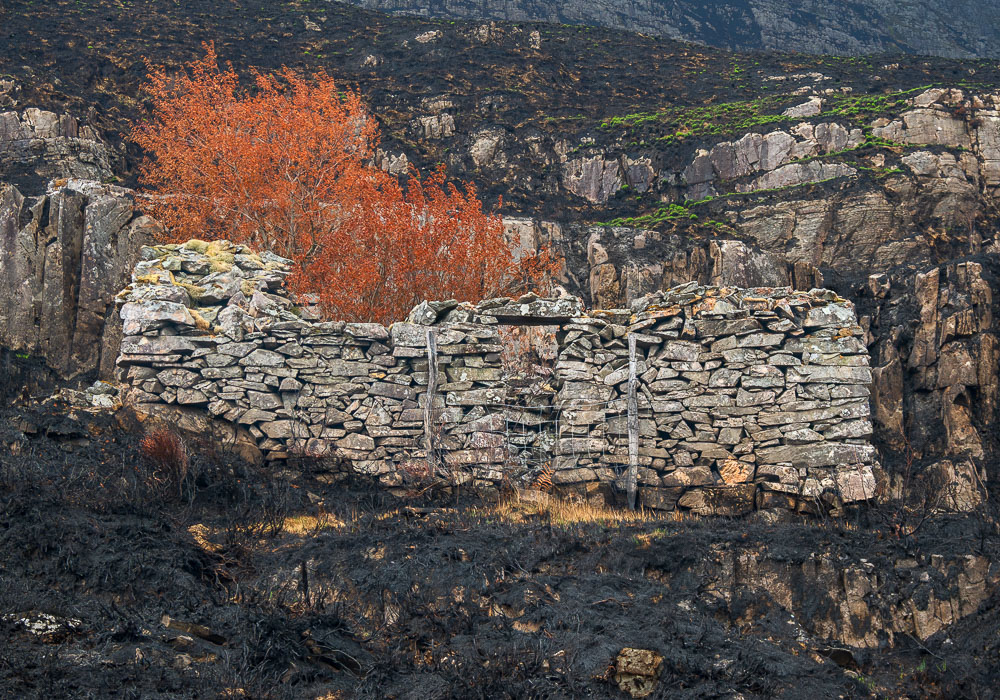
Derelict cottage and burnt mountain ash tree in the Rhinogydd.

At the end of part two (click to read) in this series I asked rhetorically what NRW (and the fire service) were doing in the Rhinogydd during the wildfire there in July this year. Shortly afterwards an article appeared on the Cambrian News website, and I wrote following response:

The fire started on Thursday July 9th (not the 12thas your article stated) when, allegedly, a gas stove being used by a wildcamper was knocked over and set fire to nearby vegetation. It spread, as they say, like wildfire. At some point over the weekend the farmer at Cwm Bychan (or perhaps the landowner) called in a helicopter pilot to extinguish the fire on his land, which he successfully did. The pilot offered his services to NRW in order to extinguish the fire on Crown land nearby but they turned his offer down, claiming that he was not qualified to do so.

By Monday morning (July 13th) the fire had spread from Cwm Bychan eastwards into the Rhinogydd National Nature Reserve and by that afternoon seven fire engines were present in Cwrt forestry plantation to the east of the mountains. But what were they doing there? There seemed to be no attempt to prevent the fire spreading further into the NNR.

By Tuesday afternoon (July 14th) the fires around Cwm Bychan were more or less out but the whole east side of Rhinog Fawr was ablaze and there had been no apparent attempt to put it out. So what exactly had the Fire Service and NRW been doing all that time?

A little bit more about Rhinog Fawr; it is a National Nature Reserve, Special Area for Conservation and Site of Special Scientific Interest. Furthermore, “because of its remarkable natural condition” it is also a Wales’s only “bioenergetic reserve”, so described because it is “one of a network of special sites across Europe chosen for their importance to try to preserve the genetic variety of European wildlife species – in this case heather”.

But not important enough for NRW to attempt to save the vegetation from fire, clearly. I believed that NRW and the Fire Service were doing nothing more than attempting to retain the economic value of the timber in Cwrt Forest. This was confirmed in a press release from the Welsh Government issued on July 23rd about wildfires in Wales. Among acres of verbiage it stated that in the Rhinogydd “key forestry assets have been protected.” I myself visited the area recently and saw the firebreaks which had been bulldozed along the eastern side of the plantation, which had been largely successful.

Since the fire NRW was widely criticised for being incompetent. But it is more than that. NRW is completely dominated by procedure and bureaucracy. It could not engage with a helicopter company actually on the spot, and qualified to put out wildfires, even in an emergency, because it was not on an approved list of contractors. NRW is also the result of an ill thought out merger of three different bodies, with three different priorities – forestry, water quality and nature conservation. It is not difficult to work out which of those three got the shortest straw in the new organisation.

Looking at the bigger picture, climate change deniers would also claim that this fire was the result of carelessness, rather than climate change; a wildcamper – who shouldn’t even have been there – knocking over a stove. Well yes, but how careless have we been to perform an unimaginably massive experiment in changing the composition of the atmosphere when for decades we have been warned what the result would be.

Climate chaos.

To read more Tales from Wild Wales as they are published please click the Follow button

Firestarter.

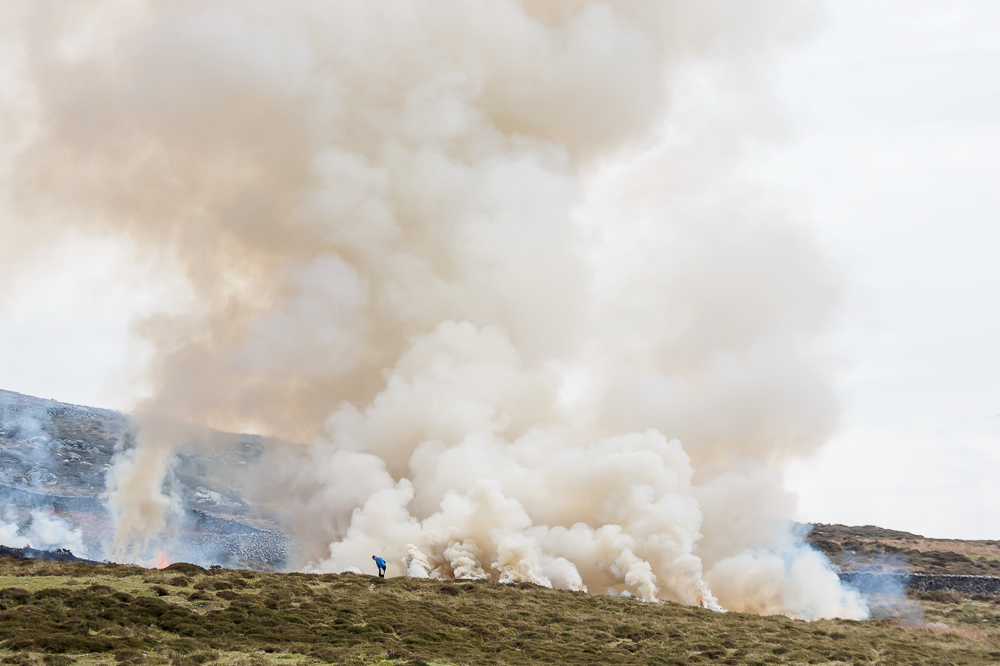
Conflagration on Mynydd Mawr, with the village of Y Fron in the foreground.

Apparently this time of year is widely known as the burning season. This year, in particular, after ten days of continuous sunshine and desiccating southeasterly winds our natural vegetation is now tinder dry.

Last Wednesday morning I set off into north Wales on the last of this winter’s postcard delivery trips. I didn’t have a very full timetable of calls so by lunchtime I was in Porthmadog. I decided to have a leisurely sandwich and birdwatch by the artificial tidal lagoon on the edge of the town. As the water was high few birds were to be seen there but there was a nice selection of waders on Traeth Mawr nearby. Turning back towards the van I noticed a pall of smoke drifting over from the north. I phoned a good friend who lives in Nantlle, about ten miles in that direction as the crow flies. He was very concerned about a fire in the hills nearby that he believed had been set by a farmer the previous evening. It had been burning out of control ever since. I wondered if the smoke I had seen was the product of that fire.

After a final call in Beddgelert I continued northwards. A huge mass of smoke was rising vertically in the still air from the summit of Mynydd Mawr, and then drifting northwards. The mountain looked like an active volcano. But it didn’t really fit the description of the fire I had heard about. Turning westwards at Rhyd Ddu towards Nantlle, the fire was to my right whereas the fire he had described would have been on my left. Entering the village I could see a few wisps of smoke rising from the crags and moorland south of Llyn Nantlle while the main fire was now raging behind me. There were two separate fires.

Mynydd Mawr from Nantlle

My friend – an ecologist by training and with many years of professional experience – was outraged to see the second fire. He had just returned from Argentina where he had had a bout of Covid, and probably wasn’t in the best frame of mind to see both sides of his beloved Nantlle valley being consumed in a conflagration! We walked a short distance to get a better view of it. It was his opinion that both fires had been set by the respective landowners/farmers. Upland vegetation is burnt like this to kill the older, more woody stems of heather, producing more younger shoots, and more grass; in other words better grazing for sheep. But over long periods of time repeated burning and grazing prevents heather from regenerating and results in upland vegetation being restricted to coarse grasses that can resist fire but have little wildlife value. It is one of the reasons why there is now so little heather moorland in Wales.

Mynydd Mawr again……

I was anxious to get more photographs of the fire so headed off in the van towards the village of Y Fron, at a higher altitude than Nantlle. Cresting the brow of a hill the fire in all its destructive reality was visible – see the main photograph above. Four fire engines were present and I had a quick chat with one of the firemen. It was while they were attempting to tackle the original fire to the south of Nantlle that they noticed this second fire take hold. “Whatever can you do about it?” I asked. He spread both arms in front of him, fingers on both hands conspicuously crossed. He said it could have been started by bored teenagers or careless walkers, but I think we both knew who the culprit was. He said that farmers are allowed to perform controlled burns but that they “sometimes got out of hand”. I spent a few more minutes taking photographs before leaving the area.

Near Pant Glas……

I spent the night in the van on the open shoreline of Foryd Bay ; it is one of my favourite places in Wales. But around breakfast time another pall of smoke began rising into the sky to the south. I had enough time to investigate the source of the smoke and fairly quickly located it near the hamlet of Pant Glas. I parked up and walked towards the fire; a figure was visible, moving around near the base of the flames. Through my binoculars I could see him carrying some kind of fire-lighting implement that every so often he would dip into a plastic container of brown liquid. This was a job for my long telephoto lens! I could see he was slowly, methodically and calmly lighting fires in the dry vegetation, without a care in the world. He was completely oblivious to my presence and I took a whole series of photographs. I don’t know how far this fire spread but the BBC Wales News website referred to a wildfire “at Pant Glas” on that day.

Firestarter………

Normally farmers can ignore the guidelines for “controlled” burning because they know no-one will ever see them. The most unprincipled can light destructive fires in the expectation that they WILL rapidly get out of control and be all but impossible to extinguish. But the expenses involved in the Fire Service attending these wildfires, including the cost of helicopter hire, are, unfairly, borne by the public purse. I have sent a batch of photos like the one above to North Wales police, and I believe that the identity of the man lighting this fire would be identifiable from them. How seriously the authorities will take them is another matter, because all too often unscrupulous farmers are given the benefit of the doubt.

Update : A petition asking the Welsh Government to ban so-called “controlled” burning has been started; please click on the link below to sign it.

https://petitions.senedd.wales/petitions/245129

To read more Tales from Wild Wales as they are published please click on the Follow button

Support the Climate and Ecological Emergencies Bill (2020)!

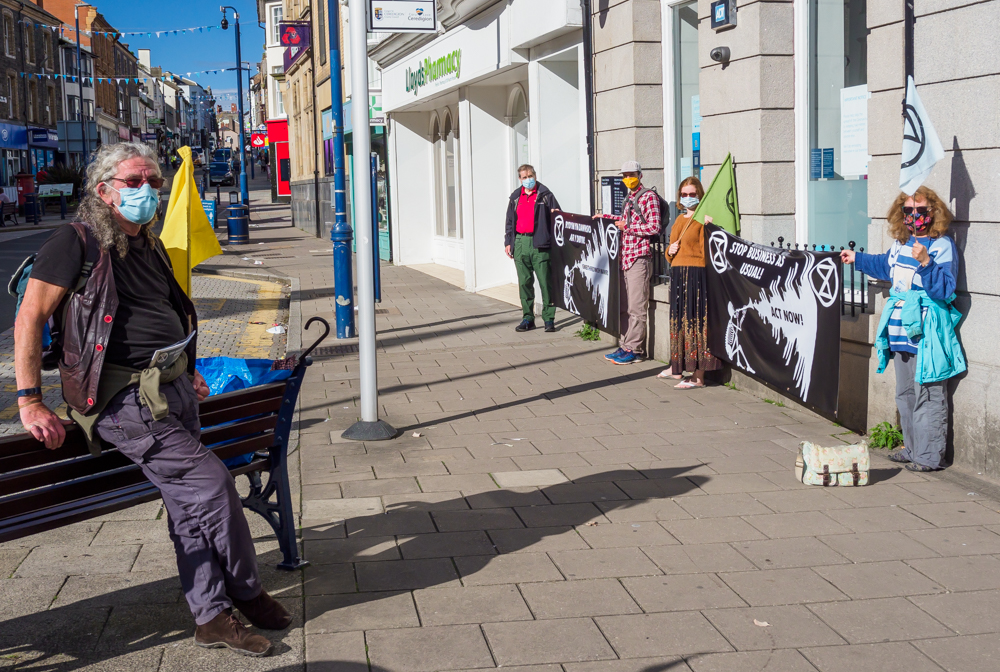
XR action at Aberystwyth

Extinction Rebellion groups in Ceredigion, Powys and nationwide have held actions and events over the Bank Holiday weekend to revitalise the fight for action on the Climate and Ecological emergencies.

It is hardly surprising that members of public are now less willing to engage with the Climate and Ecological Emergencies than they were six months ago. They have been acutely aware of an imminent danger to their own health and that of their families, and doing whatever was necessary to prevent that happening.

At the same time the focus of government activity and the media has also shifted from the Climate and Ecological Emergencies. But that does not mean that those problems have gone away. Far from it.

Following catastrophic wildfires in Australia late last winter (with massive loss of wildlife), extreme heat and drought in the western United States has resulted in serious wildfires which are ongoing. Heatwaves have again occurred in north-west Europe, while in Siberia, temperatures were an astonishing 10 degrees centigrade above average this June. It has been estimated that as a result, an additional 59,000,000 tonnes of CO2 were emitted to the atmosphere.

You could say that governments around the world are fiddling while the planet burns.

So far in 2020, the months of February, March, April, May and July have all globally been the second-hottest on record.

On measure after measure, the results of climate change are happening sooner and more severely than has been predicted.

Carbon emissions have reduced slightly in the developed world as a result of lockdown measures, but the temptation now is for governments and industry to return to “Business as Usual”.

However the economic recession resulting from the Coronavirus lockdown is an ideal opportunity to rethink the direction that development is taking us.

Air travel, for example, has dramatically declined during lockdown and its return to its previous level should be discouraged. We need to fly less; the planet just cannot afford it. Now is the time to “Build back Better”

The Climate and Ecological Emergency Bill (2020) will shortly put before Parliament. This will :

Require the Prime Minister to ensure that the UK achieves specified objectives regarding
climate change, ecosystems and biodiversity; to give the Secretary of State a duty to draw
up and implement a strategy to achieve those objectives; to establish a Citizens’ Assembly
to work with the Secretary of State in drawing up that strategy; to give duties to the
Committee on Climate Change regarding the objectives and the strategy; and for connected purposes.

The CEE Bill, written with contributions by respected climate, energy and ecology academics, aims to bring urgent action on the climate and ecological crisis into law.

Green Party M.P. Caroline Lucas said :

The Climate Change Act was ground-breaking when it became law over 10 years ago, but it’s nowhere near ambitious enough for the scale of the crisis we face today.”

Caroline Lucas is the lead sponsor of the CEE Bill. Members of all political parties but one have put their support behind this Private Members Bill, including Ceredigion M.P. Ben Lake (Plaid Cymru). I think we can all guess which party is missing from the list of supporters: unfortunately it does hold power in Parliament at the moment.

Extinction Rebellion Aberystwyth fully supports the introduction into Parliament of the Climate and Ecological Emergency Bill. We warmly and sincerely thank Ben Lake M.P. for his commitment to a greener future.

If you think your M.P. might be amenable to persuasion to support the CEE Bill, please contact him/her.

Link to for more information on the CEE Bill –

https://www.independent.co.uk/environment/climate-crisis-extinction-rebellion-emergency-bill-parliament-law-greenpeace-a9665561.html


(This is a slightly amended version of a press release recently sent to the Cambrian News, my local newspaper.)

To read more Tales from Wild Wales as they are published, please click on the Follow button