Birding at Heron H.Q.

Glastonbury Tor from Ham Wall at sunrise.

Only twenty years ago one could reasonably expect to see a grey heron or two at a wetland in southern England and possibly the one of the first little egrets to arrive on these shores. How things have changed! Little egrets can now be seen all over the south, and several other heron species have arrived in Britain since then. Spoonbills nest in Norfolk and probably elsewhere, and it cannot be long before glossy ibis nests in the UK. The great white egret, previously a rare vagrant, has been breeding on the Somerset Levels (a.k.a. the Avalon Marshes) for several years, and may well do so elsewhere. Cattle egrets have nested there and even little bitterns. To avoid confusion it is now necessary to refer to its larger relative as the “greater bittern” instead of plain “bittern”; and  there are now more of them in the Avalon Marshes than there were in the whole of Britain at the end of the last century.  The conversion of large areas of redundant peat cuttings into reedbeds has created what could accurately be described as U.K. Heron H.Q. The RSPB has a fabulous reserve (Ham Wall) there and is constantly adding new areas of land to its holding. It might be a massive corporate behemoth beset by unpleasant internal practices but, boy, does the RSPB do a good job when it comes to habitat creation!

Great white egret over the Avalon marshes.

In a previous post I wrote about a trip to the Somerset Levels in winter, where I photographed starlings and great white egrets. Earlier this week I spent a couple of days around Ham Wall and what a great place it is!  My internal clock woke me about 4 a.m on the first morning and from the van I could see wisps of low fog in the air.  I wasted no time (well, maybe a little….) in getting myself up and on to the reserve. It was a gorgeous, atmospheric morning, with misty conditions throughout;  the iconic shape of Glastonbury Tor, with its tower, was often visible, and this was my first photographic objective (see above). It was soon sunrise and birds were leaving roost sites and moving to feeding areas in the marshes.  I tried to include over-flying birds in these early morning landscapes even if they were quite small in the viewfinder. It was particularly noticeable how many great white egrets there were, and I saw several greater bitterns in flight. Despite being extraordinary birds in themselves I can’t get too excited about the appearance of the latter in flight, while the former are delightful.

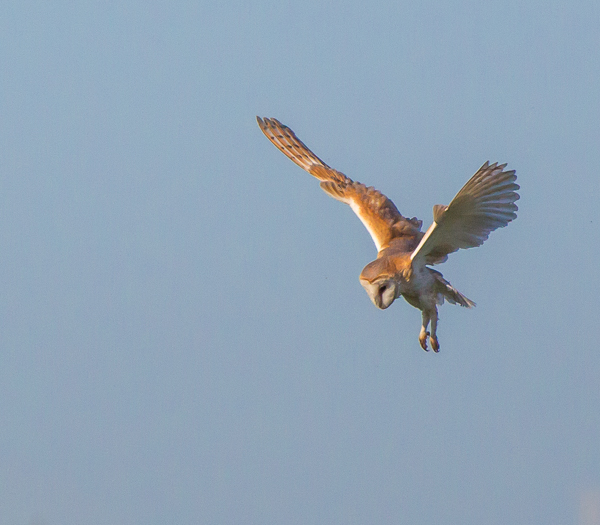
Barn owl.

As the morning sun rose and burned away the mist the landscape began to look a little more ordinary. Mid-June is not the greatest time of year for landscape photography but there was still plenty of interest bird-wise. A barn owl was hunting in broad daylight near one of the hides and flying past with prey – a nest nearby, no doubt. I’ve never been that good at birds-in-flight so it was a bonus to find that a few images I took of it are reasonably sharp!

It is usually possible to have an exchange of information with other birders and I think most enjoy it.  But with rare species, especially if they are nesting, there’s so much misinformation around. You just don’t know who or what to believe. Was the guy in the welcome hut – no doubt anxious to keep visitor numbers up – being honest about the red-footed falcon that had apparently been seen earlier?   The Ham Wall recent sightings blog made no mention of little bitterns, but despite that were they back again this year? So after a well-deserved (I thought) and rather lengthy siesta I headed back on to the reserve in the late afternoon from the Glastonbury end. It wasn’t long before I came across a gaggle of birders standing by the main track looking into the reeds. This looked like a gathering. Had I stumbled onto the location of the legendary little bittern? At first my attempts to ascertain this were met with a rather frosty silence. But soon it emerged that yes, I had. It had been heard there earlier in the day and seen briefly. I waited around for an hour or more but all was quiet; it was time to move on.

Greater bitterns had been booming on and off all day and it was the first time I had heard the “in-breath” and really got to grips with the sound.  If all else failed I was also hoping to hear the “bark” of the little bittern; sometimes the sound of an elusive bird’s song can be enough; you know it is there somewhere and it all adds to the sum of one’s knowledge of wildlife. So I stopped at the same section of reedbed on the way back to the van and listened. And there it was – a regular, nay, monotonous single note repeated every two seconds exactly. After half an hour of listening I saw a movement low over the reeds – a stunning male little bittern. The sighting lasted just about second, but I was elated. The barking resumed from the reeds in the direction the bird had disappeared in.

Marsh harrier at dawn, Ham Wall

My second morning at Ham Wall was similar. Misty, still, and full of birds.  Below the Avalon Hide marsh harriers were just arising and stretching their  wings. (In fact, I later discovered that the three birds I saw together were probably one male and his two females…..) The barn owl was still hunting the same area. A cuckoo was very active. The little bittern was still calling, and there seemed to be assorted other heron species everywhere. What a sight and sound!


To Follow Tales from Wild Wales, scroll right down to the bottom and click Follow


Swings and roundabouts

Fish farm, Penmon: Purchased by National Library of Wales

Over a period of many years the National Library of Wales bought complete sets of prints from each of my books as it was published, or as they were exhibited. They currently have a total of 371 Cibachromes purchased in this way. This came to a sudden end about ten years ago when they took on a new member of staff whose task it was to raise income from items in its Collection. I’m not sure what her background was but this bright spark decided it would be a good idea to sell copies of photographs bought from photographers or donated by them. She obviously had no idea about copyright. I was asked to sign a statement approving this and I refused. I found it astonishing that an institution whose readers had to sign a “personal use only” statement every time they photocopied a page of one of its books should believe it could appropriate photographers work in this way.  It may have been a coincidence but no more of my work was purchased for the following decade. It was just one of the ways in which my income declined over that time.

I’m glad to say the situation seems to have changed. That particular member of staff has apparently retired and I’m now in the process of selling a set of prints from “Wales at Waters Edge” to the Library. Not the whole lot (there are over a hundred) but a selection of twenty made by their Curator of Photography Will Troughton. He has described me as “Wales’ leading environmental photographer” and goes on to say that “his meticulous work has received extensive praise from many quarters”. For months on end it feels as if one is working in a vacuum, so this came as a very pleasant surprise. Environmental photography might sound a bit of a niche but it does suit my work quite well. I’ll quite happily use a building – a castle, lighthouse or cottage – as an aid to composition in my more commercial landscapes (the postcards, for example). But in my personal work I’m usually careful to use human elements within the landscape only when I’m tring to say something about that landscape.  I’m not always sure what exactly I’m trying to say but photographs do not always provide answers; sometimes they can pose questions. In my case the question is often “What exactly is our place within the landscape?” That is also why I have always been so keen on Fay Godwin’s work. It was very pleasing to see from his choice of prints that Will understands what I am trying to do.

Life is full of ups and downs and I have also suffered a major setback recently – although hopefully only a temporary one. Most of my books have been published by Gomer Press, arguably Wales’ premier publisher. However they are clearly now downgrading their publications department and in an attempt at “restructuring” are replacing the number of posts by 50%. All eight current members of staff were asked to re-apply for the four posts now envisaged. All refused and took redundancy payments. Gomer currently thus has no publications department, and any books “in development” but not contracted have been shelved.  However I am still hoping that either Gomer Press or another publisher will take my new book up before too long. Both Jon Gower (the author) and I are well-known and respected in Wales in our respective fields so they should be leaping at the chance!

To follow Tales from Wild Wales, please scroll right down to the bottom and click Follow.


Tripod head talk….and our cutest mammal (surely!)

Red squirrel, Anglesey

For many years I used a Magicball tripod head which I thought was a brilliant and very versatile piece of kit. I had two, in fact, with a Mini-Magicball on my lightweight “walking” tripod. The secret of the design was that it was “upside down” and screwed directly into the base of the camera or lens plate. It wasn’t until I started using long, heavy lenses to photograph wildlife that I began to see the weakness in the Magicball design. It was VERY stable when the lens (even a heavy one) was aligned along the main axis of the head. When it was at 90 degrees for a portrait format image it tended to slip out position very easily. So it was time for a rethink…..

Then  I discovered the Uniqball, as its name suggested another unique design this time with one ball inside another. The outer ball was first locked to fix the horizontal axis; the inner ball then behaving like a pan-and-tilt head for an exact composition. About a year ago I got hold of one of the very first UBH35P models in the UK, and I really, really wanted to like it. Over a period of a few weeks I got to know it reasonably well and concluded that it was a qualified success as a piece of equipment. It had two weaknesses, but I thought I would get to grips with them over a period of time (to read the full review click here). The problem was, I just couldn’t. While using the head in  “landscape” mode I found it incredibly frustrating to have to re-set the outer ball every time I moved the tripod. This was particularly annoying on uneven and/or sloping ground, and I found myself cursing over and over again in such situations. The photographer should never have this kind of relationship with their equipment so I retired it and dug out a rather cruddy old ball-and-socket head while I decided what to do next.

Poseur? Moi?

After many hours of browsing the internet I came across an American brand called Acratech. Their ball-and-socket heads are distinctive in several ways, including their very light weight, and their astronomical price in the UK, but what really grabbed my attention was the claim that they could also be used as a gimbal head. I’ve never used one myself but actual gimbals are very specialised and bulky heads used by bird photographers. With a well-balanced camera/lens combination, all the locks can be slackened off to allow movement in all directions using only fingertip pressure.  I was sceptical that a lightweight ball-and-socket head could also include this functionality.  I worried particularly that with a heavy camera/lens combo tipped over to one side,  the tripod would become unbalanced and tip over. Manufacturers continually claim that their new gadget will solve all your photographic problems, and it may solve some. But at the same time it may have disadvantages which only become apparent when you get one in the field……. however, I digress: my b&s head was getting stickier and stickier and I was cursing it more and more. Things were looking desperate. I saw one final positive Acratech review and my mind was made up. It was time to click “buy”.

Last weekend saw the first outing of the new head (model code GPss) when I headed off up to Anglesey to have a go at photographing red squirrels. This lovely mammal was close to extinction on Anglesey in the late 1990’s when the Red Squirrel Trust Wales was set up. Its aim was through education and conservation measures – including the release of captive bred animals – to re-create a thriving population of red squirrels on the island. Grey squirrels had already arrived by using the bridges across the Menai Strait (or by swimming) but it was thought to be relatively easy to keep Anglesey free of them. The project has been a real success and it is thought there is now a population of about 700 on the island. They are beginning to re-colonise the area around Bangor on the mainland from this stronghold, and extermination of greys there will help to encourage this process. I had been told that the Newborough Forest – where there are some feeders – was the place to see them, although I failed to do so on my first visit last November.  This time, however, I was more successful and I spent several happy hours in their company over a couple of days.

Another red squirrel……

What lovely creatures they are! On a cuteness scale of one to ten, they must be at least eleven! They proved pretty elusive during the day but around breakfast time and before dusk up to five visited the area around the feeders. They are also kept well-fed with treats there by nature lovers and wildlife photographers.  They are partial to all sorts of nuts and seeds and at quieter times of the day will sit calmly feeding (and looking really, really, cute) just a few yards away from people sitting at nearby picnic tables. When more nervous they might scamper up a nearby tree-trunk and then stop, posing for all their worth for the photographer. Problems included trying to keep up with their erratic movements within the trees and occasionally high levels of contrast when stray sunbeams found their way through the tree trunks into the feeding area. It was sometimes difficult to expose correctly when an individual moved from a dark background to a light one, or vice versa.

And how did the new tripod head cope? I have to say very well. I was pleasantly surprised at how easy it was to use the head as a gimbal; there was no real threat that the tripod was about to overbalance although one would always need to keep an eye on this. And even with shutter speeds down to 1/125th second due to the low light levels within the woodland I managed a high percentage of sharp images. This suggests the tripod and head combo was keeping the lens pretty stable, even at 600mm.

There was a steady stream of other photographers and wildlife lovers visiting the site over the couple of days I was there, and I enjoyed some interesting conversations. On Sunday morning I shared a long session of red squirrel fun with Martin and Jayne from Rhos-on-Sea.  We were entranced by the animals’ antics and, as our shutters clicked away busily,  it felt quite special to share the experience with other like-minded people. But the thought remains that if it wasn’t for those dedicated people, often volunteers, who worked on this conservation project we would have had no red squirrels to photograph and enjoy. So my thanks go to all of them.

UPDATE: A fter using the Acratech GPss for a couple of months, I exchanged it for the larger model – the GP – which holds the ball more firmly, although not always firmly enough……. However, I am otherwise very pleased with it. Many thanks to the importer, Bob Rigby, for the exchange.


To follow Tales from Wild Wales, please scroll right to the bottom and click Follow.

Fay Godwin revisited

The Dee Bridge, Flintshire (from Wales at Waters Edge)

Saturday the 18th saw the opening of a new exhibition at MOMA Machynlleth of the late Fay Godwin’s black-and-white landscape photographs. It includes a selection of original prints from the National Library of Wales’s collection linked to “The Drover’s Roads of Wales”. This was a bit of a classic from the 1980’s and one of Fay’s first forays into the world of books, and one which helped to make her name. There can be little argument that she was at that time a landscape photographer but she later came to deny this, and claim instead that she was a documentary photographer. But in my opinion this was a moot point. She worked for most of her career in the landscape and that’s good enough for me. What set her apart from most others in the same field was her knowledge of the issues around the landscape and the way she incorporated them into her photographs. While many landscape images, then and now, are stunningly beautiful they actually say very little about their subject matter. It could be said that Fay Godwin’s images, on the contrary, were landscapes with content.

Alongside these prints was another group chosen by invited photographers (including such names as Paul Hill, John Davies and John Blakemore), and others, who were inspired by Fay’s work or who had other connections with her. These were printed by Peter Cattrell, Fay’s own printer and they look absolutely sparkling. Each was asked to select one of Fay’s images and write an extended caption for it and I’m glad to say that I was one of those invited. My choice, and the caption I wrote for it is below. The image appeared on the rear cover of the third of Fay’s “landscape trilogy” – The Edge of the Land (published in 1995). With its rather enigmatic composition I assumed it was from relatively late in her career, but I have recently learned that it dated from the early 1970’s and was included in her retrospective Landmarks as a “snapshot”.

Ramsgate, Kent by Fay Godwin. Fay Godwin’s work has been a visual soundtrack for most of my photographic life. I roamed wild landscapes with my camera from the 1980’s onwards and sometimes came across quirky, incongruous or downright ugly scenes. The photographs I took of them became my “human landscapes”. It was certainly reassuring to know that Fay Godwin had already ploughed the same furrow that I was following. Whether mine work as well in colour as hers did in black-and-white, I don’t know: perhaps not. Fay Godwin’s photographic journey in the landscape began by making images to illustrate guidebooks (e.g. “The Drovers Roads of Wales”) and ended with very personal statements about her own place within it. “Ramsgate, Kent” appeared in the “Edge of the Land”, the last of her landscape book trilogy. Its meaning was probably clearer to her than it is to the viewer. But I like the way that each individual element in the picture has absolutely its own place in the image; rather like chess pieces on a board. And I have an interest in verbal messages displayed in the countryside. They tell us a lot about what we are like as a species.
Ramsgate, Kent by Fay Godwin.

Fay Godwin’s work has been a visual soundtrack for most of my photographic life. I roamed wild landscapes with my camera from the 1980’s onwards and sometimes came across quirky, incongruous or downright ugly scenes. The photographs I took of them became my “human landscapes”.  It was certainly reassuring to know that Fay Godwin had already ploughed the same furrow that I was following. Whether mine work as well in colour as hers did in black-and-white, I don’t know: perhaps not.
Fay Godwin’s photographic journey in the landscape began by making images to illustrate guidebooks (e.g. “The Drovers Roads of Wales”) and ended with very personal statements about her own place within it. “Ramsgate, Kent” appeared in the “Edge of the Land”, the last of her landscape book trilogy. Its meaning was probably clearer to her than it is to the viewer. But I like the way that each individual element in the picture has absolutely its own place in the image; rather like chess pieces on a board. And I have an interest in verbal messages displayed in the countryside. They tell us a lot about what we are like as a species.

Alongside these two strands is a separate exhibition at The Penrallt Gallery and Bookshop, a few doors up the road from MOMA. Invited photographers were asked to choose one image of their own which they felt was particularly inspired by Fay Godwin’s work. My own choice is at the top of this post and I wonder if anyone can see the parallels between it and “Ramsgate, Kent” reproduced above? While in many ways there is no similarity at all for me it is the chess board analogy I mentioned in the extended caption that applies in both examples.

The Penrallt Gallery/Bookshop was opened a few years ago by Geoff Young and Diane Bailey, both of whom, in previous lives, taught photography. They have an excellent selection of books, particularly on the arts, photography and the environment – just my sort of place, as you can imagine! It is just one of those places which is very difficult to leave without having bought something. They also show the work of  upcoming photographers and hold a regular series of talks and readings with photographers and authors, plus various writing workshops. The Fay Godwin exhibition at MOMA and the spinoff at Penrallt were organised and curated by Geoff and Diane and a brilliant job they have done of it. It deserves a far wider audience than it is likely to get in a small town in mid-Wales.

On March 11th and linked to the exhibitions is a conference on Fay Godwin’s photography (with guest speakers) and including a preview of a new film about her life : “Don’t Fence Me In”. I’m really looking forward to it. For details click on the link below ;

http://moma.machynlleth.org.uk/?page_id=810

Both exhibitions run until April 1st. For details on how to visit MOMA Machynlleth, click on the link below.

http://moma.machynlleth.org.uk/?page_id=75

For more information about the Penrallt Gallery/Bookshop, click on the link below.

http://www.penralltgallerybookshop.co.uk/


To follow Tales from Wild Wales please scroll down to the bottom and click Follow


The Green Flash and another starling story.

Starlings at Aberystwyth yet again)
Starlings at Aberystwyth (yet again)

Several more visits to Aberystwyth seafront at sunset have elapsed since my last post. You can’t believe how frustrating it is to witness another damp squib, then go home, turn on the TV to watch Countryfile and see video of amazing displays from somewhere in the Midlands and then somewhere in Cumbria! Last Wednesday was a bit of an exception, in a way. I arrived in good time and got chatting with a photographer who had driven over from the West Midlands to see the famous Aberystwyth starling murmation.  He must have thought I was a gloomy old so-and-so when I told him it hardly ever happens!

Once any possibility of a display seems to have evaporated I swap lenses from the standard zoom to the long zoom. I set it up on the tripod and head down the wooden jetty as far as sea level will allow, and focus on the starlings as they perch on the metal framework under the pier. This area seems to serve as a ‘waiting room’,  as later – or perhaps younger / less dominant birds – await their turn to squeeze in under cover. There is constant movement as they re-arrange themselves.

On Wednesday, the sun was setting dramatically, the tide was high and there was quite a swell. The crests of big waves fizzed with orange light as they broke against the shore. I took a long series of images in really exciting conditions, although I knew I would be deleting most of them later! As it happens I did manage a few that I am pleased with such as the one above (click on it to enlarge it.)  In the nick of time I then remembered the Green Flash. The very last sliver of the sun’s disc can turn green as it disappears below the horizon, especially if the atmosphere is clear and crisp. It’s not an uncommon phenomenon; I’ve seen it a number of times while down at the starling roost,  but never managed to photograph it. I alerted my new pal from Brummidgem, who had joined me on the jetty, pointed the camera at the setting sun and quickly pressed the shutter.

Reviewing the images on the screen I could see I’d captured the Green Flash successfully behind the framework of the pier. Exposure is always a problem at sunset and I’m not sure why this image works when previous ones haven’t. It was very much a grab shot and a reflex reaction to the situation. But it so happened that the exposure was good (ie – it was underexposed) and the light levels elsewhere in the image were compatible with that of the sun’s disc; and of course, digital processing helps.

The Green Flash, Aberystwyth, 11/02/17.
The Green Flash, Aberystwyth, 08/02/17.

After sunset a gaggle of photographers tends to gather on the prom to have a moan (er….discuss the afternoon’s events…..). Our Brummie pal joined us as we muttered. He was elated! “That was amoizeen!”  he enthused; “absoluteloy moind-blaween!” He loved watching the starlings and had never seen the Green Flash before….never even heard of it, in fact.  It was lovely to encounter someone being SO excited about something which many of us locals now take for granted.


To follow Tales from Wild Wales, scroll right down to the bottom and click Follow


Twice bittern.

Kingfisher in the rain, Teifi Marshes

A few days before Christmas I headed down to the Teifi Marshes near Cardigan with high hopes of seeing a bittern. It is a regular winter haunt for this extraordinary but elusive species and I had photographed one there in January 2015 (see this post). Furthermore there had recently been reports in the local bird blog of one by the Kingfisher Pool. It all seemed very promising. But after six hours in a very cold hide without a single sighting I felt somewhat deflated……and I’m sure the bad cold I suffered over Christmas was not a coincidence.

But they do say that every cloud has a silver lining, though, and in this case it was the kingfisher which made a circular tour of its perches around the pool at lunch time. Various sticks and branches have been provided here for kingfishers by the Wildlife Trust, but they result in rather conventional “bird on a stick” type images. I think the perch shown above shows the bird in a more natural setting and the falling rain gives the photograph a rather painterly feel.

Bittern at Teifi Marshees, Cardigan
Bittern at Teifi Marshes, Cardigan

The bittern was reported (and photographed) again on Tuesday so it seemed like another attempt might produce results. Another photographer was already in the hide when I arrived about 9.30 a.m. yesterday and we were soon joined by several others. One told us that the bird had spent two full days wedged between branches in a nearby willow. Local birders and conservationists became concerned for its welfare so reserve staff had climbed up towards it and poked it with a stick, whereupon it flew back down to the reeds!

The bittern was first seen not long afterwards. It was crouched low to the ground, fluffed up like a big round feather duster, and appeared quite immobile. It did not look like a healthy or a happy creature. But after a while it began to walk slowly towards the hide, its weight breaking the ice at one point. It came closer and closer and motor drives began to rattle away in earnest. Over the next hour it was hardly hidden at all. It walked slowly, and then more quickly, around, pausing to take the sun from time to time. The light was lovely, either bright sunshine or light cloud. Either was excellent for this large, cryptically patterned bird. It can’t eventually have been further than 20 yards from the hide. Then there was a crouch, a pause, another crouch, and it launched itself into the air, flying away quite powerfully low above the reeds and blackthorn crub.

Bittern in flight
Bittern in flight

It had been a truly exhilarating hour for everyone in the hide. One always opens oneself to disappointment by a making a tightly focussed photography expedition like this. Without the bittern it would have been a rather dismal morning – dismal and cold. So we were all happy, although we all knew we would have many hours of file processing to look forward to. Let’s just hope that the bird itself stays well and finds enough food to get through the winter.

To follow Tales from Wild Wales, please scroll down to the bottom and click Follow

A visit to woodpecker HQ.

Green woodpeckers at the nest, near Abergavenny.

Beech woodland is normally associated with the south-east of England; Burnham Beeches and Epping Forest are fine and well-known examples. But here in Wales native beech woodland extends into the south-east corner of the country, around Abergavenny, for example. It can be found as far west as Castell Coch, just to the north of Cardiff. It is what the writer and naturalist William Condry called “the district’s most distinguished calcicole” referring to its association with a narrow band of limestone rock which runs along the northern rim of the south Wales coalfield.

It is for oak woodland that most of Wales is renowned but in a forthcoming book I want to open people’s eyes to the presence and stunning beauty of beech woodland. This spring I visited Cwm Clydach, where the Heads of the Valleys main road squeezes through a narrow defile alongside the river between steep valley sides. I had first photographed here in the mid-1990’s and an  image of the polluted watercourse complete with dumped debris was used in my first book “Wales  – The Lie of The Land” (published in 1996). The gorge’s steep and rugged southern flank is clothed with native beech, but it is a far cry from the expansive woodland of southeast England. Here it is largely inaccessible but a public right of way descends to the valley bottom from the A465 and then climbs steeply through the trees to reach scattered houses, narrow lanes and an abandoned railway track.

Walking back to my van on this year’s first visit I heard the familiar laughing call of a green woodpecker, which I tracked down to the branches of an venerable but dead beech tree right by the side of the road. What’s more the tree’s branches were riddled with woodpecker holes large and small. One bird visited one particular hole which I took to be a potential nest-site. This looked like a photo-opportunity!

Anyone at home?
Anyone at home?

I spent many hours on three visits sitting in my van watching the woodpeckers going to and from the hole. The off-duty bird would call from a distance and its mate would appear in the entrance to the hole. They would then swap over. I was surprised at how late their breeding season was – there was no sign of food being brought to the nest even as late as June 11th. On one occasion a great spotted woodpecker peered in, and I believe I may have seen a lesser spotted on the same tree as well.  This really was Woodpecker HQ! Green woodpeckers seem to be quite wary birds at the nest and they are apparently very difficult to photograph there. So I was really thrilled when I managed to get what seems to me the perfect image of a pair at the nest.


To follow Tales from Wild Wales, please scroll right to the bottom and click Follow.


Sunset suite.

Sometimes I come back from a field trip and my partner asks me “Well, how did it go?” Getting me to talk about my experiences can be a bit like getting blood out of a stone. I may be hopeful about the results of a trip but until I’ve processed them I can never be sure. Sometimes the images that looked really great on the screen can be disappointing when seen full size but sometimes the opposite is true. I may not have spoken to anyone for a couple of days and I may have been confined to the van for hours on end, particularly at this time of year. While the process of making landscape images – the minuteae of the weather and the tides, the seasons, f-stops and shutter speeds, the near misses and the successes – can still occasionally be pretty exciting, I imagine this can be difficult to convey to the unitiated.  So in recognition of this, I’m just going to show you a few sunsets that I’ve photographed this autumn. Hope you enjoy them!


Traeth Llyfn, near Fishguard


Mouth of the Tywi/Taf, near Kidwelly


Mawddach estuary
Mawddach estuary


Llyn Pendam, near Aberystwyth

To read more Tales from Wild Wales, scroll down to the bottom and click Follow

The Great Wall of Aberdyfi (part 2)

Valley fog, Dyfi estuary

Click here for the first part of this post

It was a few minutes’ drive inland to my next location, a hilltop overlooking the Dyfi valley near Derwenlas. I knew from numerous previous visits (see this post) that it would be mid-morning before the sun would be where I wanted it. A heavy shower moved inland on my arrival, creating another fine rainbow. Light was still good half an hour later despite the sun’s relentless rising, and I got the shot I had come for; would it be suitable for a new postcard, I wondered? See the upper picture of the pair below.

A couple of days later I decided to have another go at both the Glandyfi and Derwenlas viewpoints. Still conditions were forecast overnight and hence the formation of valley fog was possible. It was a very different morning to my previous visit. At Derwenlas all was gloomy low cloud but at Glandyfi a river of fog flowed continuously down towards the sea. Over about ninety minutes I took a number of images, but it was when the “river” began thinning and receding inland that I felt the best results were obtained (see above). It was an interesting contrast to the scene two days earlier (see previous post).

Dyfi valley, near Machynlleth
Dyfi valley, near Machynlleth (first visit)
Dyfi valley, near Machynlleth
Dyfi valley, near Machynlleth (second visit)

Then it was back to the Derwenlas viewpoint. It was still like being inside a bundle of cotton wool when I arrived, but after a few minutes the cloud cleared entirely,  revealing the gorgeously-lit Dyfi valley complete with a necklace of cloud draped around the hillside above Machynlleth. If this doesn’t work as a postcard, I’ll eat my hat!

As a postscript I have just sent a cheque for £70 to the charity Rewilding Britain (click for more info). This is a donation per work sold at the Aberystwyth showing of my Bird/land exhibition.


To follow Tales from Wild Wales, please scroll to the bottom and click Follow.


The Great Wall of Glandyfi (part 1)

Rainbow over the Dyfi estuary

En route to Machynlleth the trunk road from Aberystwyth to north Wales, along with the railway line, is squeezed between the Dyfi estuary and its wooded slopes. Until a few years ago the road was narrow and winding with the occasional gridlock occuring if two large vehicles met there. There’s no doubt that the “Glandyfi Bends” needed improvement to improve journey times. Costs were orginally estimated at £10 million, but there must have been a bottomless purse for this project; a total of £18m was apparently spent altogether. The result is a smoothly curving, two-lane carriageway with excellent visibility. So what did the Highways Authority do? Slap a 40 mph speed limit on the new section of road and extend it all the way back to the village of Eglwysfach. Improve journey times my ****!

Like all trunk road improvements in Wales it is over-designed and over-engineered. There is a one-way lay-by for motorists driving northwards; access from the north or exit to the south is forbidden. On the lay-by there is a lay-by. Would you believe it! Oh yes, there’s a picnic table on a mound. The wall alongside the main road is too high over most of its distance for car drivers or passengers to enjoy the stunning views across the estuary. But the most prominent of all is the retaining wall to hold the hillside back. This massive construction is known locally as the Great Wall of Glandyfi. It can be viewed most conveniently from the north side of the river – in fact it is very hard to miss it for miles around.

There is a silver lining for the photographer, however. There is a narrow walk-way, fenced off for safety, along the top of the wall, which gives fabulous panoramic views across the estuary to the southern hills of the Snowdonia National Park. An access gate is half-heartedly padlocked at the eastern end.  On the last day of September I headed up to Glandyfi on a morning when torrential downpours alternated with strong sunny intervals; ideal conditions for the photographer with good waterproof clothing! On arrival I prepared my gear in the van while it absolutely hammered down outside.  The downpour moved over quickly and a brilliant rainbow appeared over the estuary. I quickly accessed the walk-way, set up the tripod and began taking pictures.

Rainbows are never easy. They are almost always unpredictable and may only last a couple of minutes. It is almost always raining and this plays havoc with one’s equipment. Filters are particularly vulnerable to wetting. As I wiped raindrops from one side of my 2 stop ND grad, a fresh crop appeared on the other side. This was just silly!  Landscape photographers are sometimes advised that a polariser should be used to intensify the colours of a rainbow but I have never found this to be the case. You can easily completely remove a rainbow with a polariser but who would want to? Over a period of five minutes and despite rather feverish picture-taking, I had some rather excellent rainbow images in the can, such as the one above.

Bridge over the River Dyfi

When planning my landscape photography destinations I always take into account the time of day of the visit and hence where the sun will be. A polariser is always most effective at right-angles to the sun, while that rare thing, a rainbow, always appears opposite the sun.  I can think of one location on the Mawddach estuary where you can use a polariser to your heart’s content but still be open to the possibility of a good rainbow image. The Great Wall of Glandyfi is another. Following the disappearance of  the rainbow I swung around by ninety degrees and captured some images of saltmarsh, the railway bridge over the Dyfi and its accompanying solitary white cottage, in brilliant sunshine. The hills of southern Snowdonia were still in deep darkness and low cloud swept their summits. I used the polariser and the 2 stop ND grad to add to the drama of the scene. I felt that the resulting image worked well in a panoramic format.

It might seem that I was lucky that morning but I had already made several frustrating visits to the area with no worthwhile results. What I was quickly able to do on September 30th was get to the best spot quickly and take advantage of great conditions when they finally did appear. I’d been up there for about two hours – how time flies sometimes – when I heard the sound of chain-saws. Down on the main road maintenance men were removing branches from the vicinity of some electric cables. It soon became apparent, though, that a man with a chainsaw was also clearing branches from the walk-way upon which I was standing, and approaching quite fast. It was time to beat a hasty retreat!


To follow Tales from Wild Wales please scroll right down to the vottom and click Follow