Software pros and cons.

Feral pigeons, Aberystwyth : noise reduction and sharpening in DXO Photolab

For many years – from v3.1 to v6.14 – I was a 100% Lightroom man. I had begun my digital photography life with Paintshop Pro (I think it was) before graduating to Photoshop and then fairly soon afterwards to Lightroom. My digression into Photoshop was an expensive mistake because I found it unintuitive and difficult to use. Lightroom was a whole lot better. Then Adobe moved Lightroom into a subscription only package with Photoshop, and by 2017 it became impossible to update the software without signing up to a subscription.  I stuck with the final outright purchase version (LR6.14) despite its slowly developing shortcomings. For a longer version of this process, see this post.  

It seemed that Lightroom could do everything that I needed a software package to do. But slowly I became aware that other companies were producing alternatives to it, particularly in the realms of sharpening and noise reduction. Once Adobe’s subscription model became set in stone, there was an additional impetus for software developers to produce real, genuine, “Lightroom alternatives” that could be purchased once and updated once every year or two (at a price, of course) if the user wished.  Capture One was long-established, but it was joined by DXO PhotoLab, On1, Luminar, and others, and Topaz was developing some excellent NR and sharpening tools.

My move from full-frame Canon to micro four-thirds format Olympus proved a bit of a turning point. Because of its small sensor size m4/3 has limitations, particularly at higher ISO’s; digital noise can become obtrusive. At long focal lengths, correct focusing has always been a difficult skill to master. The bird photographer is always likely to be pushing the boundaries of their equipment and I’m no exception. But I noticed some strange “clumping” of detail in wide-angle landscape images taken at the Olympus’ “base” ISO of 200. I thought it must have been the lens or the sensor, or user error of some sort. After a while I decided to take the plunge with Topaz Denoise AI, specialist denoising software which sharpens images as well. After processing an image in Lightroom you send it to Topaz which successfully cleans it up.

My go-to camera for almost three years – the Olympus EM1 mk2 – was fully supported by Lightroom v6.14, but I knew that once I upgraded it I would no longer be able to use that software. In preparation for that day I invested in DXO Photolab, software which claimed to be a fully featured Lightroom alternative. It seemed at the time to be the most “grown-up” of the new-kids-on-the-block –   it didn’t, for example, make it any easier to replace skies, which is anathema to me. There was always going to be a learning curve with new software but I fairly quickly found it was lacking several features I was used to having.   You couldn’t combine different files to create panoramic images, or blend a number of files at different exposures to overcome high levels of contrast. And bizarrely, once you have processed a file and closed down Photolab, your processing history is lost. You can’t go back to it.

Eventually I set the software up to only pre-process selected files, and then exported them back to Lightroom for further processing. In fact I’m using it in the same way as DXO’s PureRaw software, which had I known then what I know now, would have been a better choice in the first place. Potentially this works really well – the sharpening and noise-reduction is excellent, and you get a lovely clean file to work with. In extreme cases, it is possible to add even more sharpening in Lightroom because DXO’s NR is so good. The clumping of detail which I mentioned in the third paragraph just doesn’t happen. Its main drawback seems to be that it also adds contrast, which you don’t necessary want in bird photography, and the colour balance can be altered on export. Perhaps there are workarounds for this, though.

In the years after Lightroom became subscription-only Adobe continued to develop it. I heard of its new masking tools which enable the user to select specific sections of an image and work specifically on those. My purchase of an Olympus OM1 (the company’s new flagship model) in summer 2022 made life more difficult for me again. I was either going to have to jump ship from Lightroom entirely, or return to it completely by enrolling in the subscription programme. I decided to swallow my pride and do the latter. To be honest, I’m glad that I did.

While the cost of a standard subscription is £9.98 a month, if you pay in advance and buy from Amazon on Prime Day or Black Friday, that figure is reduced to £6 p.m. I’d say that is a pretty good deal and you still have Photoshop sitting on your hard drive if you want it. It is now easy to roughly select an “object” in Lightroom and software will outline it accurately.  It also very easy to select the sky.  In fact I worry that processing a file is now almost too easy! Fortunately or otherwise LR’s “content-aware healing” doesn’t work very well in my experience so far, so there’s still difficulties to overcome. Thank goodness for that!

Nothing ever seems to be straightforward, though. As mentioned above I’m using Photolab to pre-process certain files before returning them to Lightroom. I’ve come across a fairly serious problem in that more recently in many cases the export back to LR doesn’t take place successfully. It either fails completely or returns a corrupted file that has a regular pattern of coloured lines running across it. PureRaw doesn’t work either. I’ve taken this up with DXO technical support but they have not yet come up with a solution. In fact they seem to have forgotten about it altogether. Meanwhile someone on the DXO user forum has suggested that it is actually a Windows problem and suggested an easy fix.  I’ve followed his instructions and my fingers are well and truly crossed.

To read more Tales from Wild Wales as they are published, please click the Follow button

Two nights in a quiet place.

If I am in the Porthmadog area I have a favourite place to park the van overnight. It is a delightful spot on the banks of the estuary, overhung by oak trees, and no ………. I’m not going to tell you where it is! From there it is a short drive to the Cob, the causeway that runs across the Glaslyn estuary just south of Porthmadog, from which one can look inland to the Snowdon massif. This is surely one of the most iconic landscapes in the whole of Wales but strangely enough not a big seller as far as postcards are concerned. I’ve always wondered why: perhaps people just don’t notice it as they hurry along the main road across the causeway.

I’ve spent two nights at this quiet spot in recent weeks. One morning at the end of August I woke early, had a very quick breakfast, and drove straight to the Cob. I’m sure that one of these mornings I will catch the view from there to Yr Wyddfa in perfect conditions, probably with a low fog across the marshes in the foreground, but this was not going to be it. A bank of high cloud obscured the rising sun. After a short wait I drove on to Borth-y-gest, a village set around a small harbour just west of Porthmadog.

Arriving at the main car park about 8 a.m., and the only vehicle there, I put my head back against the headrest and promptly fell asleep. About ten minutes later I woke up and was aghast to find a parking ticket attached to my windscreen! The parking warden could easily have tapped on my window and asked me to leave; instead he must have crept silently up to the van, stuck down the ticket and made a quick getaway. Talk about a hit and run incident……..

Well, Borth-y-gest is an idyllic little place so after the initial shock had worn off I decided to make the most of a now sunny morning. I need to do a new postcard of the area so set off downstream along the banks of the estuary to see what I could find. The tide was high but receding and the best photograph of the morning came on my return to the harbour (above). It’s a classic “picture-postcard” image, perfectly lit, with good colour saturation; it won’t win any prizes but it will suit my purposes perfectly.

I spent another night at my secret place last week. Not so secret, I now realise: I’ve never had to share it but this time found a rather large motor-home already in occupation. Acorns falling onto the van roof and rolling groundwards woke me several times during the night and I was surprised to also hear light rain falling. I hoped that did not bode ill for the following day.

In fact it was still raining on and off at dawn but it looked like the sun was about to rise into a clear blue sky. These looked fantastic conditions for the photographer and I didn’t even bother with breakfast. There was nothing doing at the Cob (again) so headed straight for Borth-y-gest. Parking more carefully this time, I walked along the coastal footpath overlooking some tiny beaches and the still (but rising) waters of the estuary to the mountains beyond. A rainbow appeared out to the west, but it wasn’t until I began my walk back to the village that the most spectacular conditions were revealed. Brilliant “Godbeams” could be seen across the estuary as intermittent rain and cloud drifted seawards. They were even reflected in the waters of the estuary (See main pic).

It has been suggested that these were “crepuscular rays”; but strictly speaking this term refers to a similar phenomenon that occurs close to sunrise and sunset. Not wishing to split hairs, though, they are formed in the same way. I have always believed that if you follow the path of these rays upwards they will converge at the actual position of the sun, and this shows quite clearly in the photograph. And yet the sun is actually so far away (93,000,000 miles) that its rays on reaching us are virtually parallel. This appears to be an anomaly, to say the least. One website suggests –

“Next time you see sunrays, imagine them for what they really are, miles long columns of sparkling sunlit air highlighted by the darkness of adjacent unlit voids. Let the mind fly around and through them to give them solid form that replaces the flattish way we normally see the sky”

I still can’t get my head around it so if anyone can explain it in plain English, please feel free!

Later in the day I made for the hills above Harlech on the south side of the estuary. By mid-afternoon the atmosphere had completely cleared and the light was crisp and transparent. I took a series of images back towards Porthmadog and Moel Hebog (above). My quiet place is there, somewhere…….

Postscript : I successfully challenged my parking ticket.

The quote is from : https://atoptics.co.uk/atoptics/rayform.htm

To read more Tales from Wild Wales as they are published, please click the Follow button

From the postcard to the minimalist.

But what about the photography, I hear you ask.

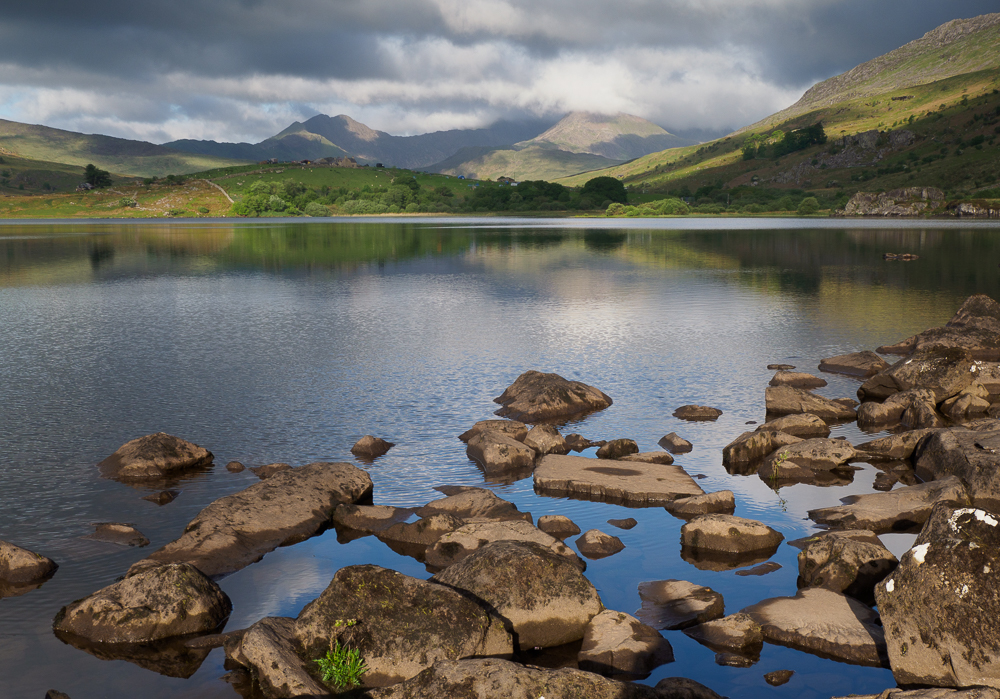
A photographer for many years now, the novelty for me of going out with the camera just for fun has long since worn off. Over time my photographic activities have become more focussed on a particular project, and since returning from Mallorca that project has been to add to my collection of possible postcards for future years. The most successful of such visits this summer was the classic location of Llyn Mymbyr, west of Capel Curig, at the end of May.

From the east end of the lake one can gaze across placid (or more likely choppy) waters towards the Snowdon Horseshoe. Halfway along, debris – brought down from the mountains by a long since disappeared torrent – almost cuts the lake in two, giving the lake its alternative name of Llynnau Mymbyr (Mymbyr Lakes). It is easy to walk to the channel joining the two waterbodies , giving views to Snowdon in one direction and back towards Capel Curig to the other. Being so close to the road the location is very popular with photographers, but it would also be well worth a decent walk to get there.

I had a feeling that something special might happen, and it did – eventually. The first morning was good, some nice light, good clouds and decent reflections. But perhaps I should have woken earlier……….. I may have missed the best conditions. I had business elsewhere during the day but returned for the evening. Again, conditions were good but not too exciting. As it was Bank Holiday weekend the campsite at the west end of the lake was busy with cars and motorhomes which provided an irritating mid-ground in front of the Horseshoe. Only in a wide-angle view would any of these images these be useable. I took my tripod around to the far side of the lake for a better angle and used a ND filter and long exposures for a different “look”, but the results were not quite what I was hoping for.

From the postcard……

The following morning I woke early and conditions looked great: blue sky overhead but fog at ground level. I walked down to the lakeside and even at 5.40 a.m I wasn’t the first photographer around. In one of my first pictures you can see a figure crouched in the reeds by the water’s edge.

….to the minimalist

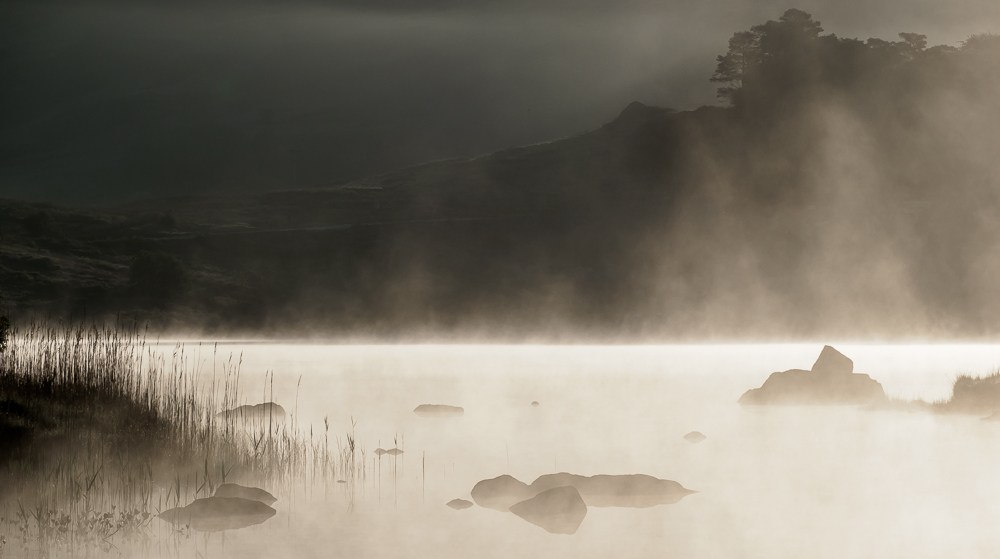
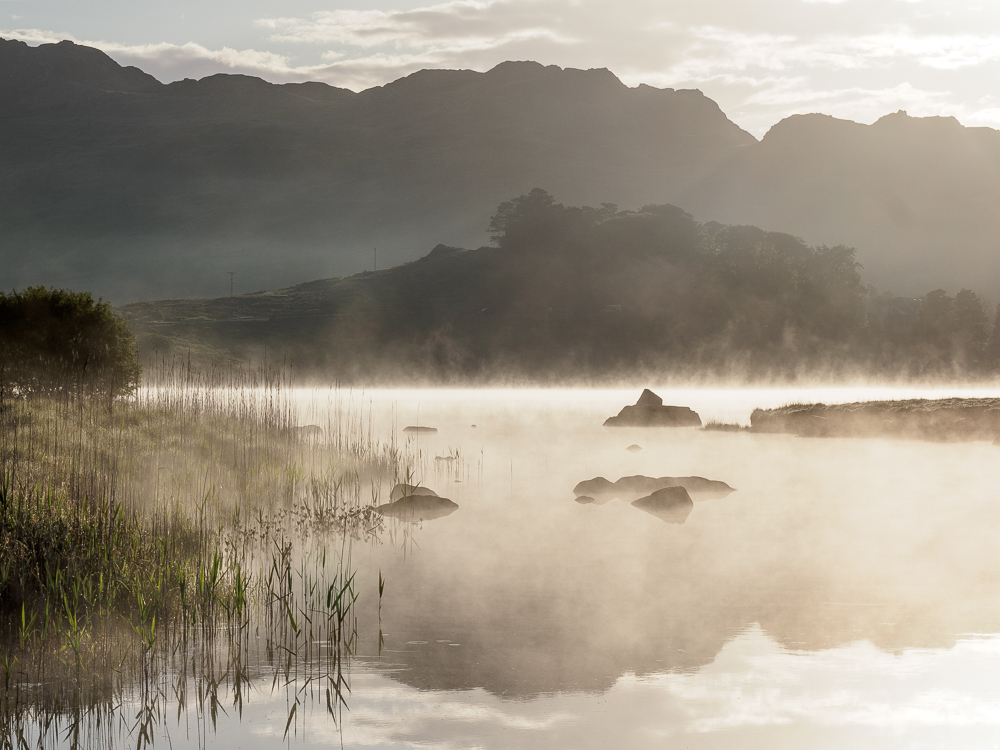
What a morning it was! The sun was already above the horizon, backlighting every feature of the landscape to the east. Mist was rising gently from the still waters of the lake. If these conditions happen at all, they are usually short-lived, but I was able to spend a good hour taking pictures in quite a relaxed fashion. I used a whole range of focal lengths from 25mm to 400 mm using both my main lenses, and got a tremendous selection of images….. if I say so myself…… ranging from the “postcard” to the minimalist.

It was the landscape photographer’s dream morning, and I was elated. But what of the other guy who appears in my first pictures? Within ten minutes he had gone. Shortly later I heard the sound of a drone flying above the lake and by the time I returned to my van in the layby his van had disappeared. I wonder how many locations he was visiting that morning, and how satisfying each one was?

To read more Tales from Wild Wales as they are published, please click the Follow button.

Letters to the Editor (3)

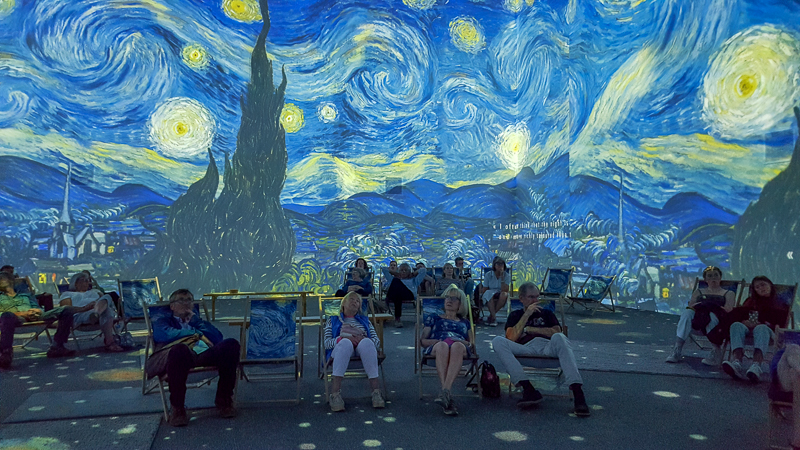
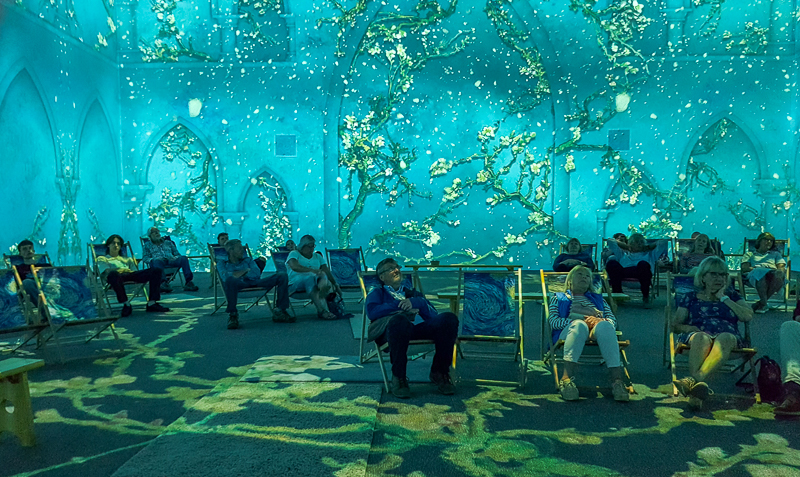
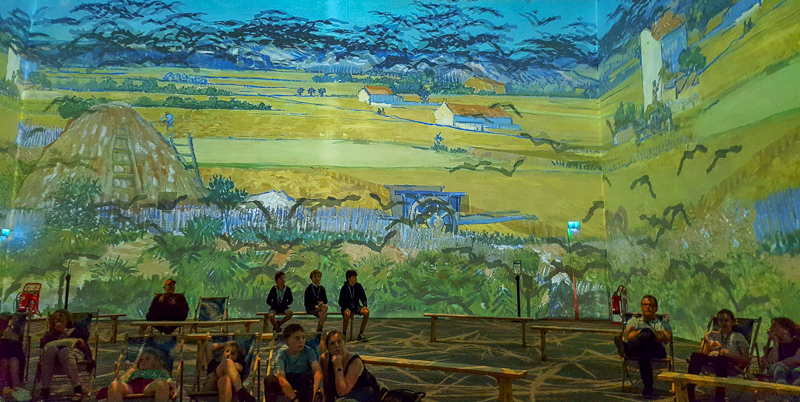
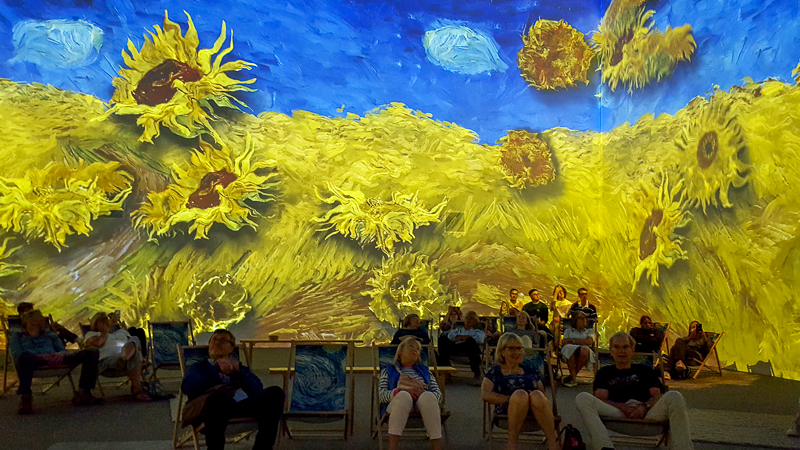
The first weekend of September is now the chosen date for the Ceredigion car rally. As the date approached I became more and more agitated and close to anger at the prospect and my partner Jane persuaded me that we should leave the area for the weekend. We spent a couple of days around the Somerset Levels near Glastonbury, where some brilliant bird-watching can be had; and then back up to Bristol for a couple of days. Here we went to the amazing “Van Gogh Immersive Experience”. This begins with potted history of the artist, his work, his thinking and his mental torment. It was moving to read how these four strands wove together to produce a vision which, it could be said, was truly “beyond art”. It was tragic to read that during his short lifetime he only sold one painting, while now they can sell for close to a hundred million dollars!

But the real highlight was the Immersive Experience itself. A large rectangular section of a disused warehouse was walled off. Carpets, benches and deckchairs were provided for ” participants” and constantly evolving visuals relating to the artist and his work were projected on to all four white-painted walls. Music and fragments of commentary were relayed over a sound system. It was the closest to an LSD trip that I think I have ever experienced. One truly was immersed in the experience and it was fascinating to watch children and adults just entranced, and I think humbled, by it. For some photographs, please see the next post.

Before I left home I posted my latest “Letter to the Editor” of the Cambrian News, which I understand has been published today. It is reproduced below.

Further to Chris Simpson’s letter (Cambrian News 31st August) about the Ceredigion car rally, the full details of the route have now been published. According to their information, and my calculations, the total distance driven on Rally Days will be 29,000 miles. Of that mileage approximately half will be travelled under rally conditions. The remainder will be travelling between stages and on driver’s recces. This does not include incidental mileage setting up the infrastructure, delivering marshals to locations etc. Could that double the above figure? It goes without saying that the carbon footprint of this event will be massive, not to mention other pollution such as noise, tyre and brake dust and other emissions.

This is not the only negative impact of the rally. The draconian closure of roads and footpaths and the authoritarian way those closures are being put into place show Ceredigion Council in very poor light. Ninety-nine public footpaths in north Ceredigion will be closed; the complete closure of the Promenade between the Marina and the Pier makes a nice round figure of a hundred. Imagine a holidaymaker, like one of those complaining about how dirty the town is, for example, innocently straying into Aberystwyth on Saturday evening. He/she will find half the town closed off to the general public, and rally cars screaming along the seafront between the Marina and the Pier! Then there is the “Festival of Fossil Fuels” as rally drivers show off their prized possessions on the Promenade. What kind of impression does this give to the non-rallying visitor?

I am lucky in that I will be taking a long weekend away from home, and I’m sure I’m not the only one, to get away from this obscenity. Not everyone is so fortunate, of course.  I’m sure the horror stories will begin to emerge once all the activity has died down. But I have already been on the receiving end of veiled threats of police involvement if I protest too loudly, and one of my neighbours has had the same treatment. I can’t help thinking that following the three-year hiatus due to Covid, the 2022 rally will open people’s eyes to the nature of this event. I certainly hope so.

To read more Tales from Wild Wales as they are published, please click the Follow button.

Letters to the Editor (2)

The second in an occasional series of pieces originally written for the Letters page of our local newspaper, the Cambrian News. A new editor has been in post for several months and he seems to be willing to publish letters on controversial subjects in order stimulate debate. The following is due for publication this week and follows on from an earlier letter, posted here.

It is ironic that the publication of more details about the Ceredigion car rally was followed so soon afterwards by the most severe heatwave in UK history, with record temperatures recorded all over England , Wales and Scotland, and wildfires in many eastern areas. The heatwave re-opened our eyes to the dangers of catastrophic global heating, which appears to be with us many years before climate scientists predicted.

This year’s car rally is said to be operating with “a focus on sustainability”. Rally organisers are said to be “looking at every conceivable option to improve the event’s environmental credentials and carbon footprint in a real way”. It is said that the rally will have a “compact route to minimize unnecessary road miles” and that  “measures will be introduced to target a carbon neutral outcome”.

Needless to say any such measures will be but a drop in the ocean of carbon emissions and other pollution created by this totally frivolous and irresponsible event. Although the details are still shrouded in secrecy, some information can be gleaned from their advance publicity. It looks like there will be an additional two night stages involving an extra distance of 41 miles. The number of cars taking part will increase from 120 to 150. A rough calculation suggests that carbon emissions from the timed sections and drivers recce’s will increase by 30%. This puts rally organisers’ claims to be environmentally friendly into context, I think.

We shouldn’t be surprised that rally car drivers to want to drive as fast as possible on country roads for fun because that is what they do. On their behalf rally organisers have produced a catalogue of greenwash and tokenism in an attempt to justify this climate-wrecking event.  But it is quite shocking that Ceredigion District Council have gone hand-in-hand with them in the full knowledge of its repercussions for the climate, and despite the fact that they have themselves declared a climate emergency. What kind of example does this set to the general public who might be confused about what they can or should do about reducing their own carbon footprint?

The UK Government is legally obliged to reach net-zero carbon emissions by 2050, although many believe that is far too late. Climatologists also believe that 50% of the required reductions will have to be made this decade, before 2030. How exactly does Ceredigion Council think we are going to reach that goal when it facilitates, partners and promotes events like this? Perhaps they would care to let us know?

Yours etc.

To read more Tales from Wild Wales as they are published, please click the Follow button.

Raptor nut (part two)

In my last post I noted that I had seen a female merlin disappearing beneath a clump of dead heather high up in a mid-Wales cwm. I wondered if it was the site of a nest. I returned in mid June and very quickly discovered that yes, it was. I informed “a trusted friend”, who in turn contacted “bird ringer extraordinaire” Tony Cross, who, incidentally, had been presented with a Lifetime Achievement Award by the Welsh Ornithological Society in 2019. We visited the site, under Tony’s licence, on June 22nd, and Tony ringed the five chicks. It seemed to go very well.

Another “raptor nut” visited the cwm on June 30th, and despite spending seven hours there saw very little merlin activity. He concluded that the merlin nest had failed. I was greatly saddened to hear this, and concerned that the disturbance at the nest during the ringing process could have been partly (or wholly) to blame. Either that or a predator – a fox perhaps – had followed our scent trails as far as the nesting ledge. I feel guilty that I may have had a small role in the loss of such a rare nesting bird. Alternatively the failure could simply have been down to wet and windy weather at such an exposed site in the week between our and his visits. We will never know.

Shortly after returning home I wrote a blog post about the visit to the merlin nest, and was about to publish it when I heard the sad news. I have decided – in the circumstances – to keep it to myself. It’s a shame: it was a good one!

To read more Tales from Wild Wales as they are published, please click the Follow button.

Raptor nut (Part 1)

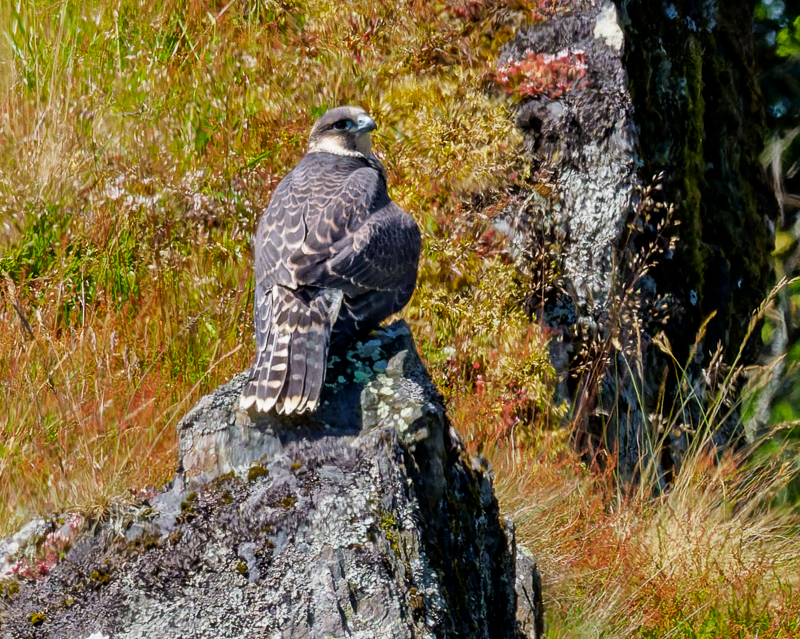
Juvenile peregrine. I got the impression this was a male.

There’s always been something special for me about birds of prey. In my “youth” (ok, I was about 30) I did several summer contracts for the RSPB which usually involved raptors and I seemed to identify with them. I spent more time with peregrines than any other species and I still seem to have an affinity with them. But I also spent many weeks with white-tailed and golden eagles on Mull, and with various species in Wales, Scotland and England. Not to mention gyr falcons and peregrines in Greenland! So you could say that since then I’ve been a bit of a raptor nut. I’d rather spend four hours watching a peregrine eyrie – even if virtually nothing happens – than four hours counting waders on an estuary.

Over the last two springs and summers I’ve been keeping my eye on several raptor eyries – from a distance, of course. It started in early 2021, during lockdown, when I discovered a pair of peregrines on a cliff within cycling distance of my home. This was exciting for me because until then I was under the impression that inland peregrine eyries had long since been abandoned in Ceredigion. I followed them through to mid-summer and saw at least one juvenile in the vicinity of the cliff. On an early visit this year I saw both adults visiting the same ledge together, which bade well for the current breeding season.

This year, following a tip-off, I found another pair nesting in an old raven nest on another cliff even closer to home. By that time the three youngsters were already well-developed and on my second visit it looked like two of them might jump and flap off the nest at any moment. One can only imagine the sense of excitement and trepidation that these young birds experience as they prepare to take their first flight. I had found a comfortable perch for myself on the opposite side of the gorge where my presence didn’t seem to worry their parents. On my third visit, a few days ago, as I approached the gorge on foot , I saw that two of the now fledged youngsters were actually using the my own perch for themselves! So I hung back and let events take their natural course. There was plenty of activity as the juveniles raced around after each other and their parents, screaming raucously. There’s nothing more stimulating to the senses than peregrines at full throttle!

I began to make plans to return to the site with my picnic chair and pop-up hide, but the truth is that I am getting very poor results from my current photographic equipment, and I don’t know why. (The image above is very much the exception.) I’ve ruled out my long lens (a Panasonic 100-400 zoom), so it looks like the problem lies with the body – an Olympus EM1 mk 2, which is now almost three years old. I’m wondering if the “in-body image stabilisation” (IBIS) is faulty or whether my settings have become corrupted in some way. Unfortunately I am a bit of a technophobe so all this is rather a challenge. But needless to say, and incredibly frustratingly, any attempt at long range bird photography is having to take a back seat for now.

In summer 2020 – again following a tip-off from a friend – I heard that merlins were nesting in a dramatic, cliff-enclosed cwm a little further away. I was not familiar with this species, so I visited the site, and was excited to see a female merlin flash by on the walk in. It all seemed very promising. Reaching the cwm I noticed several small raptors perched on erratic rocks on the grassy hillsides around the lake. I decided they were merlins but then noticed that, in the air, one of them seemed to be hovering like a kestrel. And then…….. oh….. that one’s hovering like a kestrel as well……….. Eventually the penny dropped. They were kestrels. It was all a bit puzzling. I read “The Merlins of the Welsh Marches” , by David Orton, and that whetted my appetite even more for merlin experiences.

Cliff-nesting merlins are unusual; merlins nesting anywhere in Ceredigion are unusual. In fact, merlins in Ceredigion are unusual, full stop! But last summer I managed to locate this pair’s nest on a heathery ledge part way up a low cliff above the lake. I visited the cwm several times with a few trusted friends and we all enjoyed some exciting raptor action. They are such lively, feisty little birds, especially the tiny, blue-grey male, that in a sense they almost put peregrines to shame. I visited the cwm again this spring and noticed that the merlin pair were present and showing an interest in a section of cliff high, high above the lake. Would they be nesting there this year?

To read more Tales from Wild Wales as they are published, please click the Follow button.

Birding in Mallorca -and coots in particular ……

Red-knobbed coot : just look at the size of those feet………

Mallorca has been a destination of choice for British birders for many decades. It has a wide range of raptors, notably the massive and very rare black vulture (once close to extinction) and the exhilarating Eleonora’s falcon, plus S’Albufera – one of the Mediterranean’s best wetlands. The latter is a great place to see a wide variety of resident and migratory waders, herons, and other wetland birds. I’ve already described this year’s first visit to S’Albufera in a previous post : it didn’t go too well! But a second visit was more successful. I was surprised to discover that stone curlews breed there. One pair was nesting directly in front of a hide, and I was able to photograph a changeover – one bird replacing its incubating mate on the eggs.

Stone curlews changing over at the nest

In some ways the Mallorca is an outdoor laboratory for rare bird conservation. The black vulture survived in the mountains whereas it had died out almost everywhere else in Europe. Thanks to various conservation measures it is apparently now doing reasonably well. Several species have been re-introduced there, with varying degrees of success : Bonelli’s eagle, griffon vulture, white-headed duck, marbled duck, red-crested pochard and purple gallinule to name but a few. A couple of days after arriving I added red-knobbed coot to that list. This species – also known as the crested coot – is VERY similar to the familiar bird of UK wetlands. It is found mainly in Africa and is described as “critically endangered” or “rare” in Europe (Collins Bird Guide); “occurring locally and very rarely as relict populations” in Andalucia (Birds of Europe); and “one of Europe’s rarest breeding birds” (Bird Guides). I would have start looking at coots!

I’ll be quite upfront about it : the coot is one of my least favourite British birds. They are found just about everywhere, are easy to identify, and are always fighting (or so it seems). I barely give coots a second glance. The crested (red-knobbed) coot is distinguished from it – in the breeding season anyway – by what look like two redcurrants perched on top of its head. At S’Albufera I noticed a coot in a nearby ditch and quickly noticed its red knobs. Time to get the camera out!

Hand-out time

It turned out to be the easiest bird I have ever photographed; I could have done it with a wide-angle lens. Not far away a birding couple sat down to have their picnic and the coot clambered out of the water for a handout. Didn’t it realise it was critically endangered? I just wish I had managed to include the “Do not feed the birds” sign nearby!

Other birds seen and photographed were Kentish and little ringed plovers (both diminutive but both feisty), glossy ibis, avocet and black-winged stilt. I know I missed seeing several species at S’Albufera and elsewhere on the island, but this trip was not about making a tick-list. I know this sounds corny but we did want to experience the “real” Mallorca as far as that’s possible, not rush around seeing the sights and the species. In this respect it helped that we didn’t have a hire car; instead we had four bases and relied on the island’s excellent train and bus services to get around. This did have its limitations, of course. I would love to have explored the spectacular Formentor Peninsula, which has no bus service, to see Eleonora’s falcons at their nesting cliffs. But as a consolation I was able to watch a flock of these elegant and sociable raptors playing around some coastal peaks near Puerto Pollensa towards the end of our stay.

I’d love to go back to Mallorca. There’s so much more to see there. But would I hire a car next time? That’s a difficult one………

To read more Tales from Wild Wales as they are published, please click the Follow button.

A promised land.

The Albarca Valley, north of Lluc monastery (click to enlarge)

You’ll probably be relieved to know that I’m not going to write in great detail about every aspect of the Mallorca trip. Instead I’ll just write a short piece about individual aspects or locations which particularly struck me. For this post I’d like to talk about Lluc, a small settlement based on a monastery, centrally positioned along the north-west facing side of the island.

This part of Mallorca – the Tramuntana – is uncompromisingly mountainous with vertiginous cliff faces in many places. Roads wind through the mountains with hairpin bend after hairpin bend, sometimes clinging precariously to mountain sides. Driving them is sometimes not for the faint hearted. I particularly admired the bus drivers who had to deal with scores, if not hundreds, of cyclists every day, often riding two or three abreast on narrow, winding, carriageways. Ancient trackways, suitable only for walkers and donkeys, traverse the same terrain rather more steeply and directly.

The conventional story of Lluc goes like this. In the middle of the 13th century an Arab shepherd named Luke, newly converted to Christianity, discovered a dark wooden statue of the Virgin in a cleft in the rock there. The image was placed in the local church but three times it miraculously returned to its original location, whereupon villagers recognised a message from God and built a shrine to house it. It thus became a place of pilgrimage.

But according to the Rough Guide to Mallorca, its religious significance goes back much further than that: it already was a pilgrimage site. The area’s prehistoric residents were animists, who deified the holm-oak woodlands surrounding it. The Romans later renamed the site “Lucus” or sacred forest. With the arrival of monks, it was decided to overlay a Christian explanation for the significance of the locality. History is not my strongpoint, but isn’t that a sequence of events often put forward to account for sacred sites in our own islands?

I’m not sure if there are still any monks living in the monastery at Lluc. There is a chapel dedicated to the Virgin Mary, a museum, and – outside – a slightly eccentric but interesting botanical garden showing plants of the mountains. But more than anything else, Lluc is dedicated to tourism. It has over a hundred rooms of various types, and there is a restaurant, bar, grocery store and gift shop. Not that I’m complaining about the accommodation – it has some of the only reasonably priced rooms in the Tramuntana . It was there that we stayed for four nights.

Behind the monastery buildings, a few minutes walk uphill on a cobbled track will take you to a cross set on a rocky prominence. From that point you have a panoramic view of the Albarca valley, set amongst rugged wooded cliffs and mountain tops. It is without a shadow of a doubt the most fertile area for miles around, as you can see from the main picture above, and so different from the unforgiving limestone mountains and ravines that surround it. For me it had the feeling of shangri-la, a promised land which would have delighted anyone coming across it. Did those early animists stand on this very same spot, entranced by the valley below them? It wouldn’t surprise me.

It is apparently now owned by the March family, once the 7th richest in the world, it is said, whose riches came from a variety of sources, ranging from tobacco smuggling to banking. You could say that the family has a somewhat “controversial” background, with wheeling and dealing and political chicanery to the fore.

I had discovered the Albarca valley on my first visit to Mallorca, probably thirty years ago, when it was full of the display flights and mating calls of booted eagles. Not so this year, unfortunately: if present they would probably have been sitting on eggs. On my earlier visit it was possible to explore the valley on foot. It is now only open to the public one day a week, so we had to admire this wonderful landscape from above and afar. But as I looked across the valley and watched a mixed flock of griffon and black vultures soaring around the summit of Puig Roig in the background I felt that whatever conservation initiatives are in place here, the land is in safe hands. I do hope I am right.

This post is for Jane, who accompanied me on this Mallorca trip, and whose birthday it is today!

To read more Tales from Wild Wales as they are published, please click on the Follow button.