Spreading like wildfire (Part Two)

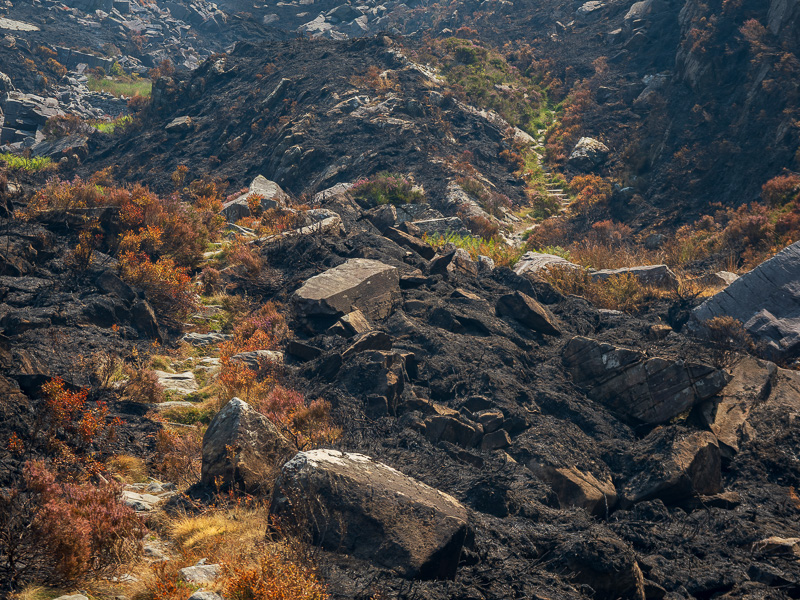
The “Roman Steps” climbing through burnt ground in the Rhinogydd.

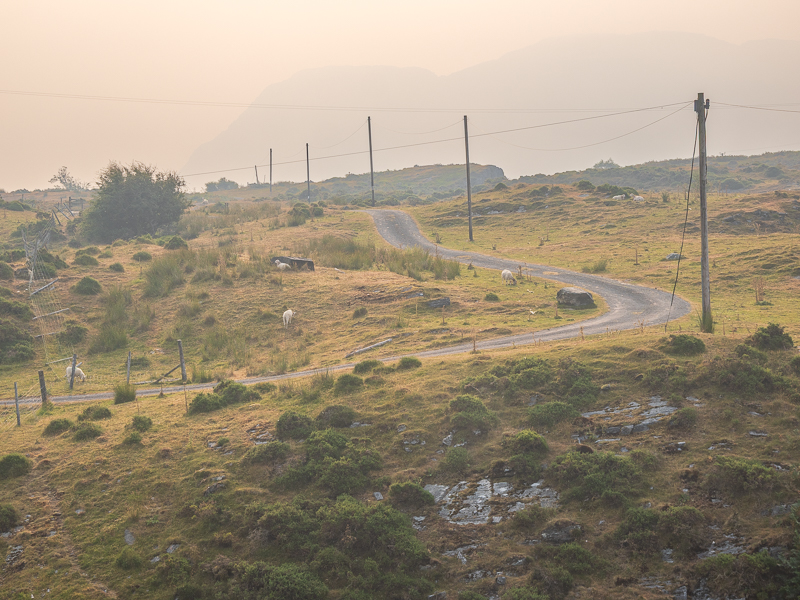
The following day I woke early. I could see the fire still burning away but decided to keep well clear of the immediate area. I drove around the northern flank of the Rhinogydd towards Harlech and then cut across to Cwm Bychan on minor roads. The lower atmosphere amongst and to the west of the mountains was thick with blue and/or orange haze and visibility was poor. In normal circumstances my camera would have stayed in its bag but the intention was to document the conditions. I stopped several times to take photographs as I made my way slowly along a gated road (at least seven gates!) into Cwm Bychan. I think they capture the atmosphere quite well.

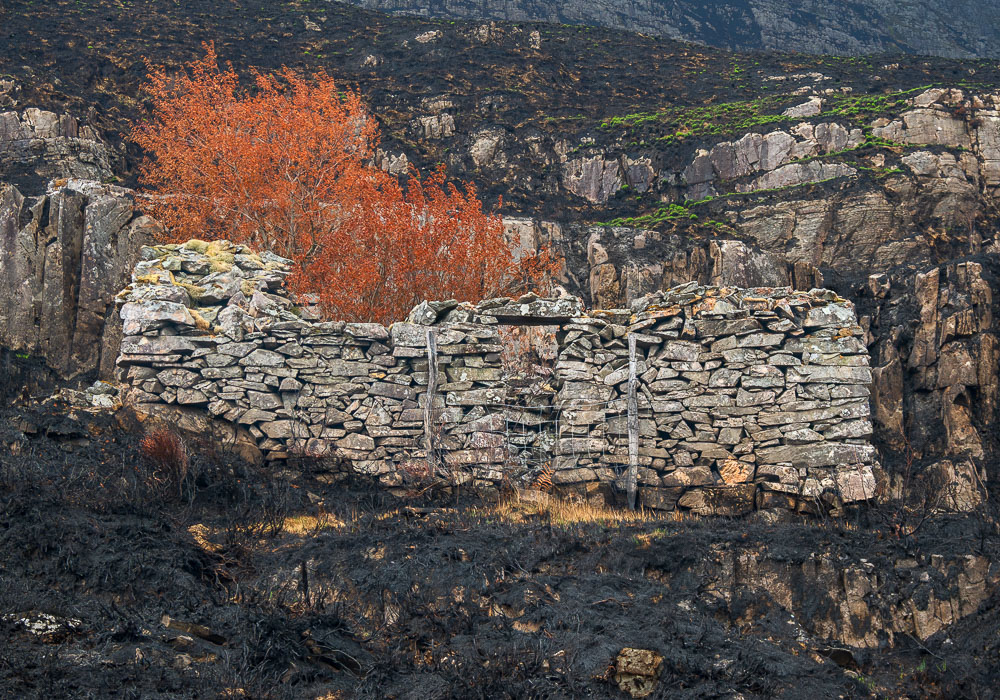
On reaching the “main” valley road into Cwm Bychan I came across a very definite “Road Closed|” sign. At this point I parked up, had a coffee in the van and put my walking feet on. But did “road closed” also mean no access to pedestrians? It wasn’t clear. Road walking is not my favourite activity but there seemed to be no alternative. After about an hour I reached Llyn Cwm Bychan; I could see that the crags on the other side of the lake had been burnt out, with small patches of vegetation still smouldering. At the farm there was no sign that footpath access to the Roman Steps (and the fire!) was forbidden so I carried on. Fire had fortunately not reached the ancient oak woodland on the lower slopes but as I emerged into open uplands I could see plenty of burnt ground. I carried on upwards along the Roman Steps towards the watershed.

The Roman Steps are definitely not Roman. However the rock laid in medieval times to allow sheep and cattle to be herded eastwards towards markets in east Wales and England did form a partial firebreak. For quite long stretches the flames had not apparently been powerful enough to jump from one side of them to the other.

Signs of the main fire to the east side of the mountains were becoming more obvious so I decided to turn back. I didn’t want to be a victim of the fire or the Emergency Services’ anger! I’d taken a range of images of the burnt ground and have posted the best one at the top of this post. I feel it works on more than level; it shows the results of the fire but also has abstract qualities. I drove home the way I had arrived, via Trawsfynydd; from the main road south it was clear that the entire eastern side of Rhinog Fawr was ablaze. How could this tragedy have happened? What were NRW and the Fire Service actually doing?

To read more Tales from Wild Wales as they are published, please click the Follow button.

Two nights in a quiet place.

If I am in the Porthmadog area I have a favourite place to park the van overnight. It is a delightful spot on the banks of the estuary, overhung by oak trees, and no ………. I’m not going to tell you where it is! From there it is a short drive to the Cob, the causeway that runs across the Glaslyn estuary just south of Porthmadog, from which one can look inland to the Snowdon massif. This is surely one of the most iconic landscapes in the whole of Wales but strangely enough not a big seller as far as postcards are concerned. I’ve always wondered why: perhaps people just don’t notice it as they hurry along the main road across the causeway.

I’ve spent two nights at this quiet spot in recent weeks. One morning at the end of August I woke early, had a very quick breakfast, and drove straight to the Cob. I’m sure that one of these mornings I will catch the view from there to Yr Wyddfa in perfect conditions, probably with a low fog across the marshes in the foreground, but this was not going to be it. A bank of high cloud obscured the rising sun. After a short wait I drove on to Borth-y-gest, a village set around a small harbour just west of Porthmadog.

Arriving at the main car park about 8 a.m., and the only vehicle there, I put my head back against the headrest and promptly fell asleep. About ten minutes later I woke up and was aghast to find a parking ticket attached to my windscreen! The parking warden could easily have tapped on my window and asked me to leave; instead he must have crept silently up to the van, stuck down the ticket and made a quick getaway. Talk about a hit and run incident……..

Well, Borth-y-gest is an idyllic little place so after the initial shock had worn off I decided to make the most of a now sunny morning. I need to do a new postcard of the area so set off downstream along the banks of the estuary to see what I could find. The tide was high but receding and the best photograph of the morning came on my return to the harbour (above). It’s a classic “picture-postcard” image, perfectly lit, with good colour saturation; it won’t win any prizes but it will suit my purposes perfectly.

I spent another night at my secret place last week. Not so secret, I now realise: I’ve never had to share it but this time found a rather large motor-home already in occupation. Acorns falling onto the van roof and rolling groundwards woke me several times during the night and I was surprised to also hear light rain falling. I hoped that did not bode ill for the following day.

In fact it was still raining on and off at dawn but it looked like the sun was about to rise into a clear blue sky. These looked fantastic conditions for the photographer and I didn’t even bother with breakfast. There was nothing doing at the Cob (again) so headed straight for Borth-y-gest. Parking more carefully this time, I walked along the coastal footpath overlooking some tiny beaches and the still (but rising) waters of the estuary to the mountains beyond. A rainbow appeared out to the west, but it wasn’t until I began my walk back to the village that the most spectacular conditions were revealed. Brilliant “Godbeams” could be seen across the estuary as intermittent rain and cloud drifted seawards. They were even reflected in the waters of the estuary (See main pic).

It has been suggested that these were “crepuscular rays”; but strictly speaking this term refers to a similar phenomenon that occurs close to sunrise and sunset. Not wishing to split hairs, though, they are formed in the same way. I have always believed that if you follow the path of these rays upwards they will converge at the actual position of the sun, and this shows quite clearly in the photograph. And yet the sun is actually so far away (93,000,000 miles) that its rays on reaching us are virtually parallel. This appears to be an anomaly, to say the least. One website suggests –

“Next time you see sunrays, imagine them for what they really are, miles long columns of sparkling sunlit air highlighted by the darkness of adjacent unlit voids. Let the mind fly around and through them to give them solid form that replaces the flattish way we normally see the sky”

I still can’t get my head around it so if anyone can explain it in plain English, please feel free!

Later in the day I made for the hills above Harlech on the south side of the estuary. By mid-afternoon the atmosphere had completely cleared and the light was crisp and transparent. I took a series of images back towards Porthmadog and Moel Hebog (above). My quiet place is there, somewhere…….

Postscript : I successfully challenged my parking ticket.

The quote is from : https://atoptics.co.uk/atoptics/rayform.htm

To read more Tales from Wild Wales as they are published, please click the Follow button