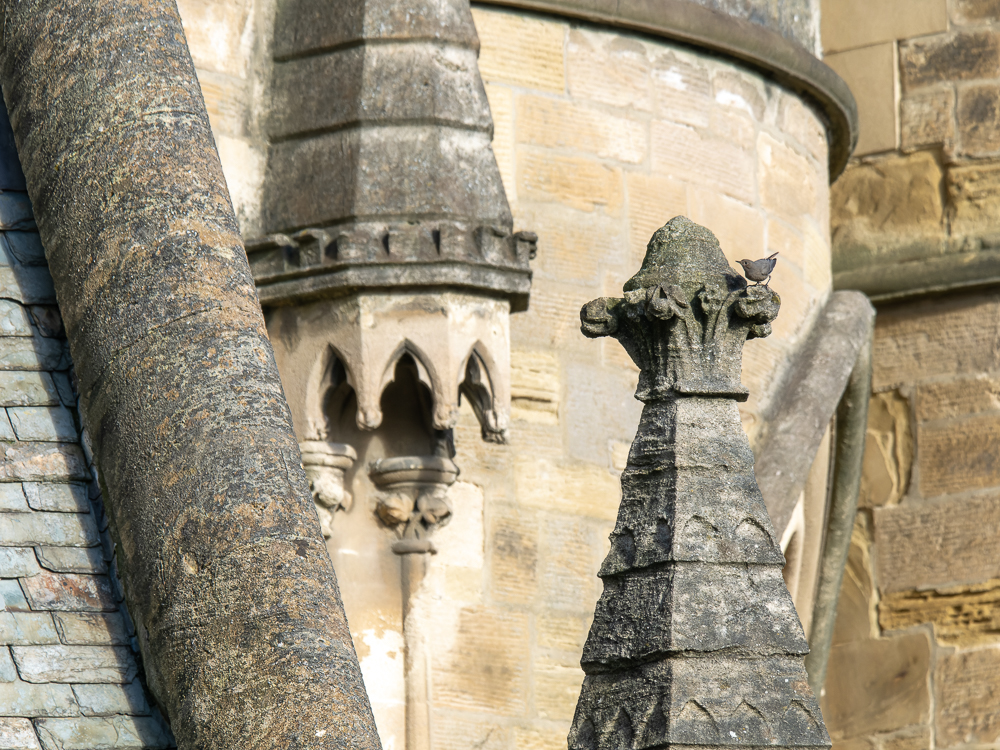
Following on from my last post about birds in the landscape, here’s another example. One day recently I stopped in my local village for some diesel. As I opened the van door I heard a collared dove calling overhead. It was in a bucket under the petrol station canopy. Wow! I excitedly told the petrol station staff who were a bit non-plussed. Hadn’t I noticed before?
It turned out that the dove had tried to nest in a pot-hole on the ground last year, and then transferred its attentions to the top of the sign – without the bucket. The twigs it brought in for the nest just blew away. The garage owners took pity on the poor thing and strapped a wooden base to the top of the sign and then balanced the bucket of sand on top of that. The doves took to it immediately. Last year it raised a youngster and apparently this year it has already reared one young. On my last visit, it called, and its mate called back from a nearby garden.
They obviously don’t waste any time, these collared doves, and they’re not too choosy either.
To read more Tales from Wild Wales as they are published, please click the Follow button.
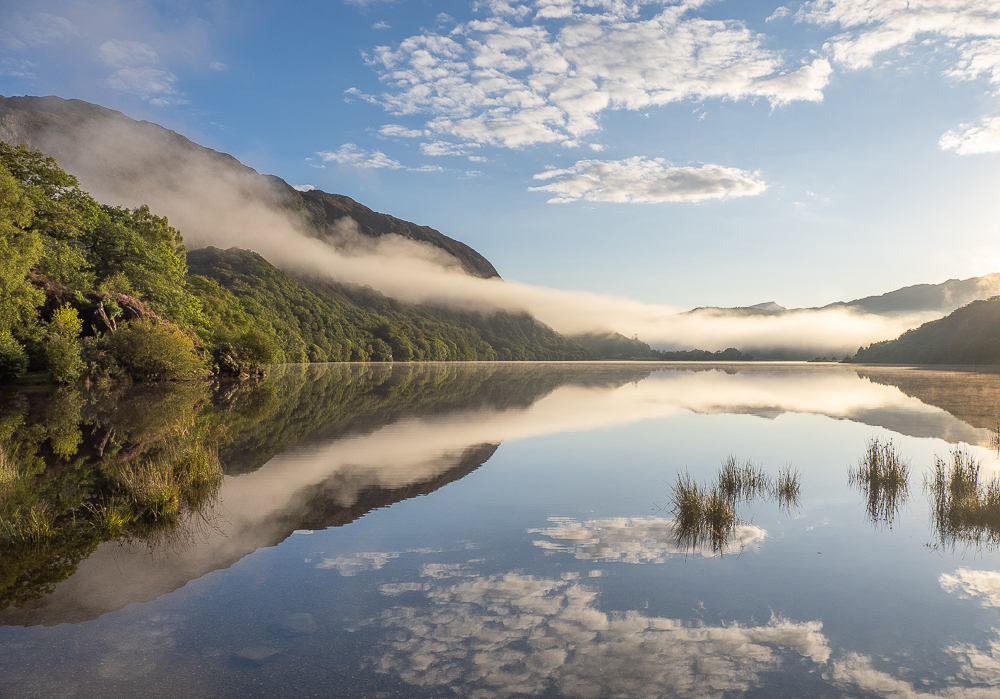
I’ve always preferred to photograph birds within their environment. With many years experience photographing the landscape, I just can’t avoid looking at the bird’s surroundings as carefully as the bird itself. One sees so many brilliant photographs of individual birds with any back- or fore-ground reduced to a minimum or blurred out completely that they could have been taken in a zoo. In my exhibition bird/land both elements within each image were given “equal billing” with the other.
It occurred to me recently that this preference may have been related to my first bird field guide. There may be a parallel here with my musical tastes, which have not changed very much since the late sixties/early seventies. Yes, I know….prog rock! But I do believe the music that inspired us in our formative years remains with us throughout the rest of our lives. My first field guide was the delightful Oxford Book of Birds, first published in 1964, with illustrations by Donald Watson. I have the tiny pocket version which I still sometimes refer to just for the pleasure of looking at the colour plates. The artist took as much care to illustrate the birds’ surroundings as the birds themselves. Accuracy may not have been the book’s strong point but it was published well over fifty years ago, and during that time our knowledge of birds’ plumage has come on in leaps and bounds.
Kingfisher at Aberystwyth
The book is a far cry from today’s birder’s field guide of choice, the Collins Bird Guide. I have the new third edition and it contains well over 400 pages of highly condensed information about Europe’s birds. There are countless illustrations on each spread but most individual birds are surrounded by white space. The plumages are incredibly detailed but most of the detail could only be observed in real life at massive magnifications or with the bird in hand. If you need to know the difference between Moltoni’s warbler and eastern and western subalpine warblers (for example) this is probably the book for you, but for us normal folks it may be overkill. And it just has a rather sterile feel about it.
I came across another interesting perspective on field guides recently. I had read an excellent article about Intensive Poultry Units, and their environmental impact, by Jasmine Donahaye, an author who lives near Aberystwyth; she also happens to be Professor of Creative Writing at Swansea University. I was very excited to discover that her new book – “Birdsplaining” – was shortly to be published. I wondered what a writer with a lifelong interest in birds and a background in the creative arts would come up with. I purchased the book at its launch in Aberystwyth.
Black redstart at Aberystwyth
In the book she uses encounters with birds to explore many issues which are barely related to wildlife. The misogyny, racism and colonialism apparently inherent in the world of nature writing, ornithology and landscape appreciation all come under her scrutiny, as do some intensely personal topics. I don’t think it is unfair to say that men get a pretty bad press in the book. In one chapter she complains that “a man in a pink jumper” was showing a corncrake to visitors to the isle of Iona as she (and they) left the ferry. Does she not realise that most people would have been grateful to be shown such an elusive bird? She also has a pop at bird photographers, who are all men as well, apparently.
But back to field guides. In “Birdsplaining” Donahaye describes how the field guides of her childhood had detailed illustrations of male birds, while the females were relegated to being crouching or half-hidden figures in the background. Or not illustrated at all. In the text females were often described as slightly duller or browner variations of the males. I’ve never had a field guide like this but I can understand why this format might have been used. In many cases the males actually are brighter or more colourful, and there is probably a good reason for it. A well-camouflaged female would probably have greater success in rearing young than a brightly coloured one. And which birder wouldn’t prefer to see a male hen harrier than a female? Yet the author believes that as a child, from the evidence in these field guides, she decided that females of the human species should also be subordinate to their male counterparts.
“Birdsplaining” is a challenging read and I would recommend it for that reason. Just don’t expect to agree with everything in it!
To illustrate this article I’m adding some photographs of birds in their landscapes at Aberystwyth, all taken during the winter.
Edit: When I say in the third paragraph that the latest Collins Bird Guide contains well over 400 pages of information about Europe’s birds, I should say it contains information about identifying those birds, and precious little about the birds themselves. But I suppose that is the purpose of a field guide.
To read more Tales from Wild Wales as they are published, please click the Follow button.
In two posts last summer (this one and this one) I admitted that yes……… I was a bit of a raptor nut. In the second I just happened to mention that I’d spent time observing peregrines and gyrfalcons in Greenland. How did I manage that? Weeelll…… I had wangled a place on the White-fronted Goose Study 1984 Expedition to west Greenland, just inside the Arctic circle. I spent more than three months there, from a sub-zero early May – with snow deep on the ground – until mid-August – well into the arctic autumn. By that time snow had started falling again instead of rain and the nights had begun to draw in. They must have been at least an hour long!
To be perfectly honest, even then I was more interested in birds of prey than geese. I would have been happier tramping around the area looking for eyries than some of the very mundane tasks us normal folks were expected to do. One example I remember of the latter was assisting with the fieldwork for one of the expedition leaders’ PhD. It involved cutting areas of vegetation back with nail scissors to simulate the effects of goose grazing, and collecting the clippings ready for analysis. I don’t think the PhD was ever completed.
Rifling through my brain cells recently I remembered that as a result of my explorations I managed to get a scientific paper published in an American publication, the Journal of Raptor Research. I may have a paper copy of it somewhere but I would have no idea where to start looking, and there was no record of it on the Journal’s website. So I emailed the President of Raptor Research Foundation and to my delight and surprise he immediately sent to me a scan of the paper.
Most of the other expedition members were very ambitious young biology or environmental science graduates. For various reasons I was a bit of an outsider, being about ten years older than them, with more experience of “life”, and in some ways, of fieldwork. Plus I had a degree in psychology! In some ways it was a difficult time. I felt that I should have had a tee-shirt made with a big slogan on the front : “Expedition Scapegoat”
Reading the paper reminded me that at the time I myself was also rather ambitiously hoping to make a career in wildlife conservation. I already had the waxed Barbour jacket. Many of the other members were using the expedition as a stepping stone to greater things. Several have made successful careers in conservation and are very well known in their fields. But for me it was the beginning of a realisation that I just wasn’t going to make it. Environmental science graduates were flooding out of British universities so my chances were poor. By the time the paper was published, in 1987, I had more or less thrown in the towel, and decided to become photographer. Ever the realist! But at least as the latter I was modestly successful.
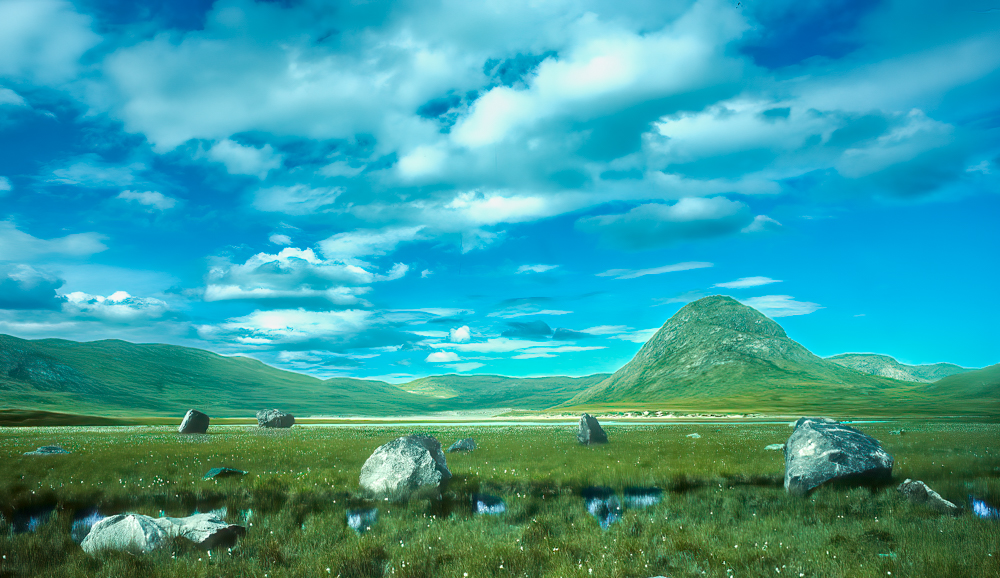
The photograph was taken a couple of miles from the ice-cap and shows a tremendous, primeval, melt-water river valley. You can just about see low sand-dunes by the river bank. The glacial erratics reminded me of standing stones. Behind the camera lay a several-mile stretch of sheer cliffs on which peregrines nested; I may have missed gyrfalcons on my visit. It was one of the most magnificent landscapes I have ever had the opportunity to visit. The original image was taken on Kodachrome 64 and has faded and lost definition over the last thirty-eight years. I scanned it in to Lightroom and spent quite some time processing it in an attempt to reproduce the vitality of the original landscape.
If you’d like to read the paper, here it is. Click on the link below: feel free to comment!
Well maybe not! I photographed this young peregrine close to the eyrie I wrote about in a mid-summer post (see here). This youngster had left its nest only a day or two previously. I have a feeling it’s a male, even though it’s impossible to say for sure. He landed in a conifer opposite the eyrie and remained there for several minutes. I was sitting quietly not far away and I think he was checking me out. It seems there is a short period after young peregrines fledge when they fly around noisily and chaotically without identifying potential sources of danger nearby. Very soon afterwards they will be acutely aware of any humans in the vicinity.
I sometimes look at this picture and wonder what has become of this handsome little fellow.
With Seasons Greetings and Best Wishes for Christmas, the Solstice and the New Year. May you enjoy good health and fortune in 2023!
And thanks for continuing to read my blog!
Jerry.
To read more Tales from Wild Wales as they are published, please click on the Follow button.
Feral pigeons, Aberystwyth : noise reduction and sharpening in DXO Photolab
For many years – from v3.1 to v6.14 – I was a 100% Lightroom man. I had begun my digital photography life with Paintshop Pro (I think it was) before graduating to Photoshop and then fairly soon afterwards to Lightroom. My digression into Photoshop was an expensive mistake because I found it unintuitive and difficult to use. Lightroom was a whole lot better. Then Adobe moved Lightroom into a subscription only package with Photoshop, and by 2017 it became impossible to update the software without signing up to a subscription. I stuck with the final outright purchase version (LR6.14) despite its slowly developing shortcomings. For a longer version of this process, see this post.
It seemed that Lightroom could do everything that I needed a software package to do. But slowly I became aware that other companies were producing alternatives to it, particularly in the realms of sharpening and noise reduction. Once Adobe’s subscription model became set in stone, there was an additional impetus for software developers to produce real, genuine, “Lightroom alternatives” that could be purchased once and updated once every year or two (at a price, of course) if the user wished. Capture One was long-established, but it was joined by DXO PhotoLab, On1, Luminar, and others, and Topaz was developing some excellent NR and sharpening tools.
My move from full-frame Canon to micro four-thirds format Olympus proved a bit of a turning point. Because of its small sensor size m4/3 has limitations, particularly at higher ISO’s; digital noise can become obtrusive. At long focal lengths, correct focusing has always been a difficult skill to master. The bird photographer is always likely to be pushing the boundaries of their equipment and I’m no exception. But I noticed some strange “clumping” of detail in wide-angle landscape images taken at the Olympus’ “base” ISO of 200. I thought it must have been the lens or the sensor, or user error of some sort. After a while I decided to take the plunge with Topaz Denoise AI, specialist denoising software which sharpens images as well. After processing an image in Lightroom you send it to Topaz which successfully cleans it up.
My go-to camera for almost three years – the Olympus EM1 mk2 – was fully supported by Lightroom v6.14, but I knew that once I upgraded it I would no longer be able to use that software. In preparation for that day I invested in DXO Photolab, software which claimed to be a fully featured Lightroom alternative. It seemed at the time to be the most “grown-up” of the new-kids-on-the-block – it didn’t, for example, make it any easier to replace skies, which is anathema to me. There was always going to be a learning curve with new software but I fairly quickly found it was lacking several features I was used to having. You couldn’t combine different files to create panoramic images, or blend a number of files at different exposures to overcome high levels of contrast. And bizarrely, once you have processed a file and closed down Photolab, your processing history is lost. You can’t go back to it.
Eventually I set the software up to only pre-process selected files, and then exported them back to Lightroom for further processing. In fact I’m using it in the same way as DXO’s PureRaw software, which had I known then what I know now, would have been a better choice in the first place. Potentially this works really well – the sharpening and noise-reduction is excellent, and you get a lovely clean file to work with. In extreme cases, it is possible to add even more sharpening in Lightroom because DXO’s NR is so good. The clumping of detail which I mentioned in the third paragraph just doesn’t happen. Its main drawback seems to be that it also adds contrast, which you don’t necessary want in bird photography, and the colour balance can be altered on export. Perhaps there are workarounds for this, though.
In the years after Lightroom became subscription-only Adobe continued to develop it. I heard of its new masking tools which enable the user to select specific sections of an image and work specifically on those. My purchase of an Olympus OM1 (the company’s new flagship model) in summer 2022 made life more difficult for me again. I was either going to have to jump ship from Lightroom entirely, or return to it completely by enrolling in the subscription programme. I decided to swallow my pride and do the latter. To be honest, I’m glad that I did.
While the cost of a standard subscription is £9.98 a month, if you pay in advance and buy from Amazon on Prime Day or Black Friday, that figure is reduced to £6 p.m. I’d say that is a pretty good deal and you still have Photoshop sitting on your hard drive if you want it. It is now easy to roughly select an “object” in Lightroom and software will outline it accurately. It also very easy to select the sky. In fact I worry that processing a file is now almost too easy! Fortunately or otherwise LR’s “content-aware healing” doesn’t work very well in my experience so far, so there’s still difficulties to overcome. Thank goodness for that!
Nothing ever seems to be straightforward, though. As mentioned above I’m using Photolab to pre-process certain files before returning them to Lightroom. I’ve come across a fairly serious problem in that more recently in many cases the export back to LR doesn’t take place successfully. It either fails completely or returns a corrupted file that has a regular pattern of coloured lines running across it. PureRaw doesn’t work either. I’ve taken this up with DXO technical support but they have not yet come up with a solution. In fact they seem to have forgotten about it altogether. Meanwhile someone on the DXO user forum has suggested that it is actually a Windows problem and suggested an easy fix. I’ve followed his instructions and my fingers are well and truly crossed.
To read more Tales from Wild Wales as they are published, please click the Follow button
If I am in the Porthmadog area I have a favourite place to park the van overnight. It is a delightful spot on the banks of the estuary, overhung by oak trees, and no ………. I’m not going to tell you where it is! From there it is a short drive to the Cob, the causeway that runs across the Glaslyn estuary just south of Porthmadog, from which one can look inland to the Snowdon massif. This is surely one of the most iconic landscapes in the whole of Wales but strangely enough not a big seller as far as postcards are concerned. I’ve always wondered why: perhaps people just don’t notice it as they hurry along the main road across the causeway.
I’ve spent two nights at this quiet spot in recent weeks. One morning at the end of August I woke early, had a very quick breakfast, and drove straight to the Cob. I’m sure that one of these mornings I will catch the view from there to Yr Wyddfa in perfect conditions, probably with a low fog across the marshes in the foreground, but this was not going to be it. A bank of high cloud obscured the rising sun. After a short wait I drove on to Borth-y-gest, a village set around a small harbour just west of Porthmadog.
Arriving at the main car park about 8 a.m., and the only vehicle there, I put my head back against the headrest and promptly fell asleep. About ten minutes later I woke up and was aghast to find a parking ticket attached to my windscreen! The parking warden could easily have tapped on my window and asked me to leave; instead he must have crept silently up to the van, stuck down the ticket and made a quick getaway. Talk about a hit and run incident……..
Well, Borth-y-gest is an idyllic little place so after the initial shock had worn off I decided to make the most of a now sunny morning. I need to do a new postcard of the area so set off downstream along the banks of the estuary to see what I could find. The tide was high but receding and the best photograph of the morning came on my return to the harbour (above). It’s a classic “picture-postcard” image, perfectly lit, with good colour saturation; it won’t win any prizes but it will suit my purposes perfectly.
I spent another night at my secret place last week. Not so secret, I now realise: I’ve never had to share it but this time found a rather large motor-home already in occupation. Acorns falling onto the van roof and rolling groundwards woke me several times during the night and I was surprised to also hear light rain falling. I hoped that did not bode ill for the following day.
In fact it was still raining on and off at dawn but it looked like the sun was about to rise into a clear blue sky. These looked fantastic conditions for the photographer and I didn’t even bother with breakfast. There was nothing doing at the Cob (again) so headed straight for Borth-y-gest. Parking more carefully this time, I walked along the coastal footpath overlooking some tiny beaches and the still (but rising) waters of the estuary to the mountains beyond. A rainbow appeared out to the west, but it wasn’t until I began my walk back to the village that the most spectacular conditions were revealed. Brilliant “Godbeams” could be seen across the estuary as intermittent rain and cloud drifted seawards. They were even reflected in the waters of the estuary (See main pic).
It has been suggested that these were “crepuscular rays”; but strictly speaking this term refers to a similar phenomenon that occurs close to sunrise and sunset. Not wishing to split hairs, though, they are formed in the same way. I have always believed that if you follow the path of these rays upwards they will converge at the actual position of the sun, and this shows quite clearly in the photograph. And yet the sun is actually so far away (93,000,000 miles) that its rays on reaching us are virtually parallel. This appears to be an anomaly, to say the least. One website suggests –
“Next time you see sunrays, imagine them for what they really are, miles long columns of sparkling sunlit air highlighted by the darkness of adjacent unlit voids. Let the mind fly around and through them to give them solid form that replaces the flattish way we normally see the sky”
I still can’t get my head around it so if anyone can explain it in plain English, please feel free!
Later in the day I made for the hills above Harlech on the south side of the estuary. By mid-afternoon the atmosphere had completely cleared and the light was crisp and transparent. I took a series of images back towards Porthmadog and Moel Hebog (above). My quiet place is there, somewhere…….
Postscript : I successfully challenged my parking ticket.
A photographer for many years now, the novelty for me of going out with the camera just for fun has long since worn off. Over time my photographic activities have become more focussed on a particular project, and since returning from Mallorca that project has been to add to my collection of possible postcards for future years. The most successful of such visits this summer was the classic location of Llyn Mymbyr, west of Capel Curig, at the end of May.
From the east end of the lake one can gaze across placid (or more likely choppy) waters towards the Snowdon Horseshoe. Halfway along, debris – brought down from the mountains by a long since disappeared torrent – almost cuts the lake in two, giving the lake its alternative name of Llynnau Mymbyr (Mymbyr Lakes). It is easy to walk to the channel joining the two waterbodies , giving views to Snowdon in one direction and back towards Capel Curig to the other. Being so close to the road the location is very popular with photographers, but it would also be well worth a decent walk to get there.
I had a feeling that something special might happen, and it did – eventually. The first morning was good, some nice light, good clouds and decent reflections. But perhaps I should have woken earlier……….. I may have missed the best conditions. I had business elsewhere during the day but returned for the evening. Again, conditions were good but not too exciting. As it was Bank Holiday weekend the campsite at the west end of the lake was busy with cars and motorhomes which provided an irritating mid-ground in front of the Horseshoe. Only in a wide-angle view would any of these images these be useable. I took my tripod around to the far side of the lake for a better angle and used a ND filter and long exposures for a different “look”, but the results were not quite what I was hoping for.
From the postcard……
The following morning I woke early and conditions looked great: blue sky overhead but fog at ground level. I walked down to the lakeside and even at 5.40 a.m I wasn’t the first photographer around. In one of my first pictures you can see a figure crouched in the reeds by the water’s edge.
….to the minimalist
What a morning it was! The sun was already above the horizon, backlighting every feature of the landscape to the east. Mist was rising gently from the still waters of the lake. If these conditions happen at all, they are usually short-lived, but I was able to spend a good hour taking pictures in quite a relaxed fashion. I used a whole range of focal lengths from 25mm to 400 mm using both my main lenses, and got a tremendous selection of images….. if I say so myself…… ranging from the “postcard” to the minimalist.
It was the landscape photographer’s dream morning, and I was elated. But what of the other guy who appears in my first pictures? Within ten minutes he had gone. Shortly later I heard the sound of a drone flying above the lake and by the time I returned to my van in the layby his van had disappeared. I wonder how many locations he was visiting that morning, and how satisfying each one was?
To read more Tales from Wild Wales as they are published, please click the Follow button.
As an addendum to my last post I am including some pictures from my visit to the Immersive Experience in Bristol on Monday. Apologies for the quality – they were taken on my mobile phone; but I hope they give you an idea of what it was like.
To read more Tales from Wild Wales as they are published, please click the Follow button
The first weekend of September is now the chosen date for the Ceredigion car rally. As the date approached I became more and more agitated and close to anger at the prospect and my partner Jane persuaded me that we should leave the area for the weekend. We spent a couple of days around the Somerset Levels near Glastonbury, where some brilliant bird-watching can be had; and then back up to Bristol for a couple of days. Here we went to the amazing “Van Gogh Immersive Experience”. This begins with potted history of the artist, his work, his thinking and his mental torment. It was moving to read how these four strands wove together to produce a vision which, it could be said, was truly “beyond art”. It was tragic to read that during his short lifetime he only sold one painting, while now they can sell for close to a hundred million dollars!
But the real highlight was the Immersive Experience itself. A large rectangular section of a disused warehouse was walled off. Carpets, benches and deckchairs were provided for ” participants” and constantly evolving visuals relating to the artist and his work were projected on to all four white-painted walls. Music and fragments of commentary were relayed over a sound system. It was the closest to an LSD trip that I think I have ever experienced. One truly was immersed in the experience and it was fascinating to watch children and adults just entranced, and I think humbled, by it. For some photographs, please see the next post.
Before I left home I posted my latest “Letter to the Editor” of the Cambrian News, which I understand has been published today. It is reproduced below.
Further to Chris Simpson’s letter (Cambrian News 31st August) about the Ceredigion car rally, the full details of the route have now been published. According to their information, and my calculations, the total distance driven on Rally Days will be 29,000 miles. Of that mileage approximately half will be travelled under rally conditions. The remainder will be travelling between stages and on driver’s recces. This does not include incidental mileage setting up the infrastructure, delivering marshals to locations etc. Could that double the above figure? It goes without saying that the carbon footprint of this event will be massive, not to mention other pollution such as noise, tyre and brake dust and other emissions.
This is not the only negative impact of the rally. The draconian closure of roads and footpaths and the authoritarian way those closures are being put into place show Ceredigion Council in very poor light. Ninety-nine public footpaths in north Ceredigion will be closed; the complete closure of the Promenade between the Marina and the Pier makes a nice round figure of a hundred. Imagine a holidaymaker, like one of those complaining about how dirty the town is, for example, innocently straying into Aberystwyth on Saturday evening. He/she will find half the town closed off to the general public, and rally cars screaming along the seafront between the Marina and the Pier! Then there is the “Festival of Fossil Fuels” as rally drivers show off their prized possessions on the Promenade. What kind of impression does this give to the non-rallying visitor?
I am lucky in that I will be taking a long weekend away from home, and I’m sure I’m not the only one, to get away from this obscenity. Not everyone is so fortunate, of course. I’m sure the horror stories will begin to emerge once all the activity has died down. But I have already been on the receiving end of veiled threats of police involvement if I protest too loudly, and one of my neighbours has had the same treatment. I can’t help thinking that following the three-year hiatus due to Covid, the 2022 rally will open people’s eyes to the nature of this event. I certainly hope so.
To read more Tales from Wild Wales as they are published, please click the Follow button.
The second in an occasional series of pieces originally written for the Letters page of our local newspaper, the Cambrian News. A new editor has been in post for several months and he seems to be willing to publish letters on controversial subjects in order stimulate debate. The following is due for publication this week and follows on from an earlier letter, posted here.
It is ironic that the publication of more details about the Ceredigion car rally was followed so soon afterwards by the most severe heatwave in UK history, with record temperatures recorded all over England , Wales and Scotland, and wildfires in many eastern areas. The heatwave re-opened our eyes to the dangers of catastrophic global heating, which appears to be with us many years before climate scientists predicted.
This year’s car rally is said to be operating with “a focus on sustainability”. Rally organisers are said to be “looking at every conceivable option to improve the event’s environmental credentials and carbon footprint in a real way”. It is said that the rally will have a “compact route to minimize unnecessary road miles” and that “measures will be introduced to target a carbon neutral outcome”.
Needless to say any such measures will be but a drop in the ocean of carbon emissions and other pollution created by this totally frivolous and irresponsible event. Although the details are still shrouded in secrecy, some information can be gleaned from their advance publicity. It looks like there will be an additional two night stages involving an extra distance of 41 miles. The number of cars taking part will increase from 120 to 150. A rough calculation suggests that carbon emissions from the timed sections and drivers recce’s will increase by 30%. This puts rally organisers’ claims to be environmentally friendly into context, I think.
We shouldn’t be surprised that rally car drivers to want to drive as fast as possible on country roads for fun because that is what they do. On their behalf rally organisers have produced a catalogue of greenwash and tokenism in an attempt to justify this climate-wrecking event. But it is quite shocking that Ceredigion District Council have gone hand-in-hand with them in the full knowledge of its repercussions for the climate, and despite the fact that they have themselves declared a climate emergency. What kind of example does this set to the general public who might be confused about what they can or should do about reducing their own carbon footprint?
The UK Government is legally obliged to reach net-zero carbon emissions by 2050, although many believe that is far too late. Climatologists also believe that 50% of the required reductions will have to be made this decade, before 2030. How exactly does Ceredigion Council think we are going to reach that goal when it facilitates, partners and promotes events like this? Perhaps they would care to let us know?
Yours etc.
To read more Tales from Wild Wales as they are published, please click the Follow button.