The “Little Camargue”

White storks on migration, part of a flock of about 150

Earlier in April I spent a week in southern France, where I had rented an apartment in Gruissan, a small town near Narbonne. The area is sometimes known as the “Little Camargue” as it is blessed with a similar range of habitats – sandy beaches, saltpans, reedbeds, and lagoons of varying salinities, for example. It has a similar range of wildlife.

It is also plagued by two other things, which are more or less mutually exclusive. Wind and mosquitoes. The Camargue has the Mistral – a strong northerly which sweeps down the Rhone valley between the Massif Central and the western Alps.  Narbonne has the “Tramontane” – a north-westerly which roars across country between the Pyrenees and the Massif Central. Both have mosquitoes but either wind renders them rather less of a problem than they otherwise would be.

During migration periods birds travelling north (or south) tend to hug the coast quite closely if the Tramontane is blowing, and they also move at very low altitudes. During my first couple of days, it was  so strong that virtually nothing was moving at all. In Gruissan there is a small rocky knoll capped with the remains of a castle; it was almost impossible to stand upright on the summit one morning. But on the third day the Tramontane very gradually decreased allowing migration to recommence. I was blissfully unaware of this, having gone a short distance inland to search out some lesser kestrels. But in the evening I took a short coastal walk and was really excited to see a large flock of very large birds heading along the coast towards me. “Cranes”, I thought, but as they got closer and then passed overhead I could see they were white storks. It was a fabulous sight. I barely needed my long lens to photograph them, which was a shame, because that was all I had…..

White storks near Gruissan (600mm)

The next morning dawned calm and sunny.  I set out in the hire-car to visit a nearby marsh. A couple of miles out of town I passed between some lagoons; to my left, in addition to groups of flamingoes, I could see other large, long-legged wading birds. White Storks! Presumably the flock that passed over me the previous evening had dropped down into the lagoon for the night, and were now busy feeding up for the next stage of their journey. The storks were pretty distant so I pulled the focal length out to 600mm for the first series of images. When photographing birds it is difficult not to use the longest focal length possible. But after a while I began to notice the pine woodland on the far hillside and how much it could add to an image of the birds and the wetland. The lower image is taken at 400 mm, and to get as much depth of field as possible, f16. The storks were not moving too quickly, so 1/320th second was acceptable.

White storks near Gruissan (at 400 mm)

So would I go back to Narbonne for another birding and photography trip? Definitely. In early/mid April there was surprisingly little bird-song in the reedbeds, scrub, woodland or nearby farmland. But I feel sure that by now all those habitats would be heaving with warblers and other desirable species.  The area is more scenic by a long way than the Camargue, with many areas having a hilly or even mountainous backdrop. The biggest advantage, though, was the accessibility of so many of the habitats; there are far fewer access restrictions than in the Camargue. And it is a relatively compact area, so driving distances are shorter.

If anyone would like more information about the area, drop me a line. I’d be happy to advise.


To follow Tales from Wild Wales, please scroll right down to the bottom and click Follow.

In crane country

Common cranes, Lakenheath Fen

Just before Easter I managed to fit in a trip to East Anglia. I had timed my visit to catch a series of spring tides, and planned to spend some time at Snettisham on the eastern coast of The Wash. At the very highest tides many thousands of waders, particularly knot, are forced off mud-flats on to some old gravel pits at Snettisham, now an RSPB reserve (see also this post). I planned to visit the roost site on the first morning for a 6.20 am high tide, and then again in the evening. It was a great plan, and everything went really well, except that the weather was uniformly dark and dismal. Trying to photograph moving subjects at dawn and dusk one is always pushing the capabilities of one’s equipment and heavy cloud cover makes it even more difficult: fifty shades of grey indeed.

So I decided to cut my losses after two visits and head south towards Lakenheath Fen on the Norfolk/Suffolk border. This is another RSPB reserve, a huge reedbed and wetland area largely created out of intensively cultivated agricultural land. I had read that bitterns and marsh harriers were frequently sighted there and that cranes had bred for several years consecutively. I was not to be disappointed. On my arrival I saw two pairs in flight within half an hour. However conditions were as dull and dismal as on the previous day, and  steady afternoon rain put a halt to proceedings.  But I had managed a decent recce of the area for the following day.

So I was on site at dawn. After a two mile walk I found myself on an elevated river bank with excellent views over wide expanses of reedbed. Pretty soon two pairs of cranes became visible simultaneously, one pair dropping down into reeds while the other flew across a railway line and disappeared. Then the reedbed pair re-appeared on a grassy bank and I picked up a single bird on the same bank perhaps a hundred yards away from them. The single bird walked slowly towards the pair. It reached a certain point and stopped, very deliberately turned around and walked away again. This manouever was repeated several times at a glacial pace, each time bringing the single bird a few yards closer to the pair. Eventually they were within a few feet of each other and the pair seemed to back down. Then a few minutes later the pair was in flight together, closely followed by the single bird, and all seemed to leave the vicinity of the reserve. I interpreted this behaviour as being a single bird intruding into the territory of a resident pair.

Back at the Joist Fen viewpoint on the reserve I encountered some RSPB staff, evidently also on the lookout for cranes. I recounted my sightings and but they seemed rather unimpressed. It was as if they didn’t really believe me. All they would say was that “it looks like there’s an extra pair on the reserve”. It didn’t really fit my version of events, and rightly or wrongly I nursed a grievance for most of the day.

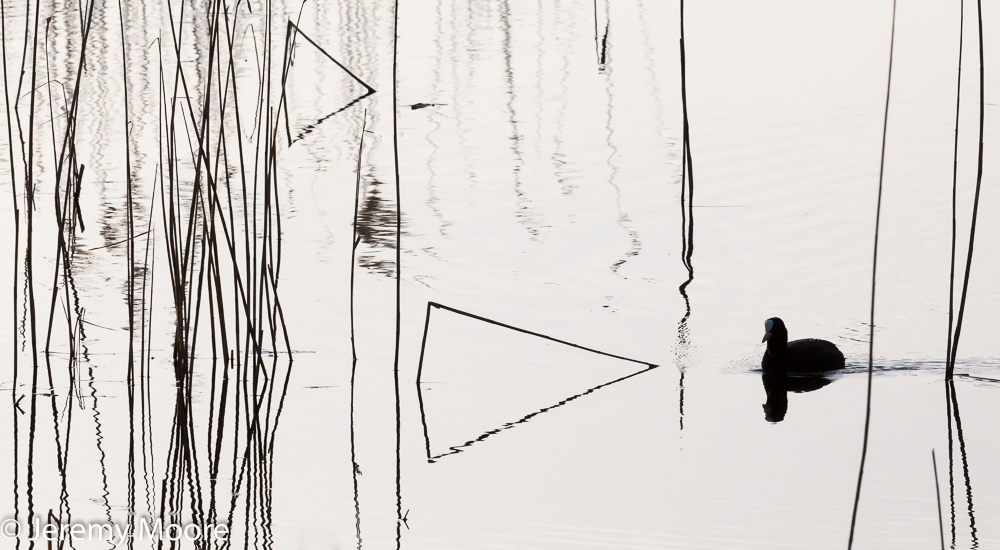
Coot, Lakenheath fen.

There were further sightings of cranes, numerous marsh harriers soaring, diving and displaying over the reedbed, and two good views of bittern in flight. During the afternoon a small crowd gathered to watch a bittern which spent a good half-hour right out in the open,  going through its full range of postures, but unfortunately too far away to photograph well. Another bittern boomed from the reedbed, and bearded tits could occasionally be heard, and briefly seen, amongst the reeds. It was a truly magical day in an amazing place. One might view with some distaste the highly corporate nature of the RSPB.  But when you see what their massive membership, influence and buying power is capable of in the shape of this vast new wetland one has to admit that the end sometimes justifies the means.

Before dusk I spent a couple more hours at the Joist Fen viewpoint. Also present was an old chap who seemed to know the place, and was chatting with other visitors. I decided to approach him with my earlier crane experience and see if it elicited a more satisfactory response. It turned out that the man was Norman Sills, ex-warden of the reserve but now retired. It was he whose vision it had been to create the reserve in the first place, and who had seen it through to maturity, allowing a younger man to then take over. He was more than forthcoming over the crane activity I had seen that morning.

I had made a simple misinterpretation. One pair of cranes was already – on March 25th – sitting on eggs; I had seen the “off-duty” bird approach and then see off a pair of intruders. The second pair I saw virtually never trespassed on the first pair’s territory and frequently fed on the other side of the railway line. It immediately made complete sense. Other than the Lakenheath birds there are several other pairs floating around other wetlands in the Fens, and I had seen one of them. He could recognise individual birds by the size and colour of their “bustle” – the shaggy tail formed by the birds’ folded wing feathers, and he showed me sketches of each one. He showed me detailed plans of the reserve and where each pair’s territory was. It is a pity that a perceived need for secrecy had prevented the reserve staff from being more open with me earlier in the day.   The generosity with which Norman Sills divulged his hard-gained knowledge restored my faith in human nature. And what a legacy for him to be able to look back on in old age!

Seeing several rare and specialised reedbed dwellers had been the highlight of an excellent day, but my best photographs were of a far more humble species – the coot. All were set within reeds and backlit by the powerful spring sunshine. I may well use a selection of them in the expanded version of Bird/land when it shows at Aberystwyth Arts Centre over the summer.

To follow Tales from Wild Wales, please scroll right down to the bottom and click Follow.

A tale of three images.

Ramsey Island (on left) and the Bishops and Clerks, from Whitesands.

It has been a while since I last posted but things have been moving apace. Most of February and March was spent getting postcards out into shops in various parts of Wales. It is always difficult to drag oneself out of the semi-hibernation of mid-winter and this year was particularly fraught because Easter was so early.

It has to be admitted that sales of postcards are steadily declining. This is partly because people are using phones and Facebook to contact their friends while they are away but also because the number of potential outlets is declining rapidly. The perils of running a bookshop in the Amazon era are well recognised, but independent retailers of all kinds have been closing and are not being replaced in similar numbers. What is particularly sad is the number of Tourist Information Centres that have closed, will soon close or are under threat of closure. It is happening all over Wales as a result of cuts to local authority funding. It may be our local councils (and National Park authorities) that are having to make the difficult decision to close them but the root cause is central Government.

A selling trip that would until recently have taken two and a half days now takes two or less. But that does mean I have a little more time available for photography on these trips and I was lucky with the weather on some of them. After one particularly busy day in Pembrokeshire I was able to nip down to Whitesands, arriving just after sunset. I started a short high-tide walk along the beach but quickly ran back for the camera. The conditions were just stunning! I only had a few minutes to run off a few exposures and I wasn’t entirely happy with the composition in any of them. But I’ll settle for the above…….

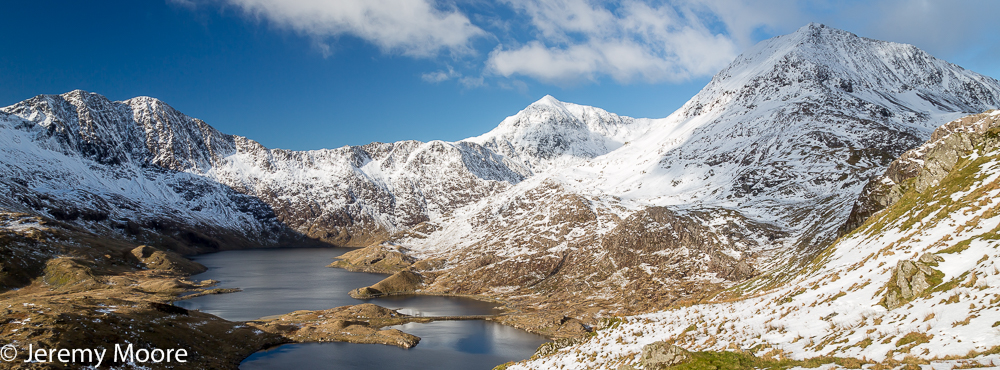
On a trip up to north Wales I spent one night at Pen-y-pass YHA. I normally avoid youth hostels these days but Pen-y-pass is so well situated for an early morning walk in the foothills of Snowdon that in winter I occasionally make an exception. Unfortunately my dorm also contained a snorer so I had a disturbed night’s sleep and was not able to get up at the crack of dawn as I had hoped. But a little later on this was the view of the Snowdon horseshoe from “The Horns”, situated between the PyG and Miners’ paths.

Snowdon summit and Y Lliwedd
Y Lliwedd, Yr Wyddfa and Crib Goch from “The Horns”

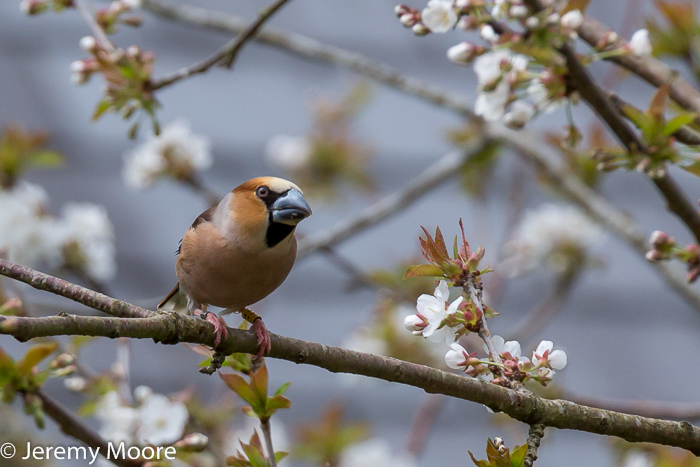
I was able to devote the whole of this superb day to photography so then headed off eastwards to photograph the packed masses of waders at their high-tide roost at the Point of Air, near Prestatyn. The only trouble was – there weren’t any. Just a handful of the commonest species. I then spent a couple of hours searching for, and failing to find, my current birding obsession – hawfinches. I won’t broadcast the location because villagers get pretty cheesed off with the behaviour of some birders, but there is a well-known site for this rare and elusive bird in the Conwy valley. So for the second time in one day I assumed I must be driving around in a van with a huge sign, facing upwards, on its roof saying “Bird photographer approaching destination – make a run for it”.

But I had more joy at my final location, the RSPB Conwy reserve at Llandudno Junction. There has been a starling roost there all winter and on my arrival I was pleased to discover they were still around. There was no wind and it looked like there would be a good sunset, so I found a location where I hoped the birds would be silhouetted against a stunning sky. There was even the possibility of a reflection for good measure!  Towards sunset small groups of starlings began to arrive, some time later than they do at Aberystwyth. And they just kept on coming!  Several sparrowhawks made appearances and made hunting dashes into the flock. The starlings created tightly-packed balls and ribbons of birds to try to evade them. It was fabulous to watch but set against part of the sky which was too dark to allow successfully photography.

It really was a very large flock by the time they eventually disappeared together into the reedbed. It was almost dark by that time and they had been displaying for some forty minutes since the first birds arrived.  It was interesting to compare this with their behaviour at  Aberystwyth, where they were going to roost some forty-five minutes earlier. I managed this image as the flock swirled over one the reserve’s shallow lagoons.

Starlings in pre-roost display, RSPB Conwy reserve.

I don’t know if it be useable anywhere else but on the web.  It was taken at 6.31 pm on March 10th, using pretty extreme settings for this type of subject – 4000 ASA, 1/160th second and f4.

Finally, just before Easter, I installed part of my Bird/land exhibition in the Visitor Centre at RSPB Ynyshir. It will be showing there until May 30th; but for the full Bird/land experience wait until June 25th, when an updated and expanded version will be opening in the Photography Gallery at Aberystwyth Arts Centre. Watch this space for more information.


To follow Tales from Wild Wales, scroll down to the bottom and click Follow.

What if…..?

It has been a rather fallow period recently, photographically speaking, but there have been a couple of interesting experiences to recall.

A month or so ago I was snoozing at my desk (er…..editing images on the PC…..) when the phone woke me from my reverie.

“It’s Barry from Hinterland” said the caller.

“Erm, sorry, who is that?” I asked, assuming it was a scam.

“Barry, from Hinterland, you know, the Welsh detective series?”. I brightened up: perhaps they needed a stills photographer…..?

Hinterland is a bilingual TV drama filmed locally in which an unfeasibly large number of people are murdered in north Ceredigion. It has an aura of Nordic Noir about it and is good fun to watch in the hope of identifying an acquaintance or a location or spotting where a police car goes from A to B via C whereas in fact C is in completely the opposite direction.

“Oh, yes, hello!” said I.

“You put your name down to be an extra and we’re wondering if you’re free a week on Monday”.

“Oh, OK. ”

“There’s a press conference scene and we’re looking for photographers with their own kit to come along.”

It sounded interesting and perhaps even fun, so I was keen to take part.

“I think I have a meeting then but I should be able to re-arrange it”

The Monday happened to be the morning of the big storm and spring tide at Aberystwyth, and it wasn’t easy to walk upright between the car and the old County Hall, close to the sea-front, where many of the indoor scenes are shot. It certainly was interesting but did involve rather a lot of hanging around, waiting, and then waiting some more while the scene, which lasted about a minute, was shot and re-shot in English, then in Welsh, then re-shot again, then the audience was shot from two different angles, then the scene where the superintendent leaves the room was filmed from outside the room, then shot again from inside…… There was no heating on and over a period of about two hours everyone involved was getting colder and looking more pale. I wonder – if the scene makes the final cut -whether that will be apparent on screen?

There were three of us and all we had to do was pretend to take pictures while the detective made an announcement from the front of the room. I was sitting in the back row and had I actually been pressing the shutter I would have ended up with a large number of images of the back of the head of the person sitting in front of me. Hardly realistic, but hey….who cares? It’s only TV.

A couple of weeks earlier I had been asked to judge the entries of a photography competition run by a University society.  I’ve been a judge in a Camera Club competition and it took up an inordinate amount of time, but this sounded like it would be  a one-off, in-and-out event – and I really couldn’t say no. I arrived in good time to discover that I was actually one of two judges, the other being Janet Baxter, another local photographer, who is a direct competitor of mine. For many years Janet and I never spoke, so it could have been very embarrassing for all concerned. But fortunately we get on much better now!

It turned out to be a very interesting experience.  The entries (about thirty of them) were printed and displayed very cheaply (frames courtesy Poundland…..). But there was a theme – “What if…..?” – which gave plenty of room for interpretation, and added another dimension to the competition. The entries varied from the frankly terrible to the quite professional looking. As far as judging was concerned we had to consider two separate aspects; firstly the images themselves, and secondly, how well they illustrated the dilemmas chosen by each photographer. Janet and I made a shortlist of five and went for a coffee to discuss the winning entries.

We’re both very experienced landscape photographers and it may have been that we were more critical of the landscape entries. Whatever – there was only one pure landscape in the final three. Another was a street scene including a couple kissing passionately, which was either brilliantly seen and captured, or very professionally posed. Another on the short-list stood out from the other entries by a country mile, though. It was a gritty, black-and white, head and torso image of a middle-aged woman with only one breast. It was completely honest, not in any way designed to titillate or shock,  and quite challenging to look at.

What if ……… I live?“.

I felt it was a very brave image, it was brave of the photographer to enter it, and brave of the organisers to show it. Janet said that she knew of women who had lost a breast and that they suffered in silence.   We went though the motions of discussing the rest of the short-list but neither of us had much hesitation in awarding first prize to this photographer. It turned out that she is in fact a photography student, and a number of years older than the average undergraduate.  The image was part of a series that she was doing of the woman – her own mother – as she recovered from surgery.

We returned to the Hall. The organisers were there to meet us. It had been discovered that the street scene with the kissing couple was actually stolen from the internet and the “photographer” was passing it off as their own. A hasty re-assessment of the prizewinners was required. You would expect members of the University Christian Union would be a little more honest than that, wouldn’t you?


In search of starlings at Glastonbury and Aberystwyth

Starlings, Avalon marshes, Somerset

Last weekend Jane and I headed off to Glastonbury for a few days. It’s an unreal place. If ever you needed to visit a personal transformation coach, an angelic reiki practitioner or a shamanic hairdresser, make for Glastonbury. It would be easy to sneer at the apparent pretentiousness of it all, but that would be unfair. While there may be some charlatans involved, I’m sure many of these people are quite genuine in their thinking; and I sometimes think how comfortable it must be to live according to a ready-made belief system. It was curious to note the vigorous campaign for the retention of the last remaining bank (Barclays, if I remember correctly….) in the town, though.

An extensive area of former peat workings near Glastonbury has been reclaimed to create a cluster of wetlands and reedbeds, now known as the Avalon Marshes. These are home to several rare bird species, notably bittern and great white egret. The latter was fairly prominent at the Ham Wall RSPB reserve, and I photographed one on a beautiful, still, winter’s morning with warm light and a hint of frost on the ground. The former lived up to its reputation for skulking. But arguably the biggest  draw on the Avalon Marshes in winter is its huge starling roost, which I spent three evenings trying to capture. For roosting, the birds have a very large area to choose from, and they can move from one site to another on a daily basis. Even the local birders and photographers admit to being unable to predict what they are likely to do next. On my first visit I found a likely looking foreground at sunset and hoped a flock would fill the sky with interesting shapes. Needless to say it didn’t work out how I had hoped, but there was the above; I’m not sure yet if the image works or not.

On the second night, from a different location,  I watched as huge flocks gathered over farmland and in trees to the east against a dull background; and later, with mounting disbelief, as a continuous stream of starlings moved from one section of reedbed to another. The process lasted some 15 – 20 minutes; there must have been millions of birds altogether. But it was a frustrating encounter;  they flew too low over the ground to photograph successfully. On the third night I sought out the trees where they had gathered the previous evening but again the results were disappointing.

Starlings at Aberystwyth

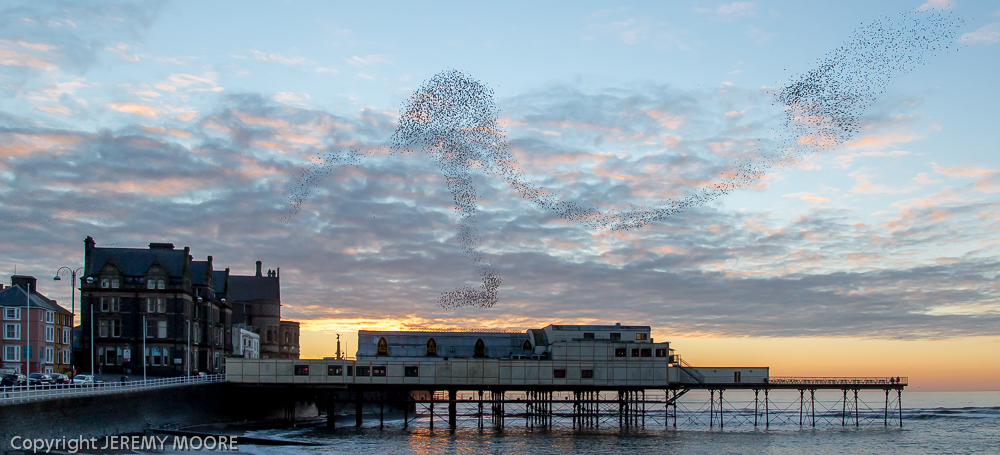
Back in Aberystwyth,  decent sunsets have encouraged me to visit the starling roost three times this week. Tuesday was just the most gorgeous winter evening; cloud had largely cleared during the afternoon and there was no wind. The starlings must have felt it too. For a few brief moments a flock briefly indulged in one of their spectacular ribbon/bracelet formations before dropping in under the pier. At last! Something to write home about……

For the last couple of months my camera bag might have been a door stop for all the use it has had, so it was good to pick up the camera again….. even if I could barely remember what some of its buttons were for! But the experience did remind me how important it is to be familiar with the controls of your equipment. A few seconds delay and confusion can mean the difference between getting the shot and missing it. And which shutter speed would blur the movement of birds in flight most successfully? I just couldn’t remember. But there is one thing about trying to photograph wildlife – it teaches you patience.


To follow Tales from Wild Wales, scroll down to the bottom of the page and click Follow.


Thoughts from a wet and windy Welsh hilltop.

Aurora Borealis, mid-Wales

I cannot remember such a long period when the weather has been so discouraging for the outdoor photographer. Days….. weeks!….. on end of cloud, rain and gales – and today is no exception. I’m shocked to discover that I’ve barely taken a decent photograph since the beginning of October.

But I can’t just blame the weather for that. In my last post I wrote how my priority over the summer was to work on images for new postcards. How one needed to visit the popular locations and somehow come up with something new. I eventually realised I was just going through the motions. I really was re-visiting the same old places and taking the same old photographs.

So as much as the weather really has been disastrous it was a partly a conscious decision to lay the camera down and give myself a break. This happened to me big time about twenty years ago. I put down the break-up of a relationship partly or largely to the fact that I saw myself as a photographer first and a human being second. There certainly were other factors but being an outdoor photographer does involve leading a very unpredictable lifestyle. Whatever…..after a few self-imposed months of keeping the business running and no more – certainly no actual photography – I picked up the reins more or less where I had left them. In my experience one’s creative side continues to develop even if putting it into practice actually takes a back seat for a while. After a few months break from photography I’m sure – well, fairly sure -that I’ll return to it with a bunch of new ideas and attitudes.

I hope it does, because I’ve recently had a very positive discussion with a publisher and author about a new book. There’s still plenty to be finalised, particularly the financial side of things, but I’ve come to the conclusion that my sanity is now more important than my bank balance! So even if it doesn’t pay very well, I’ll still do it.

In a post earlier this year I wrote about how I missed an opportunity to photograph the Northern Lights. Since March I have gained a better understanding of why and how a faint aurora – even an invisible one – can actually produce decent photographs. The reason is this : there are two types of sensor in the eye – cones and rods. The cones are colour sensitive, but the rods, which are 1000 times more sensitive than the cones and far more numerous, do not pick up colour. So our eyes do not perceive colour at low light levels. The sensor in our camera is equally sensitive to colour at low or high intensities so it will record what the eye cannot see.

A couple of evenings ago I received an “Aurora Watch” amber alert. To my surprise yet another cloudy day actually improved to an evening of clear periods and showers. There was quite a powerful moon but the northern skyline looked a bit odd.  I couldn’t be sure whether it was a pale glow that I was seeing or some cloud hugging the horizon.  I eventually realised that I would have to take some photographs to be sure if the aurora was present or not.

I set the ISO at 3200 and the meter gave a reading of 8 seconds at f4. When viewed on the camera’s LCD screen the first image immediately showed that there were vertical bands of purple in the clear sky which were completely invisible to the naked eye. I took a few more images to confirm it and then called it a day. On viewing the images this afternoon on the PC monitor it became clear that amongst the cloud on the horizon there had also been a green glow. The very localised orange glow on the horizon is usually visible to the naked eye as pale and colourless but the camera’s sensor has picked up its colour;  it must be street lighting from a nearby village reflected off low-ish cloud. The image has of course been processed, but not to an excessive level – no more than I would expect on a typical landscape.  This had been the real thing and without the camera I would never known!

Technically and artistically it is rather poor. I should have taken more care with placing the tripod and weighing it down, and the telephone pole in the foreground is hardly an attractive feature. But I’m treating it as a learning experience and hopefully there will be an opportunity to do better in the future.

Seasons Greetings to all from a wet and windy Welsh hilltop!

To follow Tales from Wild Wales, scroll down to the bottom and click Follow.


This looks like a winner to me.

The Beacons from Brecon graveyard

Following the completion of the Bird/land project I realised it was time to step back from bird photography for a while. My bread-and -butter income still comes from the sale of postcards and some of them were beginning to look a bit tired. Rather than reprint them again I decided to spend some time replacing them with new designs. So it was time to put my landscape photographer’s hat on again……

Taking photographs for postcards must be easy…..right? Well, er…..no! Somehow one must be able to sum up a well-known location in just one image, the sense of the place, if you like, and ideally in a way that has not been done before. Take the Brecon Beacons, for example. They may not be the most dramatic mountain range in the UK but they are very popular. I had seen a photograph on a flyer for a holiday cottage rental company showing  a former farmhouse idyllically situated in the foreground with the main peaks behind it. It looked like it would be worth searching out the location. When I eventually found it,  I couldn’t believe it was the same place. The original photograph appeared to have been taken from well above ground level, and there was a string of electricity cables and phone lines running to the house. It had been photoshopped out of almost all recognition!

Whilst on the lookout for a new viewpoint I’ve spent hours driving and walking around the narrow, high-hedged lines between the Beacons and Brecon. Every so often I would catch a glimpse of the view I wanted through a gap or a gate but on closer inspection there was always a snag. I eventually narrowed it down to a couple of fields, through which no public right of way existed. A  friendly farmer gave me permission to cross his land to reach the spot but on the two occasions I was there during the autumn conditions were just not good enough. So that particular view will have to wait for another year. And even then, I have a horrible feeling there will be a snag there too.

What I did find earlier in the year after many hours searching, was a view of the Beacons from the graveyard at Brecon.  The image may not have a great deal of merit in an artistic sense but as a postcard it looks like a winner. I’m not sure yet what I’ll use as a caption!

To read more Tales from Wild Wales as they are published, please click the blue Follow button

Final thoughts on Bird/land…..for now……..

Mallard (from Bird/land)

Well, Bird/land closed just over a month ago and I have to say in many respects it was a success. Feedback was excellent; visitors were particularly complimentary about how different the work was to anything that I had previously done.  Print sales were also very good  and much better than I was expecting. As a result I have just sent a cheque for £140 to the RSPB towards reconstruction of their hides at Snettisham in Norfolk. I had hoped to make multiple visits to Snettisham during the course of the project to photograph the countless thousands of waders which congregate there but a storm surge of December 2013 destroyed the hides. So my small contribution will benefit conservation generally and bird photographers in particular.

What has been disappointing is the almost complete lack of coverage I have received in the press and the photographic media in particular. I suppose the exhibition did fall between two stools – not really bird photography, and not landscape either – so it was difficult to categorise. And, of course, it was in a small town in mid-Wales and who could even pronounce its name? But not for the first time have I believed that there is a prejudice amongst the English media about all things Welsh.

All is not yet lost, however. I have agreed to display some of the work at RSPB Ynyshir, my local reserve, next spring. And on a much larger scale the whole exhibition will be shown at Aberystwyth Arts Centre for two months next summer. I am hoping to be able to expand it to fill the larger photographic gallery there but that will be subject to receiving further funding from the Arts Council of Wales. So watch this space for further information about dates, etc.

The image above is one of only two singles in the exhibition. It has sold really well and only one remains at the time of writing. How I wish I’d offered an edition of ten or more instead of just six! It is so difficult to know how to sell photographs. Over the summer I noticed an exhibition of really rather average black-and-white landscapes in a bookshop in Hay-on-Wye, in an edition of 295. Only in the photographer’s wildest dreams would anywhere near that number be sold. A short edition would, I hoped, create a feeling of exclusivity around the work, and thus increase sales. But I think I may have misjudged it. Just one of the lessons I have learned over the last few months!


To follow Tales from Wild Wales please scroll right to the bottom and click Follow

The digital darkroom is our friend.

Mawddach estuary from the New Precipice Walk (processed image)
Mawddach estuary from Llwybr Foel Ispri

It has been a dry and sunny October so far and our new solar pv panels have been getting an excellent work-out in the couple of weeks since they were installed.  The landscape photographer has other priorities, of course, and wall-to-wall sunshine is not necessarily one of them,  even in autumn.

Earlier this week I managed twenty-four hours around the Mawddach estuary in north Wales – truly one of the UK’s most stunning locations. For the life of me  I just cannot understand why more photographers don’t head for the Mawddach! Over the years I’ve got to know a few spots which are easy to get to and provide great views down or across the estuary and I suspect they make me a bit lazy. Why search for new locations when the ones you know so well usually deliver the goods?

The first location I tried was the New Precipice Walk (Llwybr Foel Ispri), high on the north side of the estuary about two miles downstream of Dolgellau. It is possible to drive along a gated road to within a few minutes walk of this fabulous spot and I was there in good time for sunset on Monday. One needs to be aware of fairly subtle changes in the landscape as they take place; for just a few minutes the brilliant sun illuminated the estuary and its wooded banks without overwhelming the eye of the beholder. I could see the potential for a good image but only if extreme levels  of contrast could be handled in some way. Stacking my 1- and 2- stop ND grads I took a few frames but the images looked very disappointing on the LCD screen. Messy and badly exposed. Why bother? Sunset itself proved to be a damp squib so that was that for the evening.

The same image before processing

Back home a quick look at the RAW files (see above) instantly confirmed my earlier judgement. But on a later viewing I had a play with the image using Lightroom’s development sliders – exposure, shadows, highlights, blacks and whites. Adding a square crop and a tweak to the colour balance, it only took a few blinks of the eye to come up with the top image, and I’m really pleased with it. The digital darkroom really is our friend!

I spent the night at Cregennen Lake on the south side – another firm favourite of mine and subject of just the second post in this blog. It is a truly dark place and I spent a couple of hours searching the northern skies unsuccessfully for an aurora.  Following a disappointing dawn at Cregennen I returned to Llwybr Foel Ispri.  The first burst of autumn colour in August and early September is still accompanied by the vivid greens of summer. By the end of October and well into November trees lose their leaves in a riot of colour if we are lucky.  But in between the colours of the autumn landscape can seem muted and rather tired. There’s a kind of tawny wash to it which doesn’t really inspire. Autumn colours and bright sunlight might seem to be a recipe for success but it’s not just a matter of turning up and pressing the shutter.

Self portrait, Llwybr Foel Ispri

I had no great expectations for this visit but realised I had two of everything in the van (tripod, camera body and lens). I decided to have a go at a selfie – or, to put it another way – photographing the landscape photographer in his habitat. Quite easily done when you have the gear with you and the time! It was great fun for a while and involved me running at full tilt from one tripod to the other as the self-timer wound down. The images needed some quite detailed processing – removing uneven saturation of the sky caused by a polariser for one thing – but once again Lightroom has done a great job.

I also photographed myself in a Tai Chi stance at the same spot. If ever one needed an uplifting outlook this has to be the place.

To follow Tales from Wild Wales, please scroll right down to the bottom and click Follow.