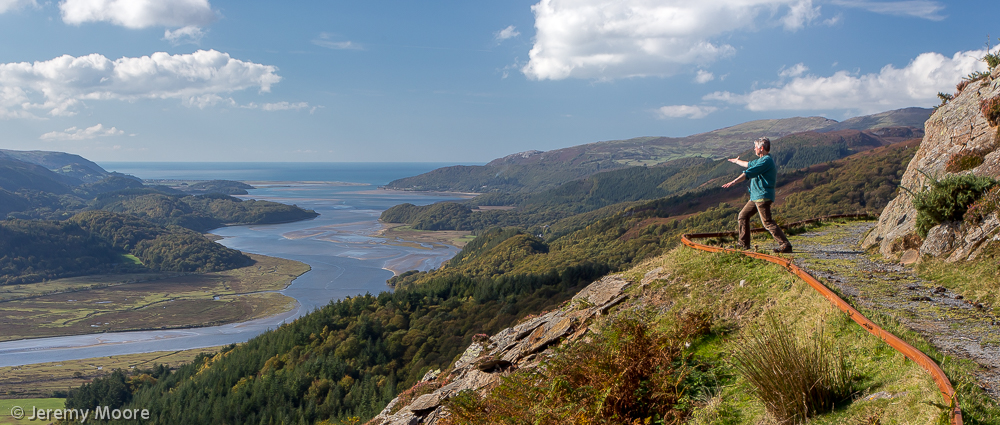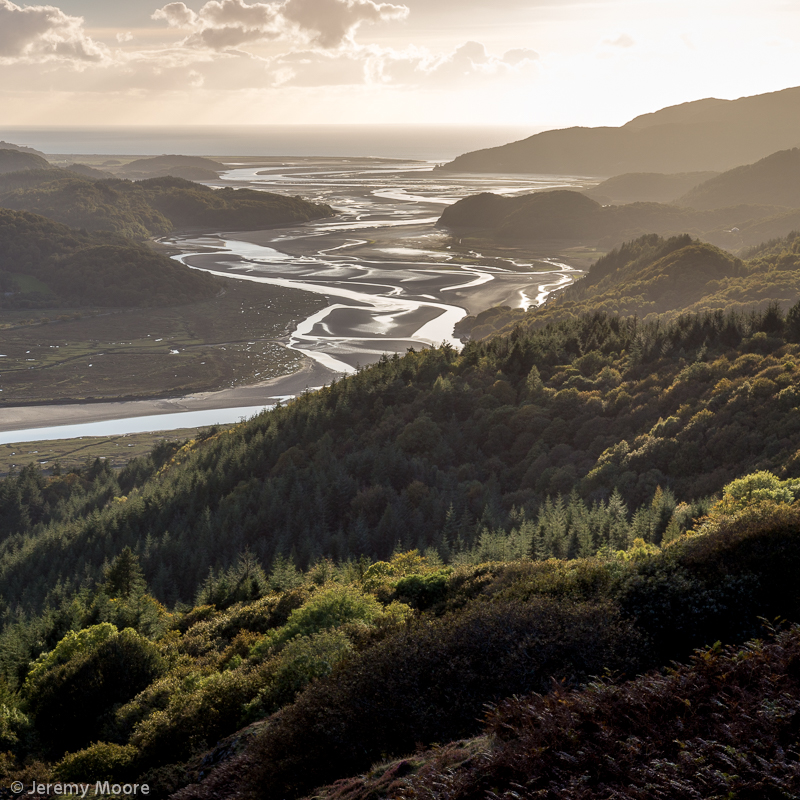
Still waters and cloud in Eryri.

Near Capel Curig.
Near Capel Curig.

Last week, the sun shone endlessly, and I was finally able to get away from domestic commitments on Thursday afternoon. It was my intention to “do Snowdon” on Friday so I parked up overnight by the Llynnau Mymbyr near Capel Curig. Dawn was frosty and valley fog had formed overnight. The forecast was for a day of unbroken sunshine and light winds. While it would be lovely in the mountains I suspected that conditions would not be that great for atmospheric landscapes. Flexibility is the name of the game in landscape photography so it was over to plan B, which involved an early morning session in Dyffryn Mymbyr as the fog cleared. Sunrise comes so late at this time of year that it was a really leisurely start!

Llyn Mymbyr is one of the classic photographic locations in the National Park. The view from Plas-y-Brenin of the Snowdon Horseshoe reflected in the lake’s still waters is often the photographers’ desire. It is quite iconic in good conditions and when done well. But in valley fog one would be immersed in damp greyness and Snowdon would be quite invisible. It is then more profitable to take the rough and tussocky path between the two sections of the lake and look back towards Plas-y-Brenin. It is one of my very favourite locations in Wales. As the sun rises the fog tends to melt away downstream, allowing more and more of the landscape to emerge. Friday morning was just about as good as it gets, as you can see from the image above.

The sun shone all day on Friday and the Horseshoe looked absolutely stunning during the afternoon from Dyffryn Mymbyr. But I was glad that I had saved my energy for an attempt on Snowdon the following day. Saturday’s forecast seemed much more promising; a broken cloud base of perhaps 500 – 600 metres but with the summits remaining above the cloud. I liked the sound of that!

The next morning the fog was denser and more extensive at Capel Curig but stars could still be seen overhead. By the time I set out from Pen-y-pass about 7 a.m. the first wisps of cloud were forming above Y Lliwedd, and as I made my way up and along the PyG track I barely noticed how quickly it was developing.  I’m nowhere near as fit as I used to be and I don’t mind admitting that it was a bit of a slog to reach Bwlch Glas. At this point one leaves the confines of the great eastern corrie of Yr Wyddfa and can take in the view to the west. An almost complete sea of cloud spread out below me. It was more or less only within the corrie and above the very highest peaks that cloud had not already formed. Blue sky could still be seen over the summit of Snowdon while cloud lapped and drifted around below it.

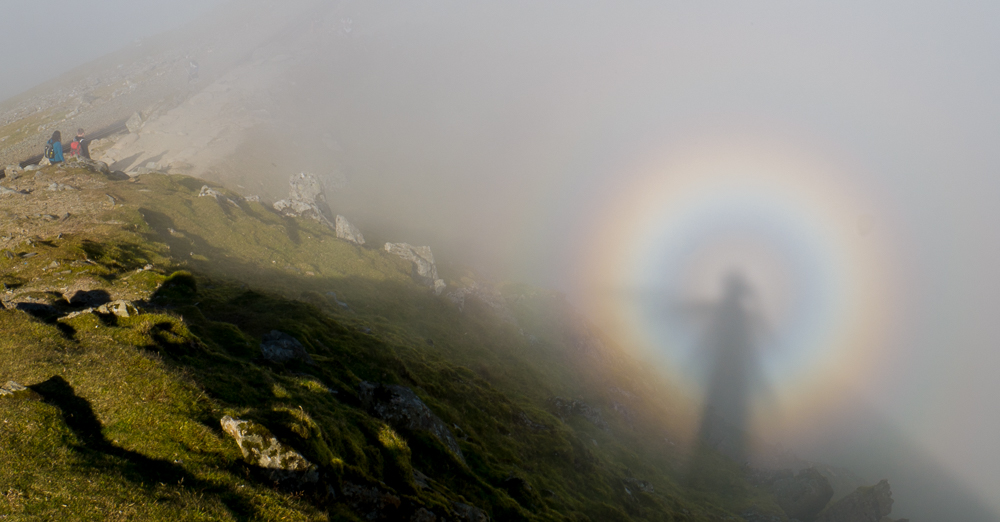
Brocken Spectre, Snowdon summit.

I grabbed a quick vat of tea from the café and assessed the possibilities. I was a little disappointed about the extent of the cloud but these were ideal conditions for seeing a Brocken Spectre. I walked around the summit area to find the best location and for an hour or so one was visible intermittently as my shadow was projected on to cloud below. The shadow itself was astonishingly three-dimensional as it fell on to countless tiny individual water droplets. The Spectre – or Glory – takes the form of a small circular spectrum of light centred on one’s own head.  It has all the colours of the rainbow, and is, in fact, formed in a similar way, with violet on the inside and red on the outside.  At times, the colours in the Glory just glowed. I have enhanced the colours slightly in the image above but it still retains a close link with reality. And interestingly, if one enhances it further, additional concentric rings of colour can be seen outside the primary spectrum.

For a while it was truly glorious up on the summit. It was warm and there was barely a breath of wind, just enough to cause the cloud to drift slowly around. A continuous stream of people were arriving by mid-morning. Every train brought another few dozen, but on such a day far more were doing it on foot. Conversations could easily be overheard. English seemed to be a minority language! Was that Welsh…..? Er….no, probably Polish. A few fully bearded Muslim men had walked up and even a few veiled Muslim women. But it was apparent that few had actually noticed the Brocken Spectre, even if they were only a few feet away from a good viewing point. Occasionally one could hear the magic words being spoken, and it was a pleasure to join these individuals in the experience.

Well, all good things must come to an end. The cloud base was lifting imperceptively until it was clear of the summit by lunch-time. Beneath the cloud it was dull and hazy so it was time to put the camera away and return to Pen-y-Pass. Still the crowds were flooding upwards, though. Little did they realise what they had missed.


Highly Commended image -2015 BWPA awards

Submerged forest with tree stump - Borth/Ynyslas
Submerged forest with tree stump – Borth/Ynyslas

I think it is now safe to announce that one of my images has been Highly Commended in the Coastal and Marine section of the 2015 BWPA competition. It will thus be appearing in the exhibition and book.

One might query whether this constitutes wildlife at all;  the trees have been dead for about 5,000 years! But it is still a fantastically wild place in the right conditions, even if the sand has long ago returned and the tree stumps been hidden again.

For more information on the submerged forest and my experiences taking the photograph, please click here.

In the footsteps of Richard Wilson (and Bill Condry)

Cadair Idris and Llyn Cau

Yesterday I planned an early start to climb Cadair Idris. I woke drowsily. Did I have the energy to “do Cader”? The long drag up  Mynydd Moel was almost vertical, I seemed to remember. The forecast was for sunshine but that is no guarantee of good light. After procrastinating for an hour or so I left the cocoon of my van and felt the cool morning air on my face. I would go for it.

My viewpoint was to be high on the slopes of Mynydd Moel, overlooking the corrie lake of Llyn Cau and the cliffs of Craig Cau which tower vertically over it. The foreground would be gorgeous with heather at this time of year. By the time I arrived the sun would be at right-angles to my angle of vision, allowing my polarising filter to be most effective. I was travelling as light as I possibly could, carrying only enough food, water and spare clothing for the day and my miniscule Panasonic GX7 kit. I left the tripod in the van. Only two hours of climbing lay between me and my destination.

The first half hour took me steeply up rustic stone steps through oak woodland. A mountain torrent tumbled downwards alongside the path. A few years ago I would have done this in one go, pausing only at the gate at the top of the woodland. Yesterday I needed a break every few minutes. At the gate I emerged on to moorland but it was steeper than I remembered. I forked right and crossed the stream. The mountain gradually became more prominent. I had prepared myself mentally for the agony of the final relentless three hundred meters of height gain, so it perhaps wasn’t quite as bad as I had feared. By 10 am I was at my location. Visibility was good but there was no cloud at all to diffuse the sunlight and add texture to the sky.

Over the next two hours I took over thirty images. I’m still new to the GX7 and I sometimes struggled with its controls but it is definitely an improvement on the GX1. The battery lasted just three hours, as it had on its first outing. Pathetic! I found the focal length range of the kit lens (14 – 42 mm or 28 – 84 equivalent) slightly limiting. I’m not a fan of ultra-wide angles but I do like a 24mm lens.  Tiny wispy clouds materialised and disappeared over a couple of minutes, but somehow never quite the right shape or in quite the right place.   Oh, the joys and frustrations of being a landscape photographer! By mid-day, though, I felt confident that I would have something to show for my efforts, and it was with a sense of achievement that I reached the summit of Cadair Idris in time for my picnic lunch. The descent was laborious but uneventful.

Llyn-y-Cau by Richard Wilson, painted in 1774.

That evening I was attending a writing workshop at a bookshop in Machynlleth, where I casually picked up a book – The Mountains of Snowdonia in Art by Peter Bishop. It almost fell open at the page showing the painting Llyn-y-Cau, Cadair Idris, by Richard Wilson (1774),  reproduced above.  To the contemporary viewer it looks astonishingly primitive, but it must have been painted close to the spot I had been earlier in the day.

I recalled that in the book Heart of the Country I had included one of William Condry’s “Guardian Country Diaries” alongside an earlier, and quite different, image I had taken of Craig Cau and Llyn Cau. Bill’s text is extraordinarily perceptive. He had searched for the spot where the artist must have stood to make the painting, but failed to find it. He explains –

“Wilson aimed to represent the scene in only the broadest outlines. For that was the way things were in his day: artists quite happily moved cliffs, woods, waterfalls, even whole mountains a bit to the left or right in order to make the picture more picturesque.”

He goes on –

“If the public has learned to appreciate the wild lonely uplands of the world, it is largely due to painters like Wilson and the travel writers who were his contemporaries. Poor Wilson. His paintings may be worth a fortune now but he died long before his work was widely acclaimed. As someone wrote later: ‘Scarcely half a century has elapsed since death relieved Wilson from the apathy of the critics, the envy of rivals, and the neglect of the tasteless public'”

To my eyes the painting has been cobbled together from three elements. Firstly, the vista from close to my viewpoint; secondly, the grassy dome called Moelfryn, which the artist has placed in front of the lake, although it is actually about half a mile to the south; and thirdly, a large dose of artistic licence. In those days so few people ever visited the Welsh mountains that no-one would have been any the wiser.


More from Cwm Idwal.

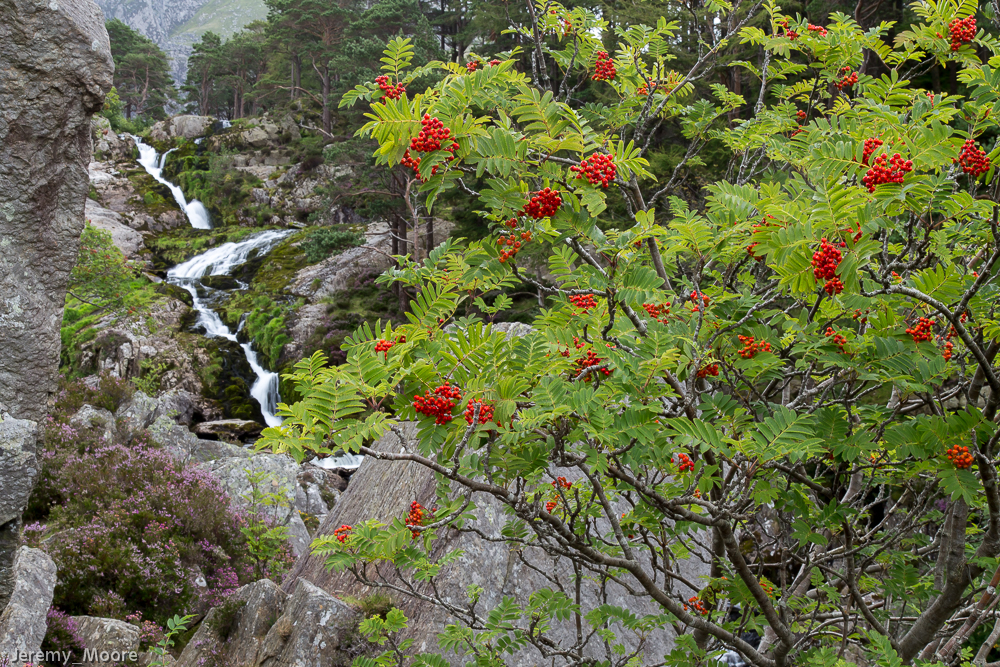
Rowan, Ogwen Cottage

Last week I posted about my eventually successful visit to Cwm Idwal in Snowdonia. But alongside the story of the photographs there was a quite different narrative running in parallel.

On my first visit to the Cwm, amongst the huge boulders below Twll Du, I came across some small brown birds. I quickly twigged that they were twite, which, strangely enough, I had been reading about the previous evening. As far as British birds go they are probably the supreme example of the “little brown job”. Visually there are no distinguishing features at all unless you can see the pale pink rump patch, but they do have a distinctive twanging call, which confirms their identity. At first it was just a couple of birds, then a juvenile begging food from a parent, then a bird leaving a possible nest site and finally a flock of 15 – 20 birds.

On my return to Idwal Cottage I looked around for someone to report my sightings to. There was no-one but a girl from the National Trust, who “thought she had heard of twite” but that was it. While I drank my coffee I noticed the nearby organic burger van, whose owner, Gwyn Thomas, the local farmer, was conversing with customers. My partner has worked with him so I went over for a chat. Eventually I brought up the subject of my  sightings. To my surprise and delight he is quite an authority on twite! Along with several other farmers in Nant Ffrancon he grows a seed crop for them to feed on during the autumn before they move down to the coast for the winter. I’m sometimes not a great admirer of farmers but this man is a star!

During our conversation a car drew up alongside and the driver came over. I recognised him but couldn’t put a name to the face. Gwyn left me with him and a tentative conversation began. I wondered aloud if I had seen him on TV. “No, I work on radio…” he replied. Not really a great help! “I did a book with you!” he added. It came to me in a flash. It was Dei Tomos, the author with whom I had worked on the Welsh version of “Wales at Waters Edge”. I buried my head in my hands in embarrassment! To be fair though, it was hardly a collaboration and we had only met once, and he couldn’t place me at first either.

The social aspect of my weekend continued the following morning. Back at Ogwen Cottage after a third unsuccessful visit to the Cwm, I was drinking coffee by my van. A familiar figure appeared. It was Martin Ashby, owner of Ystwyth Books in Aberystwyth, and one oldest and most valued friends. He was with his mate Nigel Dudley and just about to set off on a long walk up in to the Carneddau. I reluctantly turned down their invitation to join them.

On my return home I reported my twite records to the BTO Officer for Wales, Kelvin Jones. He told me that twite are declining steeply in Wales, and there is a project going to try to reverse this. Apart from the feeding project mentioned above birds are being ringed on the coast in winter in the hope that sightings in summer of ringed birds can reveal more about their movements. Although I had not seen any rings it seems my sightings had been the first this summer! The rarest breeding bird in Wales may actually now be twite, he said. (Does that make them rarer than osprey,  I wonder……)

Just a note on the photograph above. While dull, cloudy conditions are usually the kiss of death for most “big” landscapes, they can be ideal for details within the landscape. This lovely rowan tree was just below Ogwen Cottage.

To read more about Gwyn Thomas and his work in Cwm Idwal, click here.


To follow Tales from Wild Wales, scroll down to the bottom and click Follow


A weekend at Cwm Idwal

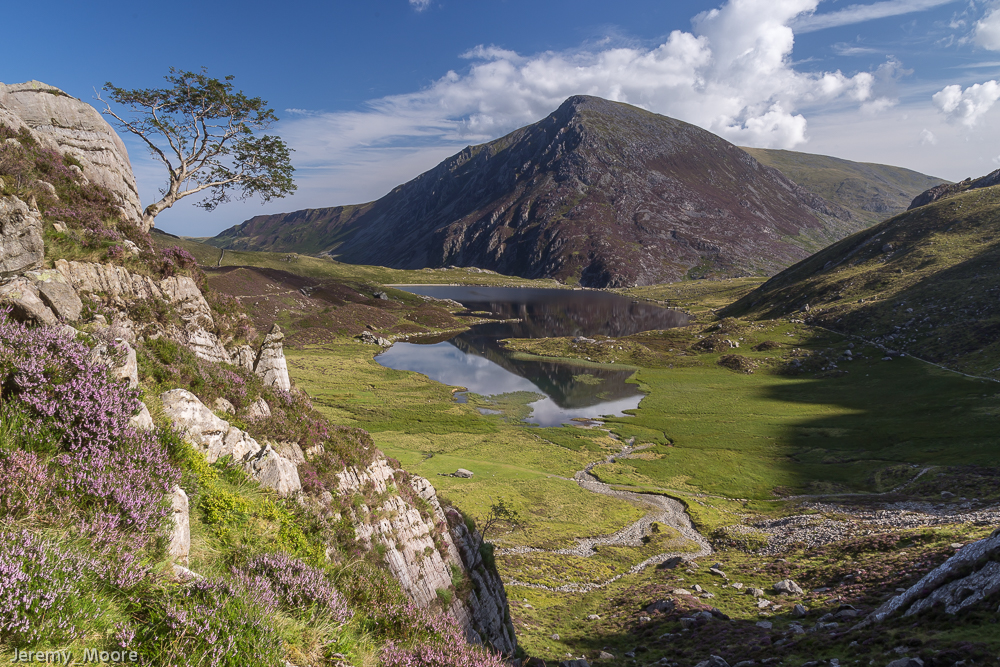
Pen Yr Ole Wen and Llyn Idwal

I’ve been in the photographic doldrums for a few weeks now. It seems to happen most years during mid-summer when I’m pretty busy getting stuff out into shops and creative activities tend to take a back seat. But last weekend the forecast seemed promising – sunny intervals rather than wall-to-wall sunshine – and I decided to head up to Snowdonia. I had it in mind to try out my new Panasonic gx7 and maybe do a mountain walk into the Glyderau or on to Snowdon. Early on Saturday morning I headed up into Cwm Idwal with the option of going on to the tops but conditions were really not pleasant. It was windy and cold with plenty of cloud cover. I can’t say that me and the gx7 got on like a house on fire. I hated the menu system on the gx1 and the gx7 does seem better in this respect. But it’s still not an SLR! I got a few decent images when the sun briefly shone. But after using it intermittently for about 3 hours, and taking about fourty shots, I noticed the battery power was practically down to zero. This wasn’t right at all! I spent a while looking for locations to re-visit later on, and then it was back down to the van to wait out the middle hours of the day.

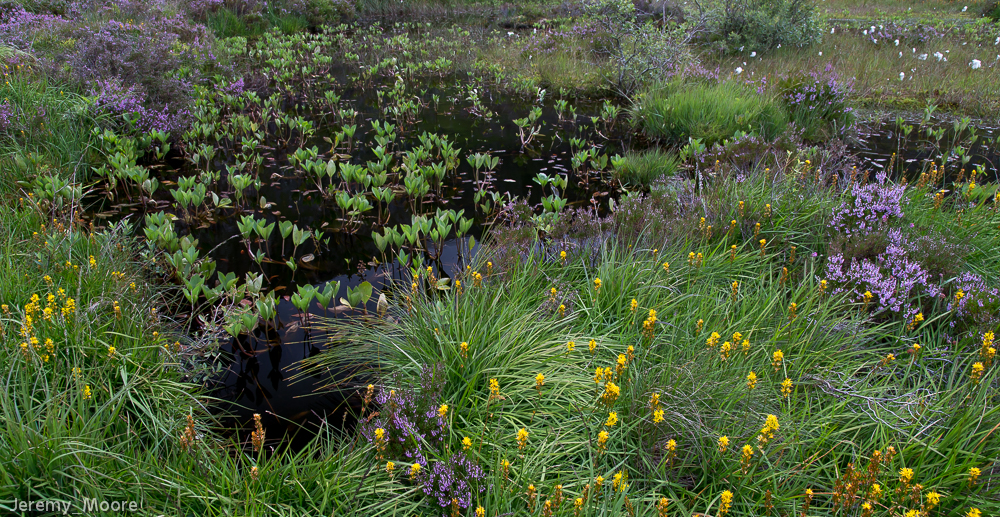
Bog pool, Cwm idwal
Bog pool, Cwm idwal

Cwm Idwal is a National Nature Reserve and location of many of Snowdonia’s rare arctic-alpine plant species. Sheep have been largely excluded for some years now to allow the flora to recover from the accumulated effects of countless nibbling teeth. I was very pleasantly surprised by how extensively the heather has regenerated and it was in full colourful bloom. In some ways mid-August is my favourite time of year for exactly this reason. Swathes of purple calluna are such a sensuous experience; a feast for both the eyes and the lens, and somehow more than that as well. So later on, under full cloud cover, I took my full DSLR kit up into the cwm and spent some time taking close-ups of a boggy pool and its surroundings, just heaving with wild flowers. Then it was over to the spot I had located earlier which gave a view over to Pen Yr Ole Wen. In still conditions this mountainous backdrop would be reflected in the lake. What made my location particularly special was that I could also include a gnarly old mountain ash tree, apparently growing out of bare rock, in the foreground.  Unfortunately the weather was not playing ball. I made a few images, but could see that much more exciting things would be possible in better light. The next morning I was up there again and the following evening as well! Conditions were still and vast hordes of midges appeared, more than I’ve ever known anywhere in Wales.

Monday morning dawned more clear and after a quick whizz round to Llynnau Mymbyr (Capel Curig) I decided to return to Cwm Idwal for one more try at the image I had envisaged two days earlier. I set off full of confidence and with a light step. It’s funny how a 5kg pack feels like 2kg in such a situation but more like 15 at the end of an unsuccessful day. I had reached my spot by 9 a.m. but the sun had not yet come over the ridge of Glyder Fach. Surely it couldn’t be long?  The edge of the mountain’s shadow slowly crept down the heathery rock-face on the left-hand side until all was illuminated. My moment came at 9.50 a.m. A few minutes later I had a selection of shots and the sun had become obstructed by spreading and developing cumulus cloud. It had all gone so well! And only on my fifth visit………

So why does this image work?

Firstly I am so thrilled by the location; the rowan was a real bonus. It is probably one of only two in the Cwm – the result of many years of sheep grazing.

Secondly my angle of vision is exactly at right angles to the sun’s rays and my polariser is at its most effective. Any uneven polarisation is partly masked by what cloud there is. (I also used a 1-stop ND grad to balance the exposure)

Thirdly, the heather is in bloom. Only for a couple of weeks in the year would that be the case.

Fourth, there is no wind to disturb the surface of the lake and a full reflection is visible.

On the other hand, it gives such a benign impression of Llyn Idwal and its surroundings. Conditions would rarely be so amiable. So there’s definitely the place for an alternative interpretation of the location.  I’ll be back.

If anyone is in the mid-Wales area next week I’ll be giving the annual Halstatt Lecture at MOMA Wales, Machynlleth on Wednesday 26th at 1 pm. I’ll be talking about how I became a birder and a photographer, and finally both!

Tickets are £6.00. Phone 01654 703355 for more details.

My exhibition Bird/land is showing there until September 19th. Entry free of charge.

To follow Tales from Wild Wales scroll right down to the bottom and click Follow.


Digging in to the memory banks (part two)

Peregrine eyass, Cumbria, summer 1982

Following on from my season on Mull (see previous post), I spent spring and summer of 1982 in Cumbria. I was a kind of roving species protection warden-come-survey worker, undertaking various raptor-related tasks. Although most birds of prey do very little most of the time – even during the breeding season – taking part in a 24-hour watch at a nest site is still a rewarding activity.  There is always the chance of seeing some previously unknown behaviour. At one cliff I noted a male peregrine at the eyrie being harassed repeatedly by a jay. The peregrine took no notice. At another I saw the well-grown eyass (peregrine youngster) being physically knocked off its nesting ledge by one of its parents. Adults do tempt fully-grown eyasses off the nest by carrying food in front of them, but this seemed a little bit extreme! Obviously not ready to fly, the juvenile tumbled down the cliff-face, then the scree slope beneath it and disappeared. A search party consisting of myself and some local ornithologists eventually found it, apparently quite well, deep in some bracken below the cliff (see pic above). Even at the tender age of six weeks, a peregrine is such a beautiful creature. There’s just something about those eyes……..

During 1983 – 84 I had what could be described as a “proper job”, working as, in effect, the first coastal footpath officer for Ceredigion. But I then began another long break from real work by spending late April – early August in the arctic on the Greenland White-fronted Goose Study 1984 expedition. The membership otherwise consisted mainly of ambitious young biology, zoology or environmental science graduates.  Although I had been through university and come out at the other end with a BSc, I had also gained a healthy ( I believe) scepticism about the scientific method.  I was also far more interested in the gyr and peregrine falcons found in the GWGS study area, which didn’t go down too well either! So I can’t claim to have been the most popular member of the expedition. But I actually managed to get a paper published in an American Raptor Research journal on my return to civilisation.

The homesickness I felt during every one of my summers with the RSPB was even more acute on the expedition.  The lyrics of the Robert Wyatt song “Moon in June” reverberated though my head over and over again during the dry Greenlandic summer.

“Ah but I miss the rain,

ticky, tacky, ticky,

and I wish that I were home again,

back home again, home again,

back home again…….”

Probably every expedition needs a scapegoat and I guess I was it. Helicopters frequently trundled over the study area and there were times when I longed for one to just pick me up and take me away.

Great northern diver, west Greenland, summer 1984.

However I had borrowed a long telephoto lens from my father and for the first time did some serious-ish bird photography. Much to the disgust of the expedition leader I set up a portable hide by the side of a lake where a pair of great northern divers was holding territory. I spent one full night in the hide, drifting into and out of dreamland as the eerie and evocative wailing calls of the divers echoed around me. It really was most surreal. The photographs I took there were technically very poor, unfortunately, but I can see quite clearly that what I was aiming for then was exactly what, thirty years later, I would be producing for  Bird/land. Birds in the landscape.

The same could be said for many of the other bird images I managed in Greenland and elsewhere during these early years. I have cropped a great northern diver image to panoramic format to illustrate this.

On return from Greenland I continued in the routine of field work during the summer, travelling and “resting” during the winter. I worked in central Scotland and north Wales during the following two summers. But it became more and more apparent that I was never going to get a “real job” in the world of conservation. I badly needed a means of earning a living that would sustain me for a period of years. Not shy of a challenge, I decided to become a photographer…….

The Halstatt lecture is at 1 p.m. on August 26th at MOMA Wales, Machynlleth, Powys. Tickets are £6.00 each. Call 01654 703355 for more details.

To follow Tales from Wild Wales, please scroll right down to the bottom and click Follow .


Digging in to the memory banks (part one)

Golden eaglet, Isle of Mull, summer 1981


To coincide with the Bird/land exhibition, I’ve been invited to give the annual Halstatt lecture at MOMA as part of the Machynlleth Festival. Rather than just running through a series of images from the exhibition this talk will have quite a strong personal content. The fee is reasonably generous so I have the time and opportunity to look back over my career as a photographer. I often wonder how the most minute details of people’s lives can be recalled by those engaged in writing their autobiographies. How can conversations be remembered if they took place decades ago? Perhaps authors keep a diary on the offchance that it might be needed or maybe there’s a liberal dash of artistic licence involved? But photographs can certainly help and I’ve been delving back into my slide collection and memory banks to see what I can find.

My first encounter with a camera came when my father gave me one of his old ones. I was about 14 and rushed around Britain taking pictures of the last steam trains in the couple of years before they were pensioned off. I even did a little developing and printing in the school darkroom until it was demolished. But I’m going to skip the very early years and move on to the late 1970’s after I moved to rural Wales. I was developing a keen interest in both wildlife and photography and North Ceredigion was a wonderful place to find myself. I was looking for a career in wildlife conservation and despite knowing very little about birds got a species protection job with the RSPB in 1979. I was sent to a remote part of north Wales where I was expected to watch two separate peregrine eyries about three miles apart which were annually robbed by falconers. I had hoped to be able to watch peregrines at close quarters but in fact spent most of the time cruising around the local roads looking for suspicious visitors. Police training would have been handy!

It was not really a success. I have two lasting memories of my couple of months there. Firstly managing to mentally construct a human figure on a ledge close to the eyrie half way up a cliff-face when in fact it was a jumble of rocks. I don’t think the local bobby was amused when he arrived. Or maybe he actually found it hilarious – bloody amateurs! Secondly I recall striking up a conversation, for some unknown reason, with a stranger who had just parked his car in a layby and was setting out for a walk. “Yes, I’m working for the RSPB” I happily told him. I suppose it was a bit odd when he returned quickly to his car and sped off. Back at base I discovered his car number plate on a list of those belonging to known nest-robbers. Later I did get to grips with another dodgy group of characters but I think by that time the peregrines had failed anyway.

As a result of my incompetence and obvious lack of knowledge about birds it took another couple of years before I worked for the RSPB again. But this time, in 1981, I suppose it was a really plum job – to spend the summer on Mull and check the island out for breeding white-tailed eagles. A group had wintered there but most were probably too young to start a serious breeding attempt. Once this had been established I turned my attention to the island’s peregrines, and then moved on to survey the whole of Mull for golden eagles. One imagines these wary birds nesting on the most inaccessible precipices but in fact, where there is a high density of them, they will build a nest on any tiny little outcrop or rocky stream side. It was quite an eye-opener! One of the classic texts on golden eagles was written by Seton Gordon during his stay on Mull and he photographed an eyrie there containing three large eaglets. I was able to clamber up to the same ledge where a pair of goldies was rearing just the one youngster in 1981. It was a rather placid creature despite its enormous size. See the picture above.

It might sound idyllic but there were many disadvantages. There is always the danger of accidents when one is tramping the hills alone. Scrambling along a crumbling line of inland cliffs I slipped and pulled a large rock down on to my head. Despite bleeding profusely I had to get myself to the local cottage hospital to be stitched up. It was a long walk over rough moorland and then a ten-mile drive to get there. I also managed to upset the local landowner network which did not go down well with RSPB HQ! I had been told by a Forestry Commission worker of a golden eagle pair whose nest had fallen out of an oak tree in a forestry plantation. The adults were rearing the eaglet on the ground and had rebuilt the nest around it. I just had to see this! Well, it was my job…….

As I entered the area through tall deer-proof forestry gates I came across a group of people coming the other way. I told them it was illegal to disturb Schedule One bird species at the nest without a licence. A very frosty conversation ensued. When I returned to my digs my landlord (a large landowner) told me that I had actually been on private forestry land. The people I questioned were the landowner and his pals and they were not amused. The island phone lines must have been buzzing that afternoon and from that moment onwards I was persona non grata on most of Mull!

The Halstatt lecture is at 1 p.m. on August 26th at MOMA Wales, Machynlleth, Powys. Tickets are £6.00 each. Call 01654 703355 for more details.

To follow Tales from Wild Wales, please scroll right to the bottom and click Follow.
An intimate and a distant encounter.

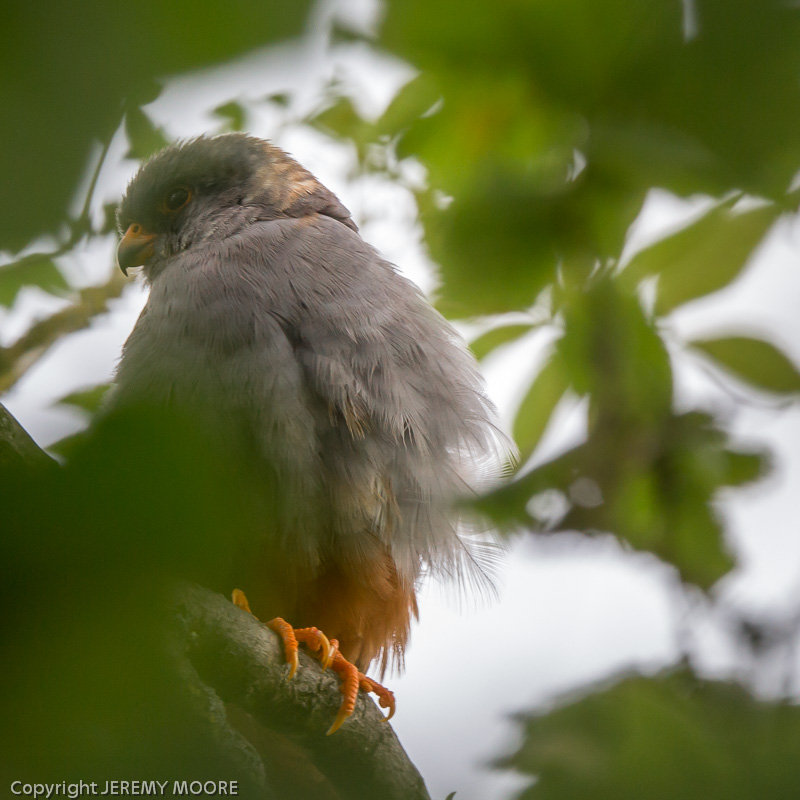
Red-footed falcon, north Staffs.

While I sometimes feel pangs of envy (…or is it lust….?) on hearing about the presence of a rare bird, I would not admit to being a twitcher. There is something rather desperate in the idea of travelling miles (or hundreds of miles) to try to see a bird which was originally found by somebody else and put out on the birders’ grapevine. I’ve sometimes described myself as the worst twitcher in the world, anyway, because on the rare occasions I’ve succumbed to temptation, the bird has usually disappeared by the time I arrive. I can justifiably claim to have been the first person not to see the great spotted cuckoo at Tenby in February 2014 because I waited too long to go down. It had probably died or been blown away during the particularly stormy day of my journey.  To fail in a pointless quest is particularly soul-destroying, I find. But if a bird is on my local patch I might eventually get round to having a quick look, sometimes successfully, sometimes not. A local bird would involve little time investment, or travel expenses or carbon emissions.

I was tempted last week, though. A red-footed falcon had been reported in Staffordshire, well over a hundred miles from here. However, a visit to my aging mother was long overdue, and she lives ……. in Staffordshire. I do like multi-purpose journeys! So Saturday morning found me on the northern outskirts of the Potteries joining a few dozen other birders staring at a red-footed falcon on an overhead electricity cable. It was hardly the most difficult twitch in the world. The click of motor-driven shutters rang out. _04A2298Being an immature male it would not be breeding this year; but one has to wonder why ever would this bird end up in north Staffordshire? It probably should have been somewhere in eastern Europe. Itcould conceivably have been escape from captivity but the only known captive red-footed falcon locally was an adult male in a rescue centre about twenty miles away. Whatever – in birder’s parlance it was “performing well” – perching on the cable in full view, searching for insects on the ground below. There was a strong breeze blowing, though, and, probably seeking shelter,  it later spent some time in a hazel bush just a few feet from the pavement on which expectant birders waited. It was so close that I had to take a few steps backwards before I could focus down on it with my binoculars. However a shield of branches and leaves made it difficult to see more than face or feet at any one time. It was an both intimate and distant encounter at the same time.

As far as the main image is concerned the bird was by no means at its closest here. I feel that the green background  sets off its plumage better than the grey sky did, however. And as for the composition, I suppose I just like to be different! Any thoughts on this?

To read more Tales from Wild Wales as they are published, please click the blue Follow button.

Bird/land

Jeremy Moore birdland 40 - oystercatchers 2 (small)

One afternoon last winter I felt a moment of panic. I was reviewing work in progress on my exhibition  – Bird/land – and realised I had broken the back of it.  There would soon come a time when it was complete.

Now, six months later, it really is ready. Since my return from France in early May I managed to get a picture of ringed plovers at Ynyslas which, combined with four other wader images, makes a nice set of five ( a quintych, perhaps?). A couple of days later it was a real bonus to find a pair of oystercatchers with a nest about three yards from a hide at Ynyshir (see above). I’ve also spent many, many hours patiently checking and adjusting every image (more than 100 of them) individually. Within each of the thirty-five works the ground colour of the images need to match. So much time spent sitting at my desk when I would rather have been outside……..

Last week I went over to St Harmon near Rhayader where Andrew Jackson is printing and framing the exhibition for me. I was very happy with most of them and he kindly agreed to reprint a few which weren’t quite up to my rigourous (and probably quite arbitrary) standards. I picked them up yesterday and they will be delivered to the gallery on Monday morning in time to be hung for the exhibition opening on Saturday June 27th. For background on the project see this post.

Bird/land consists of 35 works, many of them triptychs, in which birds and their surroundings are both integral to the               images. Within each work, the images are linked by species, location, or aesthetic considerations, or sometimes all three. Each image is in panoramic format. There are also two single images.

Subject matter extends from house sparrows at a National Trust teashop to migrant dotterel on a Welsh mountain-top. In this way Jeremy Moore explores his twin passions for wildlife and landscape in every photograph.

For each work sold a donation will be made towards the reconstruction of the hides at the RSPB’s Snettisham reserve in Norfolk, which were destroyed by the storm surge in December 2013.

Bird/land is at MOMA Wales, Machynlleth, Powys, from Saturday June 27th until September 19th 2015.

Jeremy Moore will be giving the annual Halstatt lecture at MOMA during the Machynlleth Festival on Wednesday August 26th.

Bird/land has been supported by the Arts Council of Wales.

I’ve added some of the works to my website, so log into that to see them and click on the Bird/land gallery. Or click on this link .

Why the panic that I experienced over the winter, then?  Not happy just to get the thing over and done with? As a photographer I thrive while I am working on a specific project. It gives me the impetus to keep moving forward. In years gone by I was happy just to be exploring the world with my camera, but there’s no doubt that with age and experience that inner drive fades away. So will there be a huge gap in my life? You bet there will be.

To follow Tales from Wild Wales, scroll right down to the bottom of the page and click Follow

Every picture tells a story.

Purple heron : what an amazing creature!

I can’t have been the only photographer to have recently received junk email offering…..”Always have amazing skies!”. It goes on –

With the killer App for Sky Replacement and our new Skies and Clouds Collections

With […………..] sky replacement is no longer like Rocket Science

Add Skies III and our amazing new Drag and Drop Cloud Formations and the skies the limit on creativity!”

Two New Bundles to SAVE on so you’ll never have Dull Skies Again

It goes on and on in this vein.  I find it terribly depressing. The graphic designer could thus, for example, adapt a poor quality landscape image by adding a sky downloaded from a software package. No photographic skills required whatsoever! Likewise the amateur (or professional) landscape photographer wanting short-cuts to dramatic photographs. It has until recently been difficult to incorporate stunning skies into landscape images without stunning skies being present in reality. Doing so in the days of colour film would have involved a very high level of printing skills indeed and it is probably fairly safe to say that it had rarely been done successfully. In the brave new world of digital photography much of the work involved has been already been done by the software designer.

But this kind of approach does more than make life easier for those wanting short cuts to great landscape images. It devalues photography in its most basic sense. By its very nature a photograph has documentary qualities. I don’t mean to confuse “landscape photography” with “documentary photography” here. But a photograph – any photograph – is an interpretation of a slice of reality. It is rooted in what the photographer saw through his/her viewfinder. So a landscape photograph automatically has documentary values. The very best have both aesthetic and documentary qualities in shed loads. If the photographer has added a spectacular sky – even one of their own – that link between reality and image has been lost.

Many photographers argue that all photographs are “fake” to some extent and that therefore anything goes. In my opinion this just does not hold water. I agree that the photographer makes selections and interpretations at all stages of the process. They might use film or digital, a jpeg straight out of the camera or process a RAW file to their own satisfaction. They might use a 10stop ND filter on their DSLR, a smartphone or a pinhole camera, colour or black-and-white. By making these choices the photographer interprets their surroundings in different ways. But there is a quantum leap between that and getting a sky from elsewhere – their own library  or a software program – to combine with their own image to produce a result.

If it were possible (and necessary) the photographer would physically move a minor irritant (rubbish, for example) from the foreground of a landscape image before pressing the shutter. But if not I don’t really see a problem in cloning it out at the processing stage. I’m not that much of a purist. But it is at this point we enter a very grey area indeed. Where does one draw the line between “processing” and “manipulation” – the acceptable and the unacceptable? Personally I’m happy to clone out anything which on another day might not have been there: a walker in a red cagoule, or white van in the distance, for example. Others draw the line elsewhere. But there is a line. It may well be that advertising photography is artificial through and through, and maybe we should expect that. If there was a line of telegraph poles running through a landscape, though,  I badly need and want to know about it. Every picture tells a story and a manipulated one can tell quite a different story. It could be the difference between a real wilderness and an inhabited landscape in this example.

For more thoughts on this subject see this post.

On the other hand I have no philosophical problem with improving my images at the processing stage where necessary. The more I use Lightroom the more I learn what it is capable of. I was recently introduced to the adjustment brush by my correspondent David Clegg and how useful is that? How could I have managed without it, more like! During the latter stages of my Bird/land project I was able to use the adjustment brush (rather than the radial filter) to select the bird before making minor changes to its exposure or contrast, for example.  So much more effective! See the purple heron image above.

More on Bird/land very shortly, by the way……..


To follow Tales from Wild Wales please scroll right to the bottom and click Follow