It was a few minutes’ drive inland to my next location, a hilltop overlooking the Dyfi valley near Derwenlas. I knew from numerous previous visits (see this post) that it would be mid-morning before the sun would be where I wanted it. A heavy shower moved inland on my arrival, creating another fine rainbow. Light was still good half an hour later despite the sun’s relentless rising, and I got the shot I had come for; would it be suitable for a new postcard, I wondered? See the upper picture of the pair below.
A couple of days later I decided to have another go at both the Glandyfi and Derwenlas viewpoints. Still conditions were forecast overnight and hence the formation of valley fog was possible. It was a very different morning to my previous visit. At Derwenlas all was gloomy low cloud but at Glandyfi a river of fog flowed continuously down towards the sea. Over about ninety minutes I took a number of images, but it was when the “river” began thinning and receding inland that I felt the best results were obtained (see above). It was an interesting contrast to the scene two days earlier (see previous post).
Dyfi valley, near Machynlleth (first visit)Dyfi valley, near Machynlleth (second visit)
Then it was back to the Derwenlas viewpoint. It was still like being inside a bundle of cotton wool when I arrived, but after a few minutes the cloud cleared entirely, revealing the gorgeously-lit Dyfi valley complete with a necklace of cloud draped around the hillside above Machynlleth. If this doesn’t work as a postcard, I’ll eat my hat!
As a postscript I have just sent a cheque for £70 to the charity Rewilding Britain (click for more info). This is a donation per work sold at the Aberystwyth showing of my Bird/land exhibition.
To follow Tales from Wild Wales, please scroll to the bottom and click Follow.
En route to Machynlleth the trunk road from Aberystwyth to north Wales, along with the railway line, is squeezed between the Dyfi estuary and its wooded slopes. Until a few years ago the road was narrow and winding with the occasional gridlock occuring if two large vehicles met there. There’s no doubt that the “Glandyfi Bends” needed improvement to improve journey times. Costs were orginally estimated at £10 million, but there must have been a bottomless purse for this project; a total of £18m was apparently spent altogether. The result is a smoothly curving, two-lane carriageway with excellent visibility. So what did the Highways Authority do? Slap a 40 mph speed limit on the new section of road and extend it all the way back to the village of Eglwysfach. Improve journey times my ****!
Like all trunk road improvements in Wales it is over-designed and over-engineered. There is a one-way lay-by for motorists driving northwards; access from the north or exit to the south is forbidden. On the lay-by there is a lay-by. Would you believe it! Oh yes, there’s a picnic table on a mound. The wall alongside the main road is too high over most of its distance for car drivers or passengers to enjoy the stunning views across the estuary. But the most prominent of all is the retaining wall to hold the hillside back. This massive construction is known locally as the Great Wall of Glandyfi. It can be viewed most conveniently from the north side of the river – in fact it is very hard to miss it for miles around.
There is a silver lining for the photographer, however. There is a narrow walk-way, fenced off for safety, along the top of the wall, which gives fabulous panoramic views across the estuary to the southern hills of the Snowdonia National Park. An access gate is half-heartedly padlocked at the eastern end. On the last day of September I headed up to Glandyfi on a morning when torrential downpours alternated with strong sunny intervals; ideal conditions for the photographer with good waterproof clothing! On arrival I prepared my gear in the van while it absolutely hammered down outside. The downpour moved over quickly and a brilliant rainbow appeared over the estuary. I quickly accessed the walk-way, set up the tripod and began taking pictures.
Rainbows are never easy. They are almost always unpredictable and may only last a couple of minutes. It is almost always raining and this plays havoc with one’s equipment. Filters are particularly vulnerable to wetting. As I wiped raindrops from one side of my 2 stop ND grad, a fresh crop appeared on the other side. This was just silly! Landscape photographers are sometimes advised that a polariser should be used to intensify the colours of a rainbow but I have never found this to be the case. You can easily completely remove a rainbow with a polariser but who would want to? Over a period of five minutes and despite rather feverish picture-taking, I had some rather excellent rainbow images in the can, such as the one above.
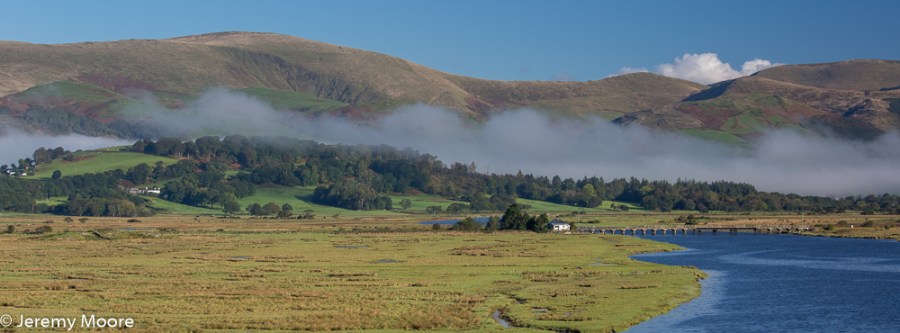
Bridge over the River Dyfi
When planning my landscape photography destinations I always take into account the time of day of the visit and hence where the sun will be. A polariser is always most effective at right-angles to the sun, while that rare thing, a rainbow, always appears opposite the sun. I can think of one location on the Mawddach estuary where you can use a polariser to your heart’s content but still be open to the possibility of a good rainbow image. The Great Wall of Glandyfi is another. Following the disappearance of the rainbow I swung around by ninety degrees and captured some images of saltmarsh, the railway bridge over the Dyfi and its accompanying solitary white cottage, in brilliant sunshine. The hills of southern Snowdonia were still in deep darkness and low cloud swept their summits. I used the polariser and the 2 stop ND grad to add to the drama of the scene. I felt that the resulting image worked well in a panoramic format.
It might seem that I was lucky that morning but I had already made several frustrating visits to the area with no worthwhile results. What I was quickly able to do on September 30th was get to the best spot quickly and take advantage of great conditions when they finally did appear. I’d been up there for about two hours – how time flies sometimes – when I heard the sound of chain-saws. Down on the main road maintenance men were removing branches from the vicinity of some electric cables. It soon became apparent, though, that a man with a chainsaw was also clearing branches from the walk-way upon which I was standing, and approaching quite fast. It was time to beat a hasty retreat!
To follow Tales from Wild Wales please scroll right down to the vottom and click Follow
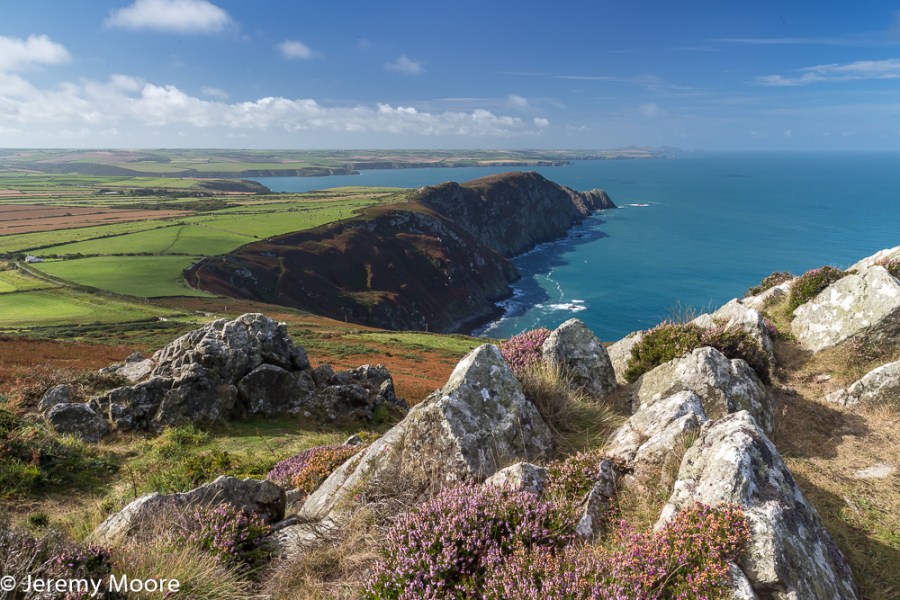
St David’s Head (in the far distance) from Garn Fawr.
One evening about ten days ago I headed down to Pembrokeshire. Postcards are still selling well down there and I need to renew a couple of cards for next season. One card in particular had sold out, a view of Strumble Head lighthouse from the mainland. I hoped that the heather would still be in flower so that it could appear in the foreground of the picture. Conditions for my journey down were poor but a clearance to sunshine was forecast for the following morning. I spent the night in my camper van on the car park just below Garn Fawr. This is a rocky 200 metre hilltop, complete with hill fort, on Pen Caer, the peninsula upon which Strumble Head is the northern-most point.
By 8.30 a.m the following day it was indeed clear and sunny. I walked the short distance up to the summit of Garn Fawr. It is a stunning viewpoint with 360 degree views across north Pembrokeshire, notably down the coast to St. David’s Head. It should have been perfect for photography, but it wasn’t. There was a murkiness in the air, possibly a legacy of the previous night’s rain, and the sky was cloudless – blue but uninteresting. After a few minutes I returned to the van. There was no point in even pressing the shutter when I knew that the results would not equal those I had achieved on previous visits. I brewed up some coffee and compared notes with another campervan driver who had recently arrived. I decided on a different walk nearby, and rather lazily drove the couple of miles to its starting point.
By this time it was about 10.30 am. I normally have a cut-off point of about 10 a.m. in summer, after which I feel that the sun is too high for successful landscapes. It’s all part of a process, of course, but shadows become insignificant and the light tends to become too harsh. But by this time some attractive clouds had begun forming and the air did appear to be sharper. So I decided to head back up to the summit of Garn Fawr instead. I could still walk from my new parking place although it would be a longer and steeper climb. One might prefer the sun to have been lower but I think you’ll agree from the picture above that it was worth it, though. And so one single, ten-minute picture-taking session made over a period of five hours was all that was needed for a successful morning’s photography.
Later that day a bank of thick cirrus cloud edged in from the north-west, gradually obscuring the sun. I walked along the coast path to the location for the lighthouse image I had in mind, but it was too late – the sun had gone. And the heather on the cliff-top was over – no longer the luscious pinky-purple that I love but brown. It was all a bit dispiriting. I returned to the van and buried myself in a book. I would have another go the following day.
Strumble Head lighthouse, Pembrokeshire.
The next morning I awoke before dawn and turned the radio on, just in time for the 5.30 a.m. weather forecast. Ever heard it? I thought not! The forecaster described the same band of cloud and, very unusually, added that there could be a good sunrise. I hadn’t thought of that! The Pen Caer section of the Pembrokeshire coast runs roughly west > east so the lighthouse might be set against a pink sunrise from my viewpoint. I gulped down a mug of tea and drove down to Strumble Head ; then there was the fifteen-minute walk! The sky was brightening and wispy cirrus pinking up quickly. But I made it. I took a series of images in the hope that one would include the lighthouse beam. A glance at the camera’s monitor was enough to tell me that I’d been successful. What a bonus! There was a real spring in my step as I walked back to the van.
The cirrus that had provided the focus of my sunrise picture proved to be a bit of a downer for the rest of the morning, however. More often than not the sun was behind it, which had the effect of casting a veil over the light on the landscape. It was the end of picture-taking for the day and I was back home by mid-morning. I had been away for 40 hours and during that time had actually had the camera in hand for 20 minutes. And yet I felt it had been a successful trip. Such is the life of the landscape photographer: you wait around and then you wait around some more. And if you’re lucky…….
To follow Tales from Wild Wales, scroll down to the bottom and click Follow.
These are exciting times as my exhibition Bird/land opens at Aberystwyth Arts Centre. It’s in the Photography Gallery (Gallery 2) on the top floor and is showing until August 27th. Opening hours are as follows:
It’s an expanded version of the original exhibition, with eight new small single images and nine new triptychs. I must say it looks very tasteful in there. So if you’re in mid-Wales in the next couple months do drop in and have a look around!
I’ll be giving a talk in the Arts Centre’s cinema at 5.30 pm on Thursday July 14th. Entry is free of charge.
For a sneak preview of the work, go to my website and click on the Bird/land gallery, or click on this link.
For background to the exhibition click here to link to my Blog.
To follow Tales from Wild Wales please scroll right down to the bottom and click Follow
Ramsey Island (on left) and the Bishops and Clerks, from Whitesands.
It has been a while since I last posted but things have been moving apace. Most of February and March was spent getting postcards out into shops in various parts of Wales. It is always difficult to drag oneself out of the semi-hibernation of mid-winter and this year was particularly fraught because Easter was so early.
It has to be admitted that sales of postcards are steadily declining. This is partly because people are using phones and Facebook to contact their friends while they are away but also because the number of potential outlets is declining rapidly. The perils of running a bookshop in the Amazon era are well recognised, but independent retailers of all kinds have been closing and are not being replaced in similar numbers. What is particularly sad is the number of Tourist Information Centres that have closed, will soon close or are under threat of closure. It is happening all over Wales as a result of cuts to local authority funding. It may be our local councils (and National Park authorities) that are having to make the difficult decision to close them but the root cause is central Government.
A selling trip that would until recently have taken two and a half days now takes two or less. But that does mean I have a little more time available for photography on these trips and I was lucky with the weather on some of them. After one particularly busy day in Pembrokeshire I was able to nip down to Whitesands, arriving just after sunset. I started a short high-tide walk along the beach but quickly ran back for the camera. The conditions were just stunning! I only had a few minutes to run off a few exposures and I wasn’t entirely happy with the composition in any of them. But I’ll settle for the above…….
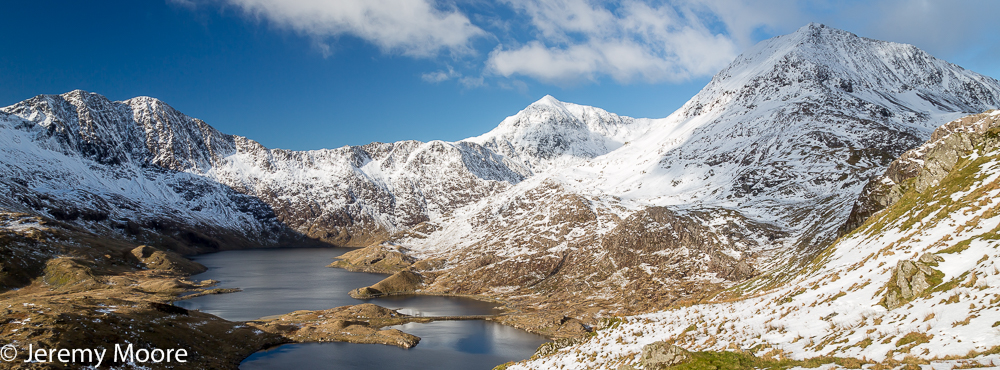
On a trip up to north Wales I spent one night at Pen-y-pass YHA. I normally avoid youth hostels these days but Pen-y-pass is so well situated for an early morning walk in the foothills of Snowdon that in winter I occasionally make an exception. Unfortunately my dorm also contained a snorer so I had a disturbed night’s sleep and was not able to get up at the crack of dawn as I had hoped. But a little later on this was the view of the Snowdon horseshoe from “The Horns”, situated between the PyG and Miners’ paths.
Y Lliwedd, Yr Wyddfa and Crib Goch from “The Horns”
I was able to devote the whole of this superb day to photography so then headed off eastwards to photograph the packed masses of waders at their high-tide roost at the Point of Air, near Prestatyn. The only trouble was – there weren’t any. Just a handful of the commonest species. I then spent a couple of hours searching for, and failing to find, my current birding obsession – hawfinches. I won’t broadcast the location because villagers get pretty cheesed off with the behaviour of some birders, but there is a well-known site for this rare and elusive bird in the Conwy valley. So for the second time in one day I assumed I must be driving around in a van with a huge sign, facing upwards, on its roof saying “Bird photographer approaching destination – make a run for it”.
But I had more joy at my final location, the RSPB Conwy reserve at Llandudno Junction. There has been a starling roost there all winter and on my arrival I was pleased to discover they were still around. There was no wind and it looked like there would be a good sunset, so I found a location where I hoped the birds would be silhouetted against a stunning sky. There was even the possibility of a reflection for good measure! Towards sunset small groups of starlings began to arrive, some time later than they do at Aberystwyth. And they just kept on coming! Several sparrowhawks made appearances and made hunting dashes into the flock. The starlings created tightly-packed balls and ribbons of birds to try to evade them. It was fabulous to watch but set against part of the sky which was too dark to allow successfully photography.
It really was a very large flock by the time they eventually disappeared together into the reedbed. It was almost dark by that time and they had been displaying for some forty minutes since the first birds arrived. It was interesting to compare this with their behaviour at Aberystwyth, where they were going to roost some forty-five minutes earlier. I managed this image as the flock swirled over one the reserve’s shallow lagoons.
Starlings in pre-roost display, RSPB Conwy reserve.
I don’t know if it be useable anywhere else but on the web. It was taken at 6.31 pm on March 10th, using pretty extreme settings for this type of subject – 4000 ASA, 1/160th second and f4.
Finally, just before Easter, I installed part of my Bird/land exhibition in the Visitor Centre at RSPB Ynyshir. It will be showing there until May 30th; but for the full Bird/land experience wait until June 25th, when an updated and expanded version will be opening in the Photography Gallery at Aberystwyth Arts Centre. Watch this space for more information.
To follow Tales from Wild Wales, scroll down to the bottom and click Follow.
I cannot remember such a long period when the weather has been so discouraging for the outdoor photographer. Days….. weeks!….. on end of cloud, rain and gales – and today is no exception. I’m shocked to discover that I’ve barely taken a decent photograph since the beginning of October.
But I can’t just blame the weather for that. In my last post I wrote how my priority over the summer was to work on images for new postcards. How one needed to visit the popular locations and somehow come up with something new. I eventually realised I was just going through the motions. I really was re-visiting the same old places and taking the same old photographs.
So as much as the weather really has been disastrous it was a partly a conscious decision to lay the camera down and give myself a break. This happened to me big time about twenty years ago. I put down the break-up of a relationship partly or largely to the fact that I saw myself as a photographer first and a human being second. There certainly were other factors but being an outdoor photographer does involve leading a very unpredictable lifestyle. Whatever…..after a few self-imposed months of keeping the business running and no more – certainly no actual photography – I picked up the reins more or less where I had left them. In my experience one’s creative side continues to develop even if putting it into practice actually takes a back seat for a while. After a few months break from photography I’m sure – well, fairly sure -that I’ll return to it with a bunch of new ideas and attitudes.
I hope it does, because I’ve recently had a very positive discussion with a publisher and author about a new book. There’s still plenty to be finalised, particularly the financial side of things, but I’ve come to the conclusion that my sanity is now more important than my bank balance! So even if it doesn’t pay very well, I’ll still do it.
In a post earlier this year I wrote about how I missed an opportunity to photograph the Northern Lights. Since March I have gained a better understanding of why and how a faint aurora – even an invisible one – can actually produce decent photographs. The reason is this : there are two types of sensor in the eye – cones and rods. The cones are colour sensitive, but the rods, which are 1000 times more sensitive than the cones and far more numerous, do not pick up colour. So our eyes do not perceive colour at low light levels. The sensor in our camera is equally sensitive to colour at low or high intensities so it will record what the eye cannot see.
A couple of evenings ago I received an “Aurora Watch” amber alert. To my surprise yet another cloudy day actually improved to an evening of clear periods and showers. There was quite a powerful moon but the northern skyline looked a bit odd. I couldn’t be sure whether it was a pale glow that I was seeing or some cloud hugging the horizon. I eventually realised that I would have to take some photographs to be sure if the aurora was present or not.
I set the ISO at 3200 and the meter gave a reading of 8 seconds at f4. When viewed on the camera’s LCD screen the first image immediately showed that there were vertical bands of purple in the clear sky which were completely invisible to the naked eye. I took a few more images to confirm it and then called it a day. On viewing the images this afternoon on the PC monitor it became clear that amongst the cloud on the horizon there had also been a green glow. The very localised orange glow on the horizon is usually visible to the naked eye as pale and colourless but the camera’s sensor has picked up its colour; it must be street lighting from a nearby village reflected off low-ish cloud. The image has of course been processed, but not to an excessive level – no more than I would expect on a typical landscape. This had been the real thing and without the camera I would never known!
Technically and artistically it is rather poor. I should have taken more care with placing the tripod and weighing it down, and the telephone pole in the foreground is hardly an attractive feature. But I’m treating it as a learning experience and hopefully there will be an opportunity to do better in the future.
Seasons Greetings to all from a wet and windy Welsh hilltop!
To follow Tales from Wild Wales, scroll down to the bottom and click Follow.
Following the completion of the Bird/land project I realised it was time to step back from bird photography for a while. My bread-and -butter income still comes from the sale of postcards and some of them were beginning to look a bit tired. Rather than reprint them again I decided to spend some time replacing them with new designs. So it was time to put my landscape photographer’s hat on again……
Taking photographs for postcards must be easy…..right? Well, er…..no! Somehow one must be able to sum up a well-known location in just one image, the sense of the place, if you like, and ideally in a way that has not been done before. Take the Brecon Beacons, for example. They may not be the most dramatic mountain range in the UK but they are very popular. I had seen a photograph on a flyer for a holiday cottage rental company showing a former farmhouse idyllically situated in the foreground with the main peaks behind it. It looked like it would be worth searching out the location. When I eventually found it, I couldn’t believe it was the same place. The original photograph appeared to have been taken from well above ground level, and there was a string of electricity cables and phone lines running to the house. It had been photoshopped out of almost all recognition!
Whilst on the lookout for a new viewpoint I’ve spent hours driving and walking around the narrow, high-hedged lines between the Beacons and Brecon. Every so often I would catch a glimpse of the view I wanted through a gap or a gate but on closer inspection there was always a snag. I eventually narrowed it down to a couple of fields, through which no public right of way existed. A friendly farmer gave me permission to cross his land to reach the spot but on the two occasions I was there during the autumn conditions were just not good enough. So that particular view will have to wait for another year. And even then, I have a horrible feeling there will be a snag there too.
What I did find earlier in the year after many hours searching, was a view of the Beacons from the graveyard at Brecon. The image may not have a great deal of merit in an artistic sense but as a postcard it looks like a winner. I’m not sure yet what I’ll use as a caption!
To read more Tales from Wild Wales as they are published, please click the blue Follow button
Well, Bird/land closed just over a month ago and I have to say in many respects it was a success. Feedback was excellent; visitors were particularly complimentary about how different the work was to anything that I had previously done. Print sales were also very good and much better than I was expecting. As a result I have just sent a cheque for £140 to the RSPB towards reconstruction of their hides at Snettisham in Norfolk. I had hoped to make multiple visits to Snettisham during the course of the project to photograph the countless thousands of waders which congregate there but a storm surge of December 2013 destroyed the hides. So my small contribution will benefit conservation generally and bird photographers in particular.
What has been disappointing is the almost complete lack of coverage I have received in the press and the photographic media in particular. I suppose the exhibition did fall between two stools – not really bird photography, and not landscape either – so it was difficult to categorise. And, of course, it was in a small town in mid-Wales and who could even pronounce its name? But not for the first time have I believed that there is a prejudice amongst the English media about all things Welsh.
All is not yet lost, however. I have agreed to display some of the work at RSPB Ynyshir, my local reserve, next spring. And on a much larger scale the whole exhibition will be shown at Aberystwyth Arts Centre for two months next summer. I am hoping to be able to expand it to fill the larger photographic gallery there but that will be subject to receiving further funding from the Arts Council of Wales. So watch this space for further information about dates, etc.
The image above is one of only two singles in the exhibition. It has sold really well and only one remains at the time of writing. How I wish I’d offered an edition of ten or more instead of just six! It is so difficult to know how to sell photographs. Over the summer I noticed an exhibition of really rather average black-and-white landscapes in a bookshop in Hay-on-Wye, in an edition of 295. Only in the photographer’s wildest dreams would anywhere near that number be sold. A short edition would, I hoped, create a feeling of exclusivity around the work, and thus increase sales. But I think I may have misjudged it. Just one of the lessons I have learned over the last few months!
To follow Tales from Wild Wales please scroll right to the bottom and click Follow
It has been a dry and sunny October so far and our new solar pv panels have been getting an excellent work-out in the couple of weeks since they were installed. The landscape photographer has other priorities, of course, and wall-to-wall sunshine is not necessarily one of them, even in autumn.
Earlier this week I managed twenty-four hours around the Mawddach estuary in north Wales – truly one of the UK’s most stunning locations. For the life of me I just cannot understand why more photographers don’t head for the Mawddach! Over the years I’ve got to know a few spots which are easy to get to and provide great views down or across the estuary and I suspect they make me a bit lazy. Why search for new locations when the ones you know so well usually deliver the goods?
The first location I tried was the New Precipice Walk (Llwybr Foel Ispri), high on the north side of the estuary about two miles downstream of Dolgellau. It is possible to drive along a gated road to within a few minutes walk of this fabulous spot and I was there in good time for sunset on Monday. One needs to be aware of fairly subtle changes in the landscape as they take place; for just a few minutes the brilliant sun illuminated the estuary and its wooded banks without overwhelming the eye of the beholder. I could see the potential for a good image but only if extreme levels of contrast could be handled in some way. Stacking my 1- and 2- stop ND grads I took a few frames but the images looked very disappointing on the LCD screen. Messy and badly exposed. Why bother? Sunset itself proved to be a damp squib so that was that for the evening.
The same image before processing
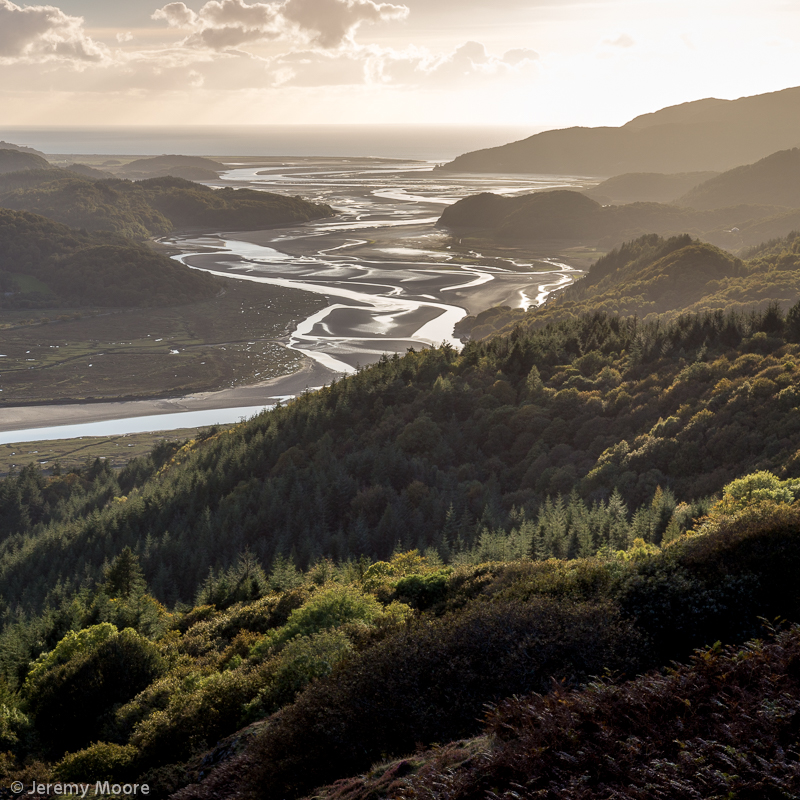
Back home a quick look at the RAW files (see above) instantly confirmed my earlier judgement. But on a later viewing I had a play with the image using Lightroom’s development sliders – exposure, shadows, highlights, blacks and whites. Adding a square crop and a tweak to the colour balance, it only took a few blinks of the eye to come up with the top image, and I’m really pleased with it. The digital darkroom really is our friend!
I spent the night at Cregennen Lake on the south side – another firm favourite of mine and subject of just the second post in this blog. It is a truly dark place and I spent a couple of hours searching the northern skies unsuccessfully for an aurora. Following a disappointing dawn at Cregennen I returned to Llwybr Foel Ispri. The first burst of autumn colour in August and early September is still accompanied by the vivid greens of summer. By the end of October and well into November trees lose their leaves in a riot of colour if we are lucky. But in between the colours of the autumn landscape can seem muted and rather tired. There’s a kind of tawny wash to it which doesn’t really inspire. Autumn colours and bright sunlight might seem to be a recipe for success but it’s not just a matter of turning up and pressing the shutter.
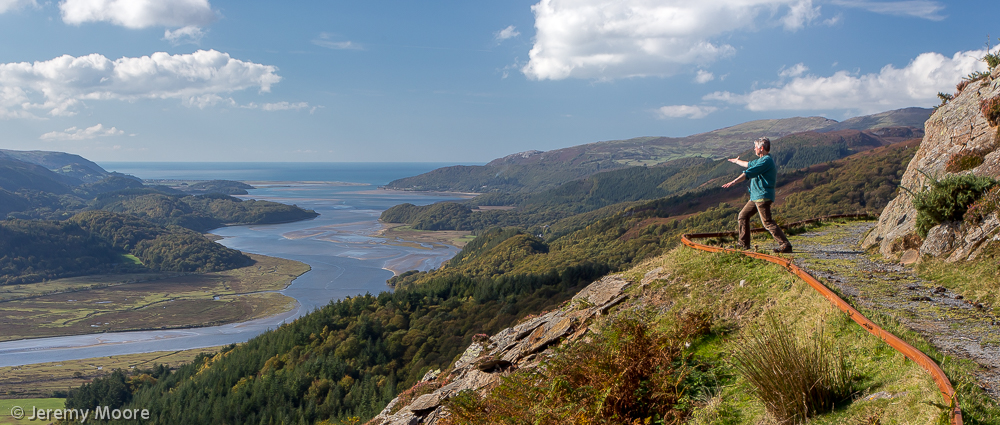
Self portrait, Llwybr Foel Ispri
I had no great expectations for this visit but realised I had two of everything in the van (tripod, camera body and lens). I decided to have a go at a selfie – or, to put it another way – photographing the landscape photographer in his habitat. Quite easily done when you have the gear with you and the time! It was great fun for a while and involved me running at full tilt from one tripod to the other as the self-timer wound down. The images needed some quite detailed processing – removing uneven saturation of the sky caused by a polariser for one thing – but once again Lightroom has done a great job.
I also photographed myself in a Tai Chi stance at the same spot. If ever one needed an uplifting outlook this has to be the place.
To follow Tales from Wild Wales, please scroll right down to the bottom and click Follow.
Last week, the sun shone endlessly, and I was finally able to get away from domestic commitments on Thursday afternoon. It was my intention to “do Snowdon” on Friday so I parked up overnight by the Llynnau Mymbyr near Capel Curig. Dawn was frosty and valley fog had formed overnight. The forecast was for a day of unbroken sunshine and light winds. While it would be lovely in the mountains I suspected that conditions would not be that great for atmospheric landscapes. Flexibility is the name of the game in landscape photography so it was over to plan B, which involved an early morning session in Dyffryn Mymbyr as the fog cleared. Sunrise comes so late at this time of year that it was a really leisurely start!
Llyn Mymbyr is one of the classic photographic locations in the National Park. The view from Plas-y-Brenin of the Snowdon Horseshoe reflected in the lake’s still waters is often the photographers’ desire. It is quite iconic in good conditions and when done well. But in valley fog one would be immersed in damp greyness and Snowdon would be quite invisible. It is then more profitable to take the rough and tussocky path between the two sections of the lake and look back towards Plas-y-Brenin. It is one of my very favourite locations in Wales. As the sun rises the fog tends to melt away downstream, allowing more and more of the landscape to emerge. Friday morning was just about as good as it gets, as you can see from the image above.
The sun shone all day on Friday and the Horseshoe looked absolutely stunning during the afternoon from Dyffryn Mymbyr. But I was glad that I had saved my energy for an attempt on Snowdon the following day. Saturday’s forecast seemed much more promising; a broken cloud base of perhaps 500 – 600 metres but with the summits remaining above the cloud. I liked the sound of that!
The next morning the fog was denser and more extensive at Capel Curig but stars could still be seen overhead. By the time I set out from Pen-y-pass about 7 a.m. the first wisps of cloud were forming above Y Lliwedd, and as I made my way up and along the PyG track I barely noticed how quickly it was developing. I’m nowhere near as fit as I used to be and I don’t mind admitting that it was a bit of a slog to reach Bwlch Glas. At this point one leaves the confines of the great eastern corrie of Yr Wyddfa and can take in the view to the west. An almost complete sea of cloud spread out below me. It was more or less only within the corrie and above the very highest peaks that cloud had not already formed. Blue sky could still be seen over the summit of Snowdon while cloud lapped and drifted around below it.
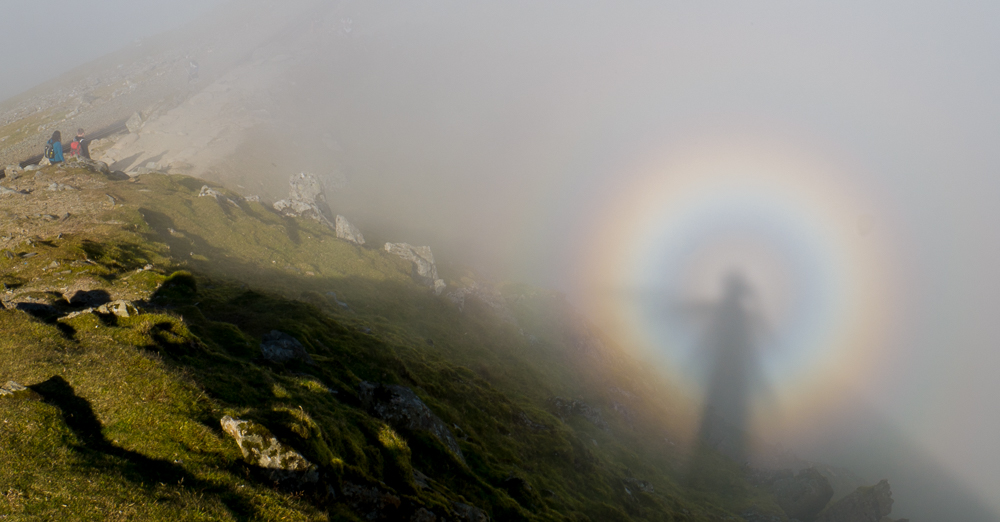
Brocken Spectre, Snowdon summit.
I grabbed a quick vat of tea from the café and assessed the possibilities. I was a little disappointed about the extent of the cloud but these were ideal conditions for seeing a Brocken Spectre. I walked around the summit area to find the best location and for an hour or so one was visible intermittently as my shadow was projected on to cloud below. The shadow itself was astonishingly three-dimensional as it fell on to countless tiny individual water droplets. The Spectre – or Glory – takes the form of a small circular spectrum of light centred on one’s own head. It has all the colours of the rainbow, and is, in fact, formed in a similar way, with violet on the inside and red on the outside. At times, the colours in the Glory just glowed. I have enhanced the colours slightly in the image above but it still retains a close link with reality. And interestingly, if one enhances it further, additional concentric rings of colour can be seen outside the primary spectrum.
For a while it was truly glorious up on the summit. It was warm and there was barely a breath of wind, just enough to cause the cloud to drift slowly around. A continuous stream of people were arriving by mid-morning. Every train brought another few dozen, but on such a day far more were doing it on foot. Conversations could easily be overheard. English seemed to be a minority language! Was that Welsh…..? Er….no, probably Polish. A few fully bearded Muslim men had walked up and even a few veiled Muslim women. But it was apparent that few had actually noticed the Brocken Spectre, even if they were only a few feet away from a good viewing point. Occasionally one could hear the magic words being spoken, and it was a pleasure to join these individuals in the experience.
Well, all good things must come to an end. The cloud base was lifting imperceptively until it was clear of the summit by lunch-time. Beneath the cloud it was dull and hazy so it was time to put the camera away and return to Pen-y-Pass. Still the crowds were flooding upwards, though. Little did they realise what they had missed.








 Tales from Wild Wales