Well, I can only think of one. Sometimes a visit to the loo before sunrise on a summer’s morning can present the photographer with scenes like this. The photograph was taken less than five minutes from my front door. Valley fog was slowly “flowing” down to the coast from the uplands; thanks to my inability to sleep I was able to get outside and take a few photographs. The sun had not yet risen above the Cambrian Mountains to the east so the light was soft and gentle.
While processing the image I found this lack of contrast frustrating at first. Adding the contrast it needed led to an unreal looking result. But that little light-bulb in my head said “think black-and-white instead” so I made the conversion. Because b&w is already an abstraction from reality I felt I could push the blacks and whites as far as they needed to go. Doing so would have been par for the course in the days of film. Having created the b&w version I then went back to the original file. Being a little more gentle with Lightroom’s sliders I produced a colour image I’m happy with. Which do you prefer?
To read more Tales from Wild Wales as they are published, please click the Follow button.
We moved to our present house about 17 years ago. It is high on an east/west ridge with excellent visibility in all directions and I knew it should be a great place to see the northern lights. In fact, prior to moving here I lived in a village a few miles away and drove up here to search for the aurora if it was predicted. I never succeeded. And for various reasons (frequent cloud, entertaining visitors, the sofa being too comfortable etc) I continued to fail to photograph the aurora for many years even after moving up here (see also this post) . It also took me years to realise that the camera can see what the naked eye cannot. It is sometimes said that the camera accentuates the colours of the aurora but in fact it is actually the eye which diminishes them. Let me explain.
The retina contains two types of light sensors, known as rods and cones. Rods are sensitive to light in a more general, black-and-white sense, while cones are sensitive to colour. It is thought that a black-and-white view of the world was useful in terms of our survival as individuals in a dangerous world, while the addition of colour was rather frivolous. Who needs to know what colour that predator is as it creeps around in the shadows? So the cones are less sensitive than the rods, and at low light intensities we see very little colour. Digital sensors (or film) are more objective about our surroundings at low light levels.
Last night the prediction was for a massive and “extreme” solar storm with the aurora likely to be visible all over the UK. I gradually prepared myself and waited until the last of the day’s light disappeared. It seemed to take forever! There was still a hint of daylight in the northern sky at 10.30pm when the camera showed the first greenish glow. It was another fourty minutes before any colour other than green appeared – in this case red – but from then on it was pretty spectacular. The aurora’s darker colours – blue, purple and various reds – were barely visible to the naked eye but the camera showed much of the sky to be full of colour. The display was right overhead for much of the time and could also be seen to the east, west and even the south. I used the minor road running up past the house as a solid base for the tripod. A steady stream of cars coming up from town (and then returning) suggested that news of this massive lightshow had reached the lowlands and people were heading for the hills to see it. It was quite frustrating at times especially when someone parked in a nearby passing place and left the car lightson!
A few words about the photography. At first I blundered around in the dark not knowing if I was coming or going. I settled on an ISO of 1600 and an aperture of f4. I used the camera’s exposure values and underexposed by about one stop. Shutter speeds were in the region of 2 to 8 seconds. The RAW files were, as expected, in need of some tweaking but no more than I would expect a normal landscape image to require. In most cases the black and white sliders in Lightroom were all I used. And here I have to hand it to Adobe…… the noise reduction/sharpening now built into Lightroom does a fantastic job. At ISO 1600 my Olympus m4/3 files of the night sky were really pretty grainy but they cleaned up beautifully in Lightroom.
Now for the negatives. There’s only one……. none of them are sharp. None of them. At first I couldn’t understand why; there is no sign of camera shake or depth of field problems. My little brain must have been turning it over while I slept because in the early hours I woke with the answer. I hadn’t switched the image stabilisation off when I mounted the camera on the tripod. I’ve pondered over this for years and have had long exposures ruined on other occasions. Some claim you can just leave IS switched on at all times, even when using a tripod. Now I’ve learned the lesson the hard way (again) that this is definitely not the case.
Many of the images are useable unless you enlarge them too far, especially where the foreground is of interest. But would it be too much to ask for another display tonight? And would I remember to switch the IS off? And if I did would I remember to switch it back on again afterwards?
Home Sweet Home
Edit: It clouded over so there was no second chance.
To read more Tales from Wild Wales as they are published please click the Follow button.
Feral pigeons, Aberystwyth : noise reduction and sharpening in DXO Photolab
For many years – from v3.1 to v6.14 – I was a 100% Lightroom man. I had begun my digital photography life with Paintshop Pro (I think it was) before graduating to Photoshop and then fairly soon afterwards to Lightroom. My digression into Photoshop was an expensive mistake because I found it unintuitive and difficult to use. Lightroom was a whole lot better. Then Adobe moved Lightroom into a subscription only package with Photoshop, and by 2017 it became impossible to update the software without signing up to a subscription. I stuck with the final outright purchase version (LR6.14) despite its slowly developing shortcomings. For a longer version of this process, see this post.
It seemed that Lightroom could do everything that I needed a software package to do. But slowly I became aware that other companies were producing alternatives to it, particularly in the realms of sharpening and noise reduction. Once Adobe’s subscription model became set in stone, there was an additional impetus for software developers to produce real, genuine, “Lightroom alternatives” that could be purchased once and updated once every year or two (at a price, of course) if the user wished. Capture One was long-established, but it was joined by DXO PhotoLab, On1, Luminar, and others, and Topaz was developing some excellent NR and sharpening tools.
My move from full-frame Canon to micro four-thirds format Olympus proved a bit of a turning point. Because of its small sensor size m4/3 has limitations, particularly at higher ISO’s; digital noise can become obtrusive. At long focal lengths, correct focusing has always been a difficult skill to master. The bird photographer is always likely to be pushing the boundaries of their equipment and I’m no exception. But I noticed some strange “clumping” of detail in wide-angle landscape images taken at the Olympus’ “base” ISO of 200. I thought it must have been the lens or the sensor, or user error of some sort. After a while I decided to take the plunge with Topaz Denoise AI, specialist denoising software which sharpens images as well. After processing an image in Lightroom you send it to Topaz which successfully cleans it up.
My go-to camera for almost three years – the Olympus EM1 mk2 – was fully supported by Lightroom v6.14, but I knew that once I upgraded it I would no longer be able to use that software. In preparation for that day I invested in DXO Photolab, software which claimed to be a fully featured Lightroom alternative. It seemed at the time to be the most “grown-up” of the new-kids-on-the-block – it didn’t, for example, make it any easier to replace skies, which is anathema to me. There was always going to be a learning curve with new software but I fairly quickly found it was lacking several features I was used to having. You couldn’t combine different files to create panoramic images, or blend a number of files at different exposures to overcome high levels of contrast. And bizarrely, once you have processed a file and closed down Photolab, your processing history is lost. You can’t go back to it.
Eventually I set the software up to only pre-process selected files, and then exported them back to Lightroom for further processing. In fact I’m using it in the same way as DXO’s PureRaw software, which had I known then what I know now, would have been a better choice in the first place. Potentially this works really well – the sharpening and noise-reduction is excellent, and you get a lovely clean file to work with. In extreme cases, it is possible to add even more sharpening in Lightroom because DXO’s NR is so good. The clumping of detail which I mentioned in the third paragraph just doesn’t happen. Its main drawback seems to be that it also adds contrast, which you don’t necessary want in bird photography, and the colour balance can be altered on export. Perhaps there are workarounds for this, though.
In the years after Lightroom became subscription-only Adobe continued to develop it. I heard of its new masking tools which enable the user to select specific sections of an image and work specifically on those. My purchase of an Olympus OM1 (the company’s new flagship model) in summer 2022 made life more difficult for me again. I was either going to have to jump ship from Lightroom entirely, or return to it completely by enrolling in the subscription programme. I decided to swallow my pride and do the latter. To be honest, I’m glad that I did.
While the cost of a standard subscription is £9.98 a month, if you pay in advance and buy from Amazon on Prime Day or Black Friday, that figure is reduced to £6 p.m. I’d say that is a pretty good deal and you still have Photoshop sitting on your hard drive if you want it. It is now easy to roughly select an “object” in Lightroom and software will outline it accurately. It also very easy to select the sky. In fact I worry that processing a file is now almost too easy! Fortunately or otherwise LR’s “content-aware healing” doesn’t work very well in my experience so far, so there’s still difficulties to overcome. Thank goodness for that!
Nothing ever seems to be straightforward, though. As mentioned above I’m using Photolab to pre-process certain files before returning them to Lightroom. I’ve come across a fairly serious problem in that more recently in many cases the export back to LR doesn’t take place successfully. It either fails completely or returns a corrupted file that has a regular pattern of coloured lines running across it. PureRaw doesn’t work either. I’ve taken this up with DXO technical support but they have not yet come up with a solution. In fact they seem to have forgotten about it altogether. Meanwhile someone on the DXO user forum has suggested that it is actually a Windows problem and suggested an easy fix. I’ve followed his instructions and my fingers are well and truly crossed.
To read more Tales from Wild Wales as they are published, please click the Follow button
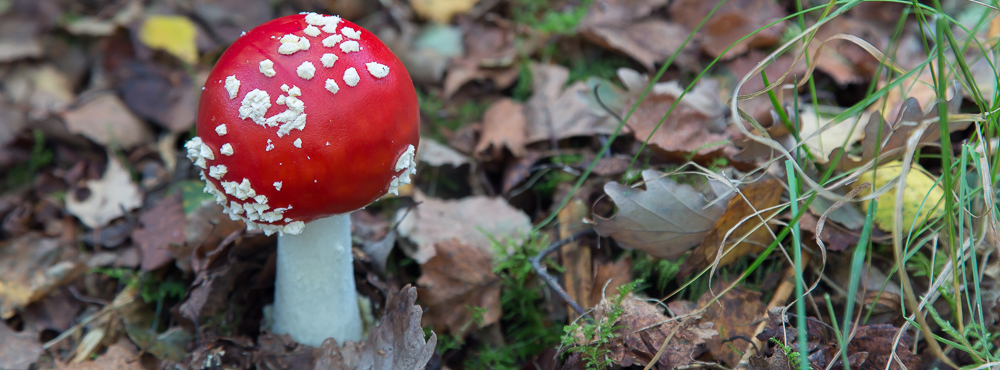
We’re well into autumn now and I recently decided I needed some photographs of that spectacular fungus, the fly agaric. I was up in north Wales for a couple of days, and a mixed forecast suggested I might get some sunny scenic landscape photography done; any cloudy conditions being more suitable for more intimate “autumn colours” and woodland scenes. Yes, I know I’m a traditionalist but at my age what do you expect!
By mid-morning on the first day it was starting to brighten up although a strong southerly wind was blowing. My first destination was a hilltop above Betws-y-coed, with the town deep in the valley below and the main peaks of Eryri in the background. But why not first spend an hour or so looking for fly agarics in the woodland leading to my destination? Two minutes later, right by the path, I had found my first! It was a perfect specimen, I thought, in my excitement, so I got the tripod out and began taking some ground level shots with my telephoto zoom. A passer-by told me that fly agarics were very common this year; some images he showed me on his phone looked great, and I realised my own specimen was not actually that special – tall and broad, yes; but crimson in colour with flecks of white on the cap? No, not really. I had a look around.
Fly agarics are usually associated with birch trees (and sometimes pine or other species). The fungus has a mutually beneficial relationship with the roots of the tree which helps both species thrive. What I found on my short exploration amazed me. Over an area of perhaps a hundred metres by fifty, I found several dozen fly agarics. Most were already past their best, being flat-capped, or even bowl shaped, with the red colouration having already faded towards orange. But I found one particularly photogenic group among some birch trees and did a bit of “gardening” to expose them. One was already broken off at ground level so I decided to make a feature of it alongside several other complete ones. Things are rarely as simple as you hope for, though, in this case because the sun was now shining brightly, creating areas of high contrast on the woodland floor. Every so often a tiny wispy cloud passed in front of the sun but even this didn’t give me the even lighting I needed for this shot. I wandered around, found more fly agarics, did some tai chi, looked at the sky over and over again, waited and waited some more. Eventually I realised that a better image would also include the mushrooms’ habitat so I swapped to a wide angle, placing them in the foreground with birch trees and bracken taking up the rest of the frame. Contrast was still a problem so I tried two other techniques:
1) Using a ND grad over the brightest part of the image (at the top), and
2) Bracketing with the intention of combining two images in Lightroom at the processing stage.
To some extent both worked, but the image (above) was processed using the HDR control in Lightroom. I had to examine individual frames carefully and choose those with the least subject movement for combining: the wind was still strong.
Thirty-six hours later I was back, and within five minutes had found a tiny, perfect little specimen freshly emerged from its protective sheath, looking just like something you might find in a very upmarket cake shop (see above). And it really wasn’t a difficult shot to take; a little gardening to clear dead bracken stems and twigs, tripod, aperture priority, f5.6 for minimal depth of field, and ….success!
Llyn Crafnant
The intervening day was glorious – warm, sunny and cloud-free; perfect for pure enjoyment but not great for the landscape photographer. I spent the night in the van by Llyn Crafnant above Trefriw. I do love the length of these autumn nights. No problem getting a good night’s sleep and no rush to be up before dawn. It was perfectly calm for several hours in the morning and, having found a good spot by the lakeside, I took a long series of images of the head of the valley and its reflection as the sun rose. In the end it was the very last image I took that was my favourite, so perhaps I should have waited longer!
Beyond the head of the valley, completely invisible from within it, lay the great peaks of Eryri – the Carneddau, Tryfan, the Glyderau, Yr Wyddfa and its outliers, and finally Moel Siabod. It was half-an-hour’s walk to a point where they could all be seen. Or so I thought: it actually took something like an hour and by the time I got there the sun was really too high and the sky too blue for successful image-making. But it was a great walk and I will do it again another day. As for the hoped-for view above Betws-y-coed, cloud was covering the peaks on both of my visits. Oh, and I got drenched in a two-hour downpour in woodland near Dolgellau on the way home. Light rain showers, the Met Office forecast said……….
To read more Tales from Wild Wales, scroll right down to the bottom and click Follow.
I made a very hesitant transition from film to digital during the period 2006/7. Photoshop was THE digital processing software in those days so I coughed up my £400 and dived in. It was HORRIBLE. Photoshop was designed for graphics professionals, not photographers, and it really showed. 90% of the programme’s features were of no use whatsoever to me and basic digital adjustments were buried deep in incomprehensible menus. Then I heard about its new “sister” product – Lightroom – which WAS designed for photographers. This sounded much more promising and so it was – far more intuitive and user-friendly. So I’ve been a Lightroom user ever since and as the software developed so have my abilities to use it. That’s not to say that I don’t still occasionally find useful new features, but my processing is pretty streamlined by now, and I’m still learning.
Take the above image, for example. It was taken at Aberystwyth on a recent afternoon, with the aim of producing a new postcard over the winter for next year. Rainbows don’t come along that often so I took over fifty shots over the period of about twenty minutes that it was intermittently visible. Back home it took me maybe an hour to do a preliminary sort of the images, select the best and process them to a rough and ready standard. Then there was maybe another hour the following morning to delete the dross and duplicates, and put the finishing touches to the above and a few others. To get from the unprocessed file (below) to the finished product (above) involved a total of 65 small or tiny adjustments. That might sound like a lot but each one takes only a second or two. It is said that the RAW file is the equivalent to the film negative and the fully processed image the resulting print. As long as the latter bears more than a passing resemblance to the former, I’m happy.
Aberystwyth rainbow (unprocessed)
What more could the digital photographer want? I have no desire to do major manipulations like swapping skies or removing large features from images, so have absolutely no need for Photoshop. There were complaints that Lightroom had become bloated and/or slow but it wasn’t a problem I had had to face. Everything seemed hunky-dory. The trouble was the software designers – Adobe – had other ideas, despite ever-increasing profits. “Stellar year-on-year growth” of 26% (latest figures) is not enough for them, nor is record revenue of $1.84 billion in the third quarter of 2017.
The rot set in with the introduction of Lightroom 5 in 2013. As well as being a standalone product available either on a DVD or a download from Adobe, it was also made available, along with Photoshop, as part of Adobe’s ‘Creative Cloud ‘, a subscription software service. At that time Adobe promised that future “versions” (note the plural) of Lightroom would be available “indefinitely” as standalone products. Lightroom 6 was introduced in 2015, available both as a standalone product and on subscription. It was difficult to find it on Adobe’s website, however, which was a sure sign of things to come. Furthermore, new features would only be added between ‘versions’ to those who enrolled in the subscription model, and so the arm-twisting began. As it happened even those who were on the subscription model felt cheesed off, because very few new features appeared during the 2 year plus lifetime of Lightroom 6.
Last month, after a long wait, Lightroom 7 arrived – or rather it didn’t, because it was now only available with Photoshop as part of the £9.98 per month Photography Plan. If you use Photoshop as well, this is a great deal, but if not, Lightoom alone would now cost just less than £240 over a typical two-year product cycle. Updating from LR6 to LR 7 , if it were possible, would cost about £65, if history is anything to go by. But that is not all, and this is so confusing that I’m not sure that I have got my head around it yet. Lightroom is now called Lightroom Classic, and appears to be an afterthought on the Adobe website. A new programme, a development of Lightroom Mobile, designed, it appears, for those taking photographs with tablets and mobile phones and with many major features missing, is now called Lightroom CC. The “Classic” name-tag Adobe have given the original programme has suggested to many people that it is on its way out, despite reassurances from Adobe that this is not the case. After the “indefinitely” promise of 2013, repeated (more or less) in 2015, who can believe a word that Adobe says?
And then there’s The Cloud, as in Lightroom CC – the Creative Cloud. Adobe’s latest big “thing” seems to be making your images accessible from any device, anywhere, but that relies on being able to upload them to the Cloud on a fast and reliable internet connection. Mine is neither. If you do, Adobe can then, of course, charge you (handsomely, no doubt) for storing them on their servers. Cloud storage is included in one or more of their new subscription plans, but it is already more expensive, apparently, than is available elsewhere. But Hell, think of the shareholders!
As I mentioned above, a subscription to Photoshop and Lightroom “Classic” together at £9.98 per month seems like a good deal, bearing in mind that before it became subscription-only Photoshop cost £600+. For Lightroom only, though, it is a non -starter. If it were £5 p.m., I’d be thinking about it. But once you sign up, Adobe have you by the short-and-curlies. If you stop your payments, for whatever reason (price increase, anyone?), the develop module becomes inoperable. You can revert back to Lightroom 6, if you have it, but you lose access to all the edits you have made in “Classic”, because its catalogue is not compatible with Lightroom 6.
What might one conclude from all of this? Firstly, that Lightroom is a brilliant product which many people entirely rely on for their photographic processing. Adobe now realises that only a limited number of new features can be added to it and that users will not necessarily upgrade to each new version as it appears. They foresee that it may be difficult to maintain (and increase) their profits and have moved to the subscription model to enable this. And they are using various “enticements” to keep users paying good money for what is, largely, old rope. There is, apparently, already a very viable and affordable Photoshop alternative called Affinity Photo. Other software designers will, I am sure, be aware of the sense of dissatisfaction that Lightroom users are feeling. They can now be sure that there will be a ready market for an alternative to Lightroom and we can but hope that this will spur them on to produce it. .
So what is the way forward for users such as myself? I have upgraded to the final update of the standalone software – v6.13. It is missing a few features that are now available in “Classic” but I can live without them. They have said that it will continue to be available until the end of 2017. I will continue to use it for the foreseeable future and if I upgrade my camera (I do like the look of the Nikon D850………!) its compatibility with Lightroom 6 will be a major factor. In the meantime I will keep my ear to the ground for new software and hope that in the next year or two a solution will become available.
Edit: It now appears there will be a LR6.14 update before the end of the year.
To follow Tales from Wild Wales, scroll down to the bottom and click Follow
It has been a dry and sunny October so far and our new solar pv panels have been getting an excellent work-out in the couple of weeks since they were installed. The landscape photographer has other priorities, of course, and wall-to-wall sunshine is not necessarily one of them, even in autumn.
Earlier this week I managed twenty-four hours around the Mawddach estuary in north Wales – truly one of the UK’s most stunning locations. For the life of me I just cannot understand why more photographers don’t head for the Mawddach! Over the years I’ve got to know a few spots which are easy to get to and provide great views down or across the estuary and I suspect they make me a bit lazy. Why search for new locations when the ones you know so well usually deliver the goods?
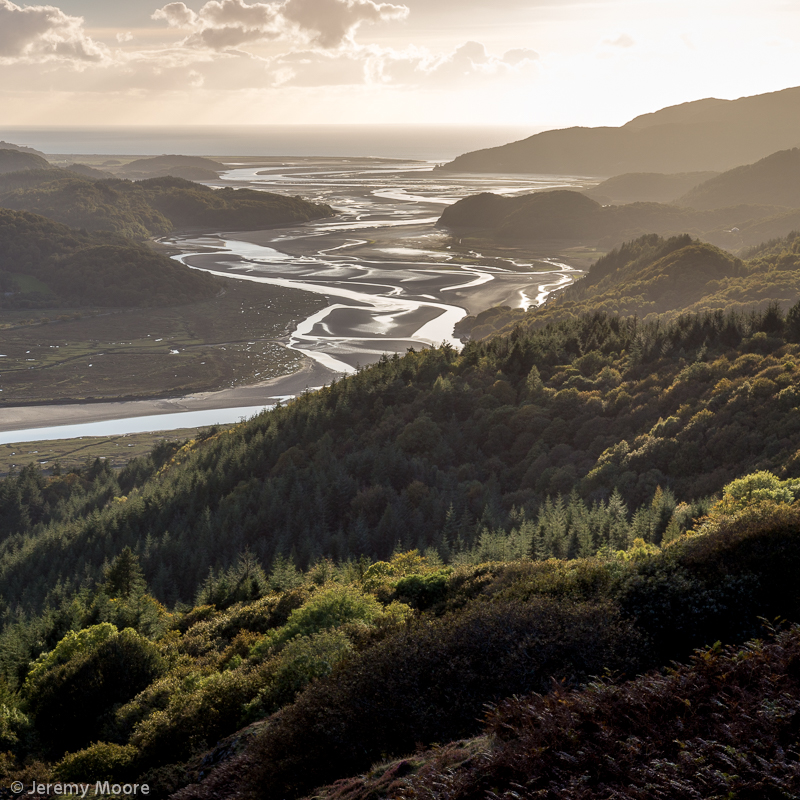
The first location I tried was the New Precipice Walk (Llwybr Foel Ispri), high on the north side of the estuary about two miles downstream of Dolgellau. It is possible to drive along a gated road to within a few minutes walk of this fabulous spot and I was there in good time for sunset on Monday. One needs to be aware of fairly subtle changes in the landscape as they take place; for just a few minutes the brilliant sun illuminated the estuary and its wooded banks without overwhelming the eye of the beholder. I could see the potential for a good image but only if extreme levels of contrast could be handled in some way. Stacking my 1- and 2- stop ND grads I took a few frames but the images looked very disappointing on the LCD screen. Messy and badly exposed. Why bother? Sunset itself proved to be a damp squib so that was that for the evening.
The same image before processing
Back home a quick look at the RAW files (see above) instantly confirmed my earlier judgement. But on a later viewing I had a play with the image using Lightroom’s development sliders – exposure, shadows, highlights, blacks and whites. Adding a square crop and a tweak to the colour balance, it only took a few blinks of the eye to come up with the top image, and I’m really pleased with it. The digital darkroom really is our friend!
I spent the night at Cregennen Lake on the south side – another firm favourite of mine and subject of just the second post in this blog. It is a truly dark place and I spent a couple of hours searching the northern skies unsuccessfully for an aurora. Following a disappointing dawn at Cregennen I returned to Llwybr Foel Ispri. The first burst of autumn colour in August and early September is still accompanied by the vivid greens of summer. By the end of October and well into November trees lose their leaves in a riot of colour if we are lucky. But in between the colours of the autumn landscape can seem muted and rather tired. There’s a kind of tawny wash to it which doesn’t really inspire. Autumn colours and bright sunlight might seem to be a recipe for success but it’s not just a matter of turning up and pressing the shutter.
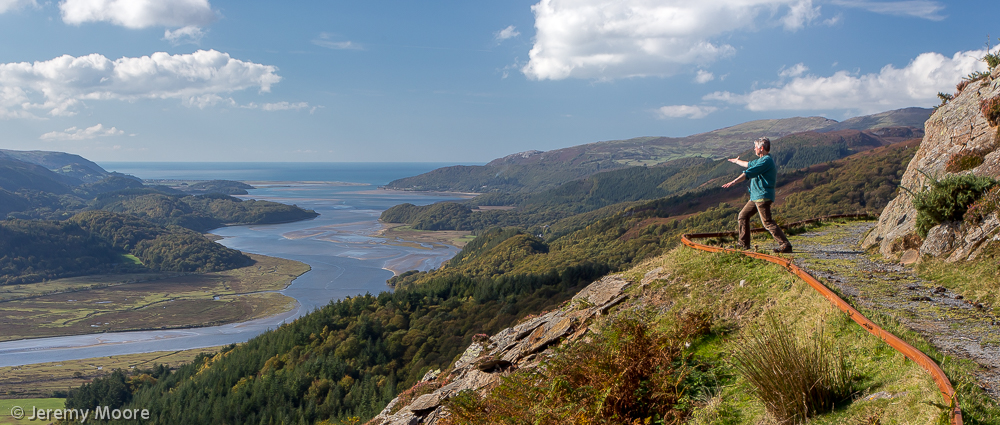
Self portrait, Llwybr Foel Ispri
I had no great expectations for this visit but realised I had two of everything in the van (tripod, camera body and lens). I decided to have a go at a selfie – or, to put it another way – photographing the landscape photographer in his habitat. Quite easily done when you have the gear with you and the time! It was great fun for a while and involved me running at full tilt from one tripod to the other as the self-timer wound down. The images needed some quite detailed processing – removing uneven saturation of the sky caused by a polariser for one thing – but once again Lightroom has done a great job.
I also photographed myself in a Tai Chi stance at the same spot. If ever one needed an uplifting outlook this has to be the place.
To follow Tales from Wild Wales, please scroll right down to the bottom and click Follow.





 Tales from Wild Wales