Thoughts from a wet and windy Welsh hilltop.

Aurora Borealis, mid-Wales

I cannot remember such a long period when the weather has been so discouraging for the outdoor photographer. Days….. weeks!….. on end of cloud, rain and gales – and today is no exception. I’m shocked to discover that I’ve barely taken a decent photograph since the beginning of October.

But I can’t just blame the weather for that. In my last post I wrote how my priority over the summer was to work on images for new postcards. How one needed to visit the popular locations and somehow come up with something new. I eventually realised I was just going through the motions. I really was re-visiting the same old places and taking the same old photographs.

So as much as the weather really has been disastrous it was a partly a conscious decision to lay the camera down and give myself a break. This happened to me big time about twenty years ago. I put down the break-up of a relationship partly or largely to the fact that I saw myself as a photographer first and a human being second. There certainly were other factors but being an outdoor photographer does involve leading a very unpredictable lifestyle. Whatever…..after a few self-imposed months of keeping the business running and no more – certainly no actual photography – I picked up the reins more or less where I had left them. In my experience one’s creative side continues to develop even if putting it into practice actually takes a back seat for a while. After a few months break from photography I’m sure – well, fairly sure -that I’ll return to it with a bunch of new ideas and attitudes.

I hope it does, because I’ve recently had a very positive discussion with a publisher and author about a new book. There’s still plenty to be finalised, particularly the financial side of things, but I’ve come to the conclusion that my sanity is now more important than my bank balance! So even if it doesn’t pay very well, I’ll still do it.

In a post earlier this year I wrote about how I missed an opportunity to photograph the Northern Lights. Since March I have gained a better understanding of why and how a faint aurora – even an invisible one – can actually produce decent photographs. The reason is this : there are two types of sensor in the eye – cones and rods. The cones are colour sensitive, but the rods, which are 1000 times more sensitive than the cones and far more numerous, do not pick up colour. So our eyes do not perceive colour at low light levels. The sensor in our camera is equally sensitive to colour at low or high intensities so it will record what the eye cannot see.

A couple of evenings ago I received an “Aurora Watch” amber alert. To my surprise yet another cloudy day actually improved to an evening of clear periods and showers. There was quite a powerful moon but the northern skyline looked a bit odd.  I couldn’t be sure whether it was a pale glow that I was seeing or some cloud hugging the horizon.  I eventually realised that I would have to take some photographs to be sure if the aurora was present or not.

I set the ISO at 3200 and the meter gave a reading of 8 seconds at f4. When viewed on the camera’s LCD screen the first image immediately showed that there were vertical bands of purple in the clear sky which were completely invisible to the naked eye. I took a few more images to confirm it and then called it a day. On viewing the images this afternoon on the PC monitor it became clear that amongst the cloud on the horizon there had also been a green glow. The very localised orange glow on the horizon is usually visible to the naked eye as pale and colourless but the camera’s sensor has picked up its colour;  it must be street lighting from a nearby village reflected off low-ish cloud. The image has of course been processed, but not to an excessive level – no more than I would expect on a typical landscape.  This had been the real thing and without the camera I would never known!

Technically and artistically it is rather poor. I should have taken more care with placing the tripod and weighing it down, and the telephone pole in the foreground is hardly an attractive feature. But I’m treating it as a learning experience and hopefully there will be an opportunity to do better in the future.

Seasons Greetings to all from a wet and windy Welsh hilltop!

To follow Tales from Wild Wales, scroll down to the bottom and click Follow.


This looks like a winner to me.

The Beacons from Brecon graveyard

Following the completion of the Bird/land project I realised it was time to step back from bird photography for a while. My bread-and -butter income still comes from the sale of postcards and some of them were beginning to look a bit tired. Rather than reprint them again I decided to spend some time replacing them with new designs. So it was time to put my landscape photographer’s hat on again……

Taking photographs for postcards must be easy…..right? Well, er…..no! Somehow one must be able to sum up a well-known location in just one image, the sense of the place, if you like, and ideally in a way that has not been done before. Take the Brecon Beacons, for example. They may not be the most dramatic mountain range in the UK but they are very popular. I had seen a photograph on a flyer for a holiday cottage rental company showing  a former farmhouse idyllically situated in the foreground with the main peaks behind it. It looked like it would be worth searching out the location. When I eventually found it,  I couldn’t believe it was the same place. The original photograph appeared to have been taken from well above ground level, and there was a string of electricity cables and phone lines running to the house. It had been photoshopped out of almost all recognition!

Whilst on the lookout for a new viewpoint I’ve spent hours driving and walking around the narrow, high-hedged lines between the Beacons and Brecon. Every so often I would catch a glimpse of the view I wanted through a gap or a gate but on closer inspection there was always a snag. I eventually narrowed it down to a couple of fields, through which no public right of way existed. A  friendly farmer gave me permission to cross his land to reach the spot but on the two occasions I was there during the autumn conditions were just not good enough. So that particular view will have to wait for another year. And even then, I have a horrible feeling there will be a snag there too.

What I did find earlier in the year after many hours searching, was a view of the Beacons from the graveyard at Brecon.  The image may not have a great deal of merit in an artistic sense but as a postcard it looks like a winner. I’m not sure yet what I’ll use as a caption!

To read more Tales from Wild Wales as they are published, please click the blue Follow button

Final thoughts on Bird/land…..for now……..

Mallard (from Bird/land)

Well, Bird/land closed just over a month ago and I have to say in many respects it was a success. Feedback was excellent; visitors were particularly complimentary about how different the work was to anything that I had previously done.  Print sales were also very good  and much better than I was expecting. As a result I have just sent a cheque for £140 to the RSPB towards reconstruction of their hides at Snettisham in Norfolk. I had hoped to make multiple visits to Snettisham during the course of the project to photograph the countless thousands of waders which congregate there but a storm surge of December 2013 destroyed the hides. So my small contribution will benefit conservation generally and bird photographers in particular.

What has been disappointing is the almost complete lack of coverage I have received in the press and the photographic media in particular. I suppose the exhibition did fall between two stools – not really bird photography, and not landscape either – so it was difficult to categorise. And, of course, it was in a small town in mid-Wales and who could even pronounce its name? But not for the first time have I believed that there is a prejudice amongst the English media about all things Welsh.

All is not yet lost, however. I have agreed to display some of the work at RSPB Ynyshir, my local reserve, next spring. And on a much larger scale the whole exhibition will be shown at Aberystwyth Arts Centre for two months next summer. I am hoping to be able to expand it to fill the larger photographic gallery there but that will be subject to receiving further funding from the Arts Council of Wales. So watch this space for further information about dates, etc.

The image above is one of only two singles in the exhibition. It has sold really well and only one remains at the time of writing. How I wish I’d offered an edition of ten or more instead of just six! It is so difficult to know how to sell photographs. Over the summer I noticed an exhibition of really rather average black-and-white landscapes in a bookshop in Hay-on-Wye, in an edition of 295. Only in the photographer’s wildest dreams would anywhere near that number be sold. A short edition would, I hoped, create a feeling of exclusivity around the work, and thus increase sales. But I think I may have misjudged it. Just one of the lessons I have learned over the last few months!


To follow Tales from Wild Wales please scroll right to the bottom and click Follow

The digital darkroom is our friend.

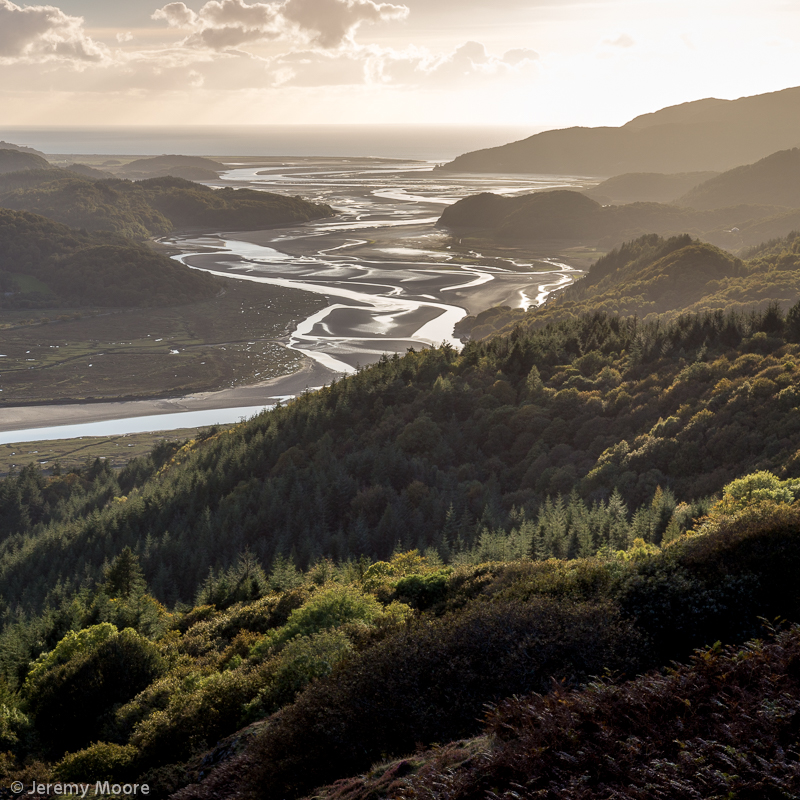
Mawddach estuary from the New Precipice Walk (processed image)
Mawddach estuary from Llwybr Foel Ispri

It has been a dry and sunny October so far and our new solar pv panels have been getting an excellent work-out in the couple of weeks since they were installed.  The landscape photographer has other priorities, of course, and wall-to-wall sunshine is not necessarily one of them,  even in autumn.

Earlier this week I managed twenty-four hours around the Mawddach estuary in north Wales – truly one of the UK’s most stunning locations. For the life of me  I just cannot understand why more photographers don’t head for the Mawddach! Over the years I’ve got to know a few spots which are easy to get to and provide great views down or across the estuary and I suspect they make me a bit lazy. Why search for new locations when the ones you know so well usually deliver the goods?

The first location I tried was the New Precipice Walk (Llwybr Foel Ispri), high on the north side of the estuary about two miles downstream of Dolgellau. It is possible to drive along a gated road to within a few minutes walk of this fabulous spot and I was there in good time for sunset on Monday. One needs to be aware of fairly subtle changes in the landscape as they take place; for just a few minutes the brilliant sun illuminated the estuary and its wooded banks without overwhelming the eye of the beholder. I could see the potential for a good image but only if extreme levels  of contrast could be handled in some way. Stacking my 1- and 2- stop ND grads I took a few frames but the images looked very disappointing on the LCD screen. Messy and badly exposed. Why bother? Sunset itself proved to be a damp squib so that was that for the evening.

The same image before processing

Back home a quick look at the RAW files (see above) instantly confirmed my earlier judgement. But on a later viewing I had a play with the image using Lightroom’s development sliders – exposure, shadows, highlights, blacks and whites. Adding a square crop and a tweak to the colour balance, it only took a few blinks of the eye to come up with the top image, and I’m really pleased with it. The digital darkroom really is our friend!

I spent the night at Cregennen Lake on the south side – another firm favourite of mine and subject of just the second post in this blog. It is a truly dark place and I spent a couple of hours searching the northern skies unsuccessfully for an aurora.  Following a disappointing dawn at Cregennen I returned to Llwybr Foel Ispri.  The first burst of autumn colour in August and early September is still accompanied by the vivid greens of summer. By the end of October and well into November trees lose their leaves in a riot of colour if we are lucky.  But in between the colours of the autumn landscape can seem muted and rather tired. There’s a kind of tawny wash to it which doesn’t really inspire. Autumn colours and bright sunlight might seem to be a recipe for success but it’s not just a matter of turning up and pressing the shutter.

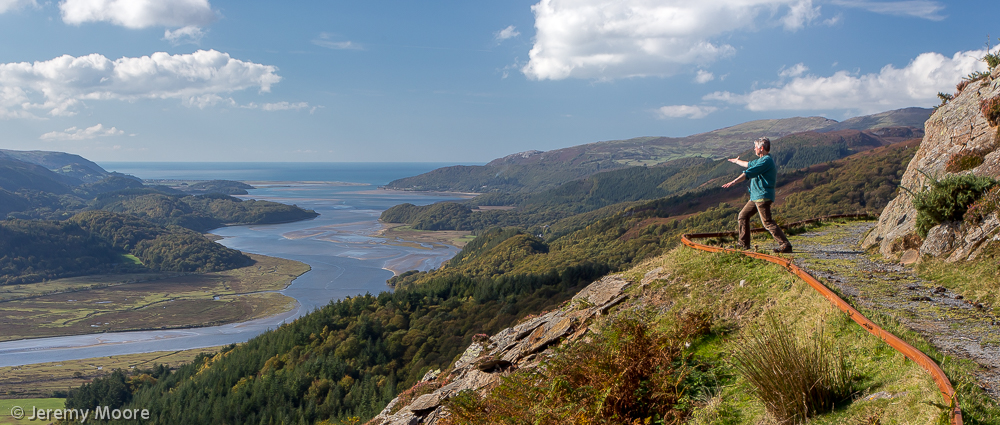
Self portrait, Llwybr Foel Ispri

I had no great expectations for this visit but realised I had two of everything in the van (tripod, camera body and lens). I decided to have a go at a selfie – or, to put it another way – photographing the landscape photographer in his habitat. Quite easily done when you have the gear with you and the time! It was great fun for a while and involved me running at full tilt from one tripod to the other as the self-timer wound down. The images needed some quite detailed processing – removing uneven saturation of the sky caused by a polariser for one thing – but once again Lightroom has done a great job.

I also photographed myself in a Tai Chi stance at the same spot. If ever one needed an uplifting outlook this has to be the place.

To follow Tales from Wild Wales, please scroll right down to the bottom and click Follow.

In the footsteps of Richard Wilson (and Bill Condry)

Cadair Idris and Llyn Cau

Yesterday I planned an early start to climb Cadair Idris. I woke drowsily. Did I have the energy to “do Cader”? The long drag up  Mynydd Moel was almost vertical, I seemed to remember. The forecast was for sunshine but that is no guarantee of good light. After procrastinating for an hour or so I left the cocoon of my van and felt the cool morning air on my face. I would go for it.

My viewpoint was to be high on the slopes of Mynydd Moel, overlooking the corrie lake of Llyn Cau and the cliffs of Craig Cau which tower vertically over it. The foreground would be gorgeous with heather at this time of year. By the time I arrived the sun would be at right-angles to my angle of vision, allowing my polarising filter to be most effective. I was travelling as light as I possibly could, carrying only enough food, water and spare clothing for the day and my miniscule Panasonic GX7 kit. I left the tripod in the van. Only two hours of climbing lay between me and my destination.

The first half hour took me steeply up rustic stone steps through oak woodland. A mountain torrent tumbled downwards alongside the path. A few years ago I would have done this in one go, pausing only at the gate at the top of the woodland. Yesterday I needed a break every few minutes. At the gate I emerged on to moorland but it was steeper than I remembered. I forked right and crossed the stream. The mountain gradually became more prominent. I had prepared myself mentally for the agony of the final relentless three hundred meters of height gain, so it perhaps wasn’t quite as bad as I had feared. By 10 am I was at my location. Visibility was good but there was no cloud at all to diffuse the sunlight and add texture to the sky.

Over the next two hours I took over thirty images. I’m still new to the GX7 and I sometimes struggled with its controls but it is definitely an improvement on the GX1. The battery lasted just three hours, as it had on its first outing. Pathetic! I found the focal length range of the kit lens (14 – 42 mm or 28 – 84 equivalent) slightly limiting. I’m not a fan of ultra-wide angles but I do like a 24mm lens.  Tiny wispy clouds materialised and disappeared over a couple of minutes, but somehow never quite the right shape or in quite the right place.   Oh, the joys and frustrations of being a landscape photographer! By mid-day, though, I felt confident that I would have something to show for my efforts, and it was with a sense of achievement that I reached the summit of Cadair Idris in time for my picnic lunch. The descent was laborious but uneventful.

Llyn-y-Cau by Richard Wilson, painted in 1774.

That evening I was attending a writing workshop at a bookshop in Machynlleth, where I casually picked up a book – The Mountains of Snowdonia in Art by Peter Bishop. It almost fell open at the page showing the painting Llyn-y-Cau, Cadair Idris, by Richard Wilson (1774),  reproduced above.  To the contemporary viewer it looks astonishingly primitive, but it must have been painted close to the spot I had been earlier in the day.

I recalled that in the book Heart of the Country I had included one of William Condry’s “Guardian Country Diaries” alongside an earlier, and quite different, image I had taken of Craig Cau and Llyn Cau. Bill’s text is extraordinarily perceptive. He had searched for the spot where the artist must have stood to make the painting, but failed to find it. He explains –

“Wilson aimed to represent the scene in only the broadest outlines. For that was the way things were in his day: artists quite happily moved cliffs, woods, waterfalls, even whole mountains a bit to the left or right in order to make the picture more picturesque.”

He goes on –

“If the public has learned to appreciate the wild lonely uplands of the world, it is largely due to painters like Wilson and the travel writers who were his contemporaries. Poor Wilson. His paintings may be worth a fortune now but he died long before his work was widely acclaimed. As someone wrote later: ‘Scarcely half a century has elapsed since death relieved Wilson from the apathy of the critics, the envy of rivals, and the neglect of the tasteless public'”

To my eyes the painting has been cobbled together from three elements. Firstly, the vista from close to my viewpoint; secondly, the grassy dome called Moelfryn, which the artist has placed in front of the lake, although it is actually about half a mile to the south; and thirdly, a large dose of artistic licence. In those days so few people ever visited the Welsh mountains that no-one would have been any the wiser.


More from Cwm Idwal.

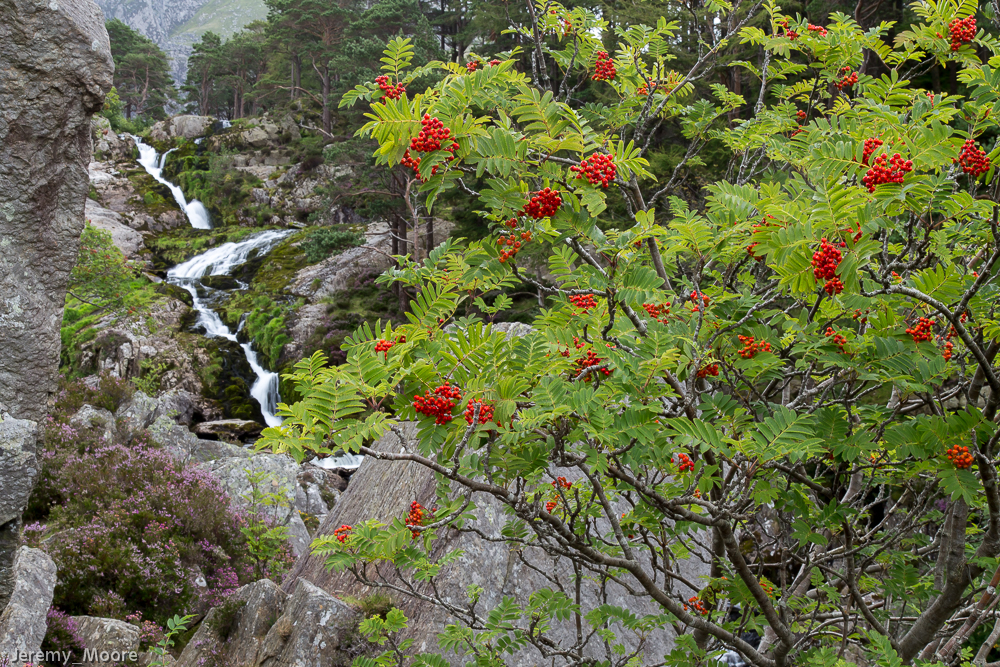
Rowan, Ogwen Cottage

Last week I posted about my eventually successful visit to Cwm Idwal in Snowdonia. But alongside the story of the photographs there was a quite different narrative running in parallel.

On my first visit to the Cwm, amongst the huge boulders below Twll Du, I came across some small brown birds. I quickly twigged that they were twite, which, strangely enough, I had been reading about the previous evening. As far as British birds go they are probably the supreme example of the “little brown job”. Visually there are no distinguishing features at all unless you can see the pale pink rump patch, but they do have a distinctive twanging call, which confirms their identity. At first it was just a couple of birds, then a juvenile begging food from a parent, then a bird leaving a possible nest site and finally a flock of 15 – 20 birds.

On my return to Idwal Cottage I looked around for someone to report my sightings to. There was no-one but a girl from the National Trust, who “thought she had heard of twite” but that was it. While I drank my coffee I noticed the nearby organic burger van, whose owner, Gwyn Thomas, the local farmer, was conversing with customers. My partner has worked with him so I went over for a chat. Eventually I brought up the subject of my  sightings. To my surprise and delight he is quite an authority on twite! Along with several other farmers in Nant Ffrancon he grows a seed crop for them to feed on during the autumn before they move down to the coast for the winter. I’m sometimes not a great admirer of farmers but this man is a star!

During our conversation a car drew up alongside and the driver came over. I recognised him but couldn’t put a name to the face. Gwyn left me with him and a tentative conversation began. I wondered aloud if I had seen him on TV. “No, I work on radio…” he replied. Not really a great help! “I did a book with you!” he added. It came to me in a flash. It was Dei Tomos, the author with whom I had worked on the Welsh version of “Wales at Waters Edge”. I buried my head in my hands in embarrassment! To be fair though, it was hardly a collaboration and we had only met once, and he couldn’t place me at first either.

The social aspect of my weekend continued the following morning. Back at Ogwen Cottage after a third unsuccessful visit to the Cwm, I was drinking coffee by my van. A familiar figure appeared. It was Martin Ashby, owner of Ystwyth Books in Aberystwyth, and one oldest and most valued friends. He was with his mate Nigel Dudley and just about to set off on a long walk up in to the Carneddau. I reluctantly turned down their invitation to join them.

On my return home I reported my twite records to the BTO Officer for Wales, Kelvin Jones. He told me that twite are declining steeply in Wales, and there is a project going to try to reverse this. Apart from the feeding project mentioned above birds are being ringed on the coast in winter in the hope that sightings in summer of ringed birds can reveal more about their movements. Although I had not seen any rings it seems my sightings had been the first this summer! The rarest breeding bird in Wales may actually now be twite, he said. (Does that make them rarer than osprey,  I wonder……)

Just a note on the photograph above. While dull, cloudy conditions are usually the kiss of death for most “big” landscapes, they can be ideal for details within the landscape. This lovely rowan tree was just below Ogwen Cottage.

To read more about Gwyn Thomas and his work in Cwm Idwal, click here.


To follow Tales from Wild Wales, scroll down to the bottom and click Follow


A weekend at Cwm Idwal

Pen Yr Ole Wen and Llyn Idwal

I’ve been in the photographic doldrums for a few weeks now. It seems to happen most years during mid-summer when I’m pretty busy getting stuff out into shops and creative activities tend to take a back seat. But last weekend the forecast seemed promising – sunny intervals rather than wall-to-wall sunshine – and I decided to head up to Snowdonia. I had it in mind to try out my new Panasonic gx7 and maybe do a mountain walk into the Glyderau or on to Snowdon. Early on Saturday morning I headed up into Cwm Idwal with the option of going on to the tops but conditions were really not pleasant. It was windy and cold with plenty of cloud cover. I can’t say that me and the gx7 got on like a house on fire. I hated the menu system on the gx1 and the gx7 does seem better in this respect. But it’s still not an SLR! I got a few decent images when the sun briefly shone. But after using it intermittently for about 3 hours, and taking about fourty shots, I noticed the battery power was practically down to zero. This wasn’t right at all! I spent a while looking for locations to re-visit later on, and then it was back down to the van to wait out the middle hours of the day.

Bog pool, Cwm idwal
Bog pool, Cwm idwal

Cwm Idwal is a National Nature Reserve and location of many of Snowdonia’s rare arctic-alpine plant species. Sheep have been largely excluded for some years now to allow the flora to recover from the accumulated effects of countless nibbling teeth. I was very pleasantly surprised by how extensively the heather has regenerated and it was in full colourful bloom. In some ways mid-August is my favourite time of year for exactly this reason. Swathes of purple calluna are such a sensuous experience; a feast for both the eyes and the lens, and somehow more than that as well. So later on, under full cloud cover, I took my full DSLR kit up into the cwm and spent some time taking close-ups of a boggy pool and its surroundings, just heaving with wild flowers. Then it was over to the spot I had located earlier which gave a view over to Pen Yr Ole Wen. In still conditions this mountainous backdrop would be reflected in the lake. What made my location particularly special was that I could also include a gnarly old mountain ash tree, apparently growing out of bare rock, in the foreground.  Unfortunately the weather was not playing ball. I made a few images, but could see that much more exciting things would be possible in better light. The next morning I was up there again and the following evening as well! Conditions were still and vast hordes of midges appeared, more than I’ve ever known anywhere in Wales.

Monday morning dawned more clear and after a quick whizz round to Llynnau Mymbyr (Capel Curig) I decided to return to Cwm Idwal for one more try at the image I had envisaged two days earlier. I set off full of confidence and with a light step. It’s funny how a 5kg pack feels like 2kg in such a situation but more like 15 at the end of an unsuccessful day. I had reached my spot by 9 a.m. but the sun had not yet come over the ridge of Glyder Fach. Surely it couldn’t be long?  The edge of the mountain’s shadow slowly crept down the heathery rock-face on the left-hand side until all was illuminated. My moment came at 9.50 a.m. A few minutes later I had a selection of shots and the sun had become obstructed by spreading and developing cumulus cloud. It had all gone so well! And only on my fifth visit………

So why does this image work?

Firstly I am so thrilled by the location; the rowan was a real bonus. It is probably one of only two in the Cwm – the result of many years of sheep grazing.

Secondly my angle of vision is exactly at right angles to the sun’s rays and my polariser is at its most effective. Any uneven polarisation is partly masked by what cloud there is. (I also used a 1-stop ND grad to balance the exposure)

Thirdly, the heather is in bloom. Only for a couple of weeks in the year would that be the case.

Fourth, there is no wind to disturb the surface of the lake and a full reflection is visible.

On the other hand, it gives such a benign impression of Llyn Idwal and its surroundings. Conditions would rarely be so amiable. So there’s definitely the place for an alternative interpretation of the location.  I’ll be back.

If anyone is in the mid-Wales area next week I’ll be giving the annual Halstatt Lecture at MOMA Wales, Machynlleth on Wednesday 26th at 1 pm. I’ll be talking about how I became a birder and a photographer, and finally both!

Tickets are £6.00. Phone 01654 703355 for more details.

My exhibition Bird/land is showing there until September 19th. Entry free of charge.

To follow Tales from Wild Wales scroll right down to the bottom and click Follow.


What a difference an hour makes…..

Mawddach estuary at 7 am.

After doing deliveries around north Wales on Friday I had the day free on Saturday for photography. Friday had been damp and drizzly with plenty of low cloud but no wind. A continuation of the calm conditions overnight coupled with the passage of a cold front suggested that better times would soon come. I guessed that there would be plenty of “interesting clouds” to photograph the next morning. I sat out Friday evening and then drove down to the Mawddach estuary to arrive just before dark. I could see that the low cloud had aligned itself in distinct layers along the steep sides of the estuary although it was too dark to photograph it. I set my alarm for 5 a.m. I didn’t want to miss a thing!

I had parked up by the side of a minor road near Barmouth with a view right down the estuary and across to Cadair Idris. Groggily I crept out of the van to find that the cloud had coalesced into a huge amorphous blob with no photographic potential whatsoever. Although it was cloud-free to the west it would take the sun quite some time to rise above the blob. Time to enjoy the birdsong and make a leisurely cup of tea. I decided to head for the Panorama Walk above the head of the estuary. At least I’d get some exercise!

The cloud was very slowly drifting downstream above the estuary and lifting. Would the sun ever break through to light up the landscape? I felt sure that all over Snowdonia photographers were making amazing images but that here it was no-go time. At last, at 7 a.m., a few gaps appeared and a dramatic scene was revealed (see top picture). Although the clearance lasted only a couple of minutes it had been worth getting up so early.

I turned my attention south- and west- wards. The tide was out, revealing beautifully patterned sandbanks; river channels reflected the blue sky as they coiled through the sand. I floundered through deep heather and young gorse to a lower viewpoint closer to the river. The brilliant young greens of oak woodland appeared. Even a gorse bush in full flower. This landscape had everything other than sunlight to illuminate it. I was close to prayer. And then, exactly an hour after the first short clearance, the cloud receded inland to allow the sun to appear. I took a series of images and stepped back to admire the view for its own sake.

Mawddach estuary 8 am.

I used a polarising filter to saturate the colours and a one-stop graduated ND filter to hold back the sky a little. It is sometimes  said that a one-stop grad is virtually useless but I find that in conjunction with a polariser it gives perfect, natural-looking skies. This may be a conventional image in many ways but for me it sums up the beauty of the Welsh landscape at the most stunning time of year. And I need new images of the Mawddach estuary for postcards. Job done!

Dotterel Days

Dotterel, Pumlumon
Dotterel, Pumlumon

The rounded mountain-top of Pumlumon in mid-Wales (more of a large hill, really, but still 2468 ft above sea level) is a recognised stopping off point for dotterel in the spring. In late April a single dotterel was reported on its summit so a couple of days later I decided to go for it. Leaving the house at lunch-time, I had reached the summit two hours later. I scoured and scanned for the bird but found nothing. Then there was a sudden movement on the ground three yards in front of me. There it was! What a gorgeous creature!

I spent a happy hour photographing it in light winds and warm sunshine. It was nice to “share the moment” with Janet Baxter, who I had overtaken on the way up. And whose dog, fortunately, was more well-behaved than it sometimes is! I was back down in time to take my van to the garage by 5.30 pm, as planned. Sorted! It’s very unusual for an expedition like this to work out so successfully. I was happy, too, that I was able to reach the summit and return so quickly, Carrying just the one lens and camera body, a snack and bottle of water helped.

Bearing in mind the image was taken in mid-afternoon on a cloudless day in late April, the sun was quite elevated. Contrast was therefore high and the shadows in the bird’s belly and chest were darker than I would have liked. Selecting this area with Lightroom’s radial filter and judicious use of the highlight and shadows sliders was quite successful in bringing this problem under control.

Other dotterel days……

1. A single bird was seen and photographed on a Lake District hilltop while I was an RSPB warden in 1981. This was during my first era of bird photography. I gave one transparency to a local ornithologist with whom I was working. It later appeared under his own name in the Cumbrian Bird Report for that year. The same image later appeared in my book “Heart of the Country” (published in 2003) to accompany one of the late Bill Condry’s Guardian Country Diaries – in which he laments never having seen one!

2. While working for the Nature Conservancy Council in Scotland in 1986 I spent a day – under licence – surveying a Grampian hilltop for breeding dotterel, with a group of friends and colleagues. During the survey I lifted a male dotterel off its nest with my finger.

3. A trip of dotterel seen on Foel Grach in the Carneddau (north Wales) in May 1987.

4. A trip seen on Pumlumon with a friend in May 1995. One bird was wearing coloured leg rings. From the combination of colours it was identified by the BTO: it had been ringed as a chick in Scotland 8 years previously and not seen since.

5. Three birds seen on a coastal field near Ynyslas in early May 2013. As I approached the field I met the farmer who was just leaving in his Land Rover. I asked him about the dotterel and he invited me to jump in: he would take me to see them. As we approached the birds they took off and flew strongly northwards, never to be seen again.

So almost every dotterel sighting in my life has a story attached to it. Their lifestyle is extraordinary. The female is the more brightly coloured bird. She takes the male’s role and vice-versa. She lays a clutch of eggs for her mate to incubate, then travels further north to do the same for another male. I particularly like the thought that they migrate from hill top to hill top, stitching Europe’s mountains together as they go.

To follow Tales from Wild Wales, please scroll right down to the bottom and click Follow

High on opinion but low on facts.

Ring ouzels, near Machynlleth

Following a talk in Aberystwyth by George Monbiot last spring on “rewilding”, a local ornithologist and friend Roy Bamford wrote a full-page article on the subject in our local newspaper, the Cambrian News. His main thrust, borne out of many years of personal experience, was that rewilding may happen – come what may – and that its effects may be unpredictable. The article was almost entirely uncontroversial but was followed a couple of weeks later by a letter from the Farmers Union of Wales. This included a personal attack on the author and a suggestion that he was quoting tittle-tattle from the internet (among other things) to support his case. I felt that this should not go unchallenged so wrote the following, which was published in the Cambrian a few weeks later.

I am writing with reference to Roy Bamford’s piece ( 3rd July) on rewilding and the subsequent letter from the Dafydd Jones, vice-chairman of the Ceredigion FUW.

Firstly I suggest that it is unfortunate that Mr Jones chose to make such personal comments in his letter. Mr Bamford has already defended himself on the letters page but a less modest man would have gone further. His knowledge is based on the many years of professional field work he has undertaken. It is upon this field work that much research into the relationship between agriculture and wildlife in the Welsh hills has been based. I cannot think of many people more qualified to make these observations than Roy Bamford. So if he quotes studies that include photographic evidence of sheep eating curlew’s eggs then this not an anecdote, it is a fact – unlikely as it may seem to most of us.

On a far more limited scale I have been surveying the same tract of land above Tal-y-bont for 20 years. I walk the same route twice a year and record every bird that I come across. I follow a fence line with improved grassland and heavy sheep grazing on one side, and unimproved grassland or “ffridd” on the other. The contrast could not be more marked. With its very low sheep numbers the ffridd is, in effect, rewilding in action, and it is home to a large and varied selection of small birds. The improved grassland might as well have been concreted over for all the wildlife it contains. A few meadow pipits and a few scavengers and that’s about it.

The farmers that Mr Jones represents have benefitted to the tune of many, many millions of pounds from the public purse since the last war. This same period has seen the Welsh uplands becoming demonstrably more and more impoverished in an ecological sense. The farming industry has itself become more depleted at the same time. Rather than the mixed farming of earlier generations, does the average hill farmer now grow more than one crop – grass? Does he farm more than one product – sheep? I suggest, in many cases, that the answer is no. Through its lack of vision the sheep farming industry has manoeuvred itself into a cul-de-sac, an evolutionary dead-end. So it is a shame that the FUW does not show a more open-minded attitude to the future – which may well include rewilding. It would be far more constructive to do so, and they would be doing their own members a service.

I could have published this letter under “name and address withheld” but chose not to. I’m not afraid to hold such opinions, which would, anyway, probably be held by a large percentage of the population. I realised that the letter might be read by the landowner whose land I walk and that there might be repercussions. And so indeed there have been. This year permission to access his land was refused.

The Cambrian News did not print the final sentence of my letter, which was as follows:

Instead we get the same anti-environment rhetoric that has become the norm from the farming unions – high on opinion and low on facts.

I’m not denying that hill farming might at times be a challenging occupation. I’m not denying that sheep farmers work hard. But so much of their income comes from the public purse. What benefit does the public receive in return for their support? By displaying such reactionary, head-in-the sand attitudes, and continuing to deny what is quite clearly true, farmers and their representatives are their own worst enemies. When the public money runs out they will need all the friends they can find.

I’m including an image of ring ouzels taken yesterday. This has become a scarce species over the decades in Wales, and they are now difficult to see, let alone photograph. But this small group of migratory birds has been feasting on ivy berries not far from here in recent days.

To follow Tales from Wild Wales, scroll right down to the bottom and click Follow