I don’t know how many times I had walked to St Davids Head along the undulating coastal path without seeing Coetan Arthur, the neolithic burial chamber. I had walked around it, possibly crawled under it and definitely photographed it in close up but never noticed how clearly it was visible from some distance away. Then one day I must have seen it and now I cannot walk along that section of the path without seeing it. It draws the eye. I don’t believe this a coincidence either; the coastal path presumably follows an ancient route to the promontory fort on the headland itself. The burial chamber must have been sited so prominently for good reason.
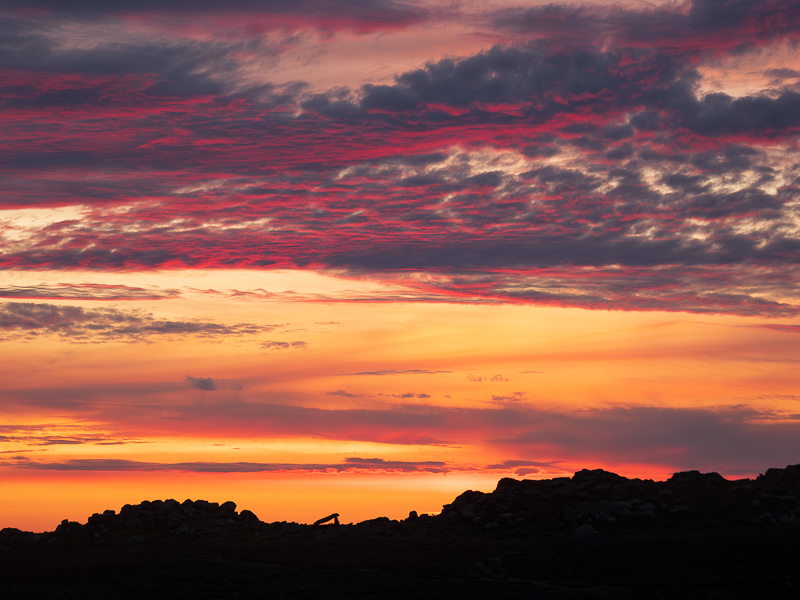
I realised on one visit that the burial chamber would be an excellent foreground against which to photograph the sunset – even if it was but a small feature in a big landscape. So, weather permitting, I have now walked there late in the evening several times to see what the sunset would bring. A few days ago I was in St Davids, exhausted after a day on the road visiting my postcard customers. The weather hadn’t been great but I could see a hint of something interesting in the sky as the evening drew on. I grabbed my camera bag and set off.
It turned out be a rather wonderful sunset. After the sun disappeared behind the headland all sorts of oranges and reds appeared in the clouds above it. The burial chamber was silhouetted nicely against this stunning backdrop. So, for a photographer who doesn’t really “do” sunsets, I seemed to have struck lucky again.
To read more Tales from Wild Wales as they are published, please click on the Follow button.
Panoramic image (two frames combined) taken eight minutes after the top one.(click to enlarge)
Last Monday I had to visit my postcard printers in Porthmadog, north Wales, and decided to make it an overnight trip. Leaving home on Sunday afternoon my journey felt rather aimless. The weather had been cloudy and drab for an extended period and there was no guarantee that it would be any better while I was away. I eventually ended up at Fairbourne , right at the mouth of the Mawddach estuary on the southern side – somewhere I very rarely visit. But as the evening slowly drew on I noticed a thinning of the cloud blanket in the west. I decided to go for a walk on the beach.
The sky was beginning to look positively very interesting with broken cloud of various types at different levels. The tide was low and a network of pleasingly shaped pools had formed in the hard sand of the beach. I actually ran back to the van to get my camera bag! Unheard of! I rarely take photos at sunset because the results can be rather predictable, but this, I felt, was an exceptional opportunity.
A few months ago I had bought a very specialised filter specifically for use at times like this. Looking towards the setting sun the light is brightest just above the horizon and gradually fades away towards darkness overhead. The reverse neutral density graduated filter is designed to counter the complex exposure changes that occur in such a situation. I was beginning to wonder if I would ever use it but there it was just sitting in my bag!
Over a period of about twenty minutes I took a series of images of one of the best sunsets I can remember ever seeing ; a complex cloudscape lit up in shades of yellow, orange and finally crimson – all reflected in the sweeping shapes of the pools on the strand. The hilltops and summits of the Pen Llyn extended across the horizon from left to right. Fairbourne itself is not a place of great beauty (or any beauty come to that) but in the right conditions the coastline there can be magical.
To be honest these were not difficult photographs to take. It was more or less a case of “1/125th of a second at f8 and be there”. I posted a couple of the results on an online photo forum and mentioned the use of the filter. One guy replied with the comment “Is that really a thing?” Well, yes, it definitely is a thing, and it works!
To read more Tales from Wild Wales as they are published, please click the Follow button.
Well, I can only think of one. Sometimes a visit to the loo before sunrise on a summer’s morning can present the photographer with scenes like this. The photograph was taken less than five minutes from my front door. Valley fog was slowly “flowing” down to the coast from the uplands; thanks to my inability to sleep I was able to get outside and take a few photographs. The sun had not yet risen above the Cambrian Mountains to the east so the light was soft and gentle.
While processing the image I found this lack of contrast frustrating at first. Adding the contrast it needed led to an unreal looking result. But that little light-bulb in my head said “think black-and-white instead” so I made the conversion. Because b&w is already an abstraction from reality I felt I could push the blacks and whites as far as they needed to go. Doing so would have been par for the course in the days of film. Having created the b&w version I then went back to the original file. Being a little more gentle with Lightroom’s sliders I produced a colour image I’m happy with. Which do you prefer?
To read more Tales from Wild Wales as they are published, please click the Follow button.
I’ve just got back from a trip around Scotland with Jane, my partner. We spent a week on Mull and then went cross country to Perthshire where we visited some great friends. Photography-wise there’s no doubt that the highlight was a boat trip from Fionnphort on Mull to the islands of Lunga and Staffa. Here’s how it happened.
I have an unfortunate tendency to arrive early or late for appointments by either an hour, a day, or even a month. Yes, the latter has happened! We were staying in the campervan most of the time but I had booked one night’s accomodation in a “pod” on Iona, just a short ferry ride from Fionnphort. Not unexpectedly I got my days mixed up and found that we had a free day on Mull before the Pod was available. Our neighbour on the campsite had booked a boat trip to Staffa and Lunga on our free day so on the spur of the moment I looked online to search for spare places. To my surprise there were, and I booked them right away. A few minutes later I checked the booking and noticed that it was for the wrong day – the day we were booked in on Iona. Cue mega-panic! Late night messages to the boat company followed, and they got back straight away with the news that they would re-arrange it for the correct day. Phew……
The forecast was great for the trip with unbroken sunshine and light winds. We cruised northwards among the Inner Hebrides in perfect conditions for an hour or so before arriving on Lunga. This island was an unknown quantity to me but a few minutes after landing puffins could easily be seen amongst their burrows on its grassy edge. I didn’t realise what was to come a little higher and further along the coast.
The path wound up through broken rock and grassy slopes dotted with bluebells and other spring flowers. Puffins seemed to be everywhere and were more approachable than they are on the Pembrokeshire islands. Some were quite oblivious to any human presence. Two visitors ahead of me seemed to be photographing a low rock-face but there was actually a pair of puffins pottering in and out of their nest in a crevice just behind it. I could easily have reached out and touched them. They are absolutely enchanting birds and I make no apologies for presenting a photograph of them in all their cuteness. Perhaps we love them so much because they remind us of ourselves? (See the main pic)
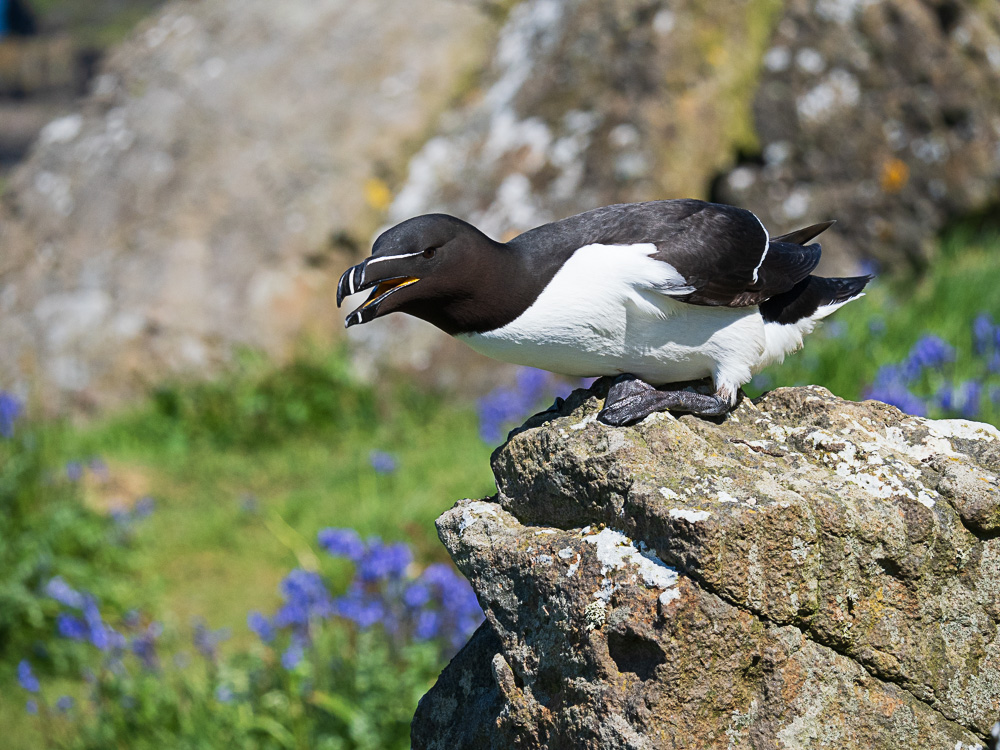
Reluctantly dragging myself away I soon came to the end of the main path close to an auk colony. While the huge majority of the birds were on the far side of a precipice that didn’t stop individuals landing this side of it close to me and the other human visitors. I’ve never been in close proximity to a shag before but one landed nearby and stayed, allowing me to photograph it at length. One young woman was sitting on a rock outcrop and a razorbill landed next to her as if she wasn’t there. It was astonishing! I reflected on how easy it would have been for the early sailors to plunder these seabird islands for food as they explored the oceans. And no wonder the great auk became extinct – it didn’t even have the advantage of flight.
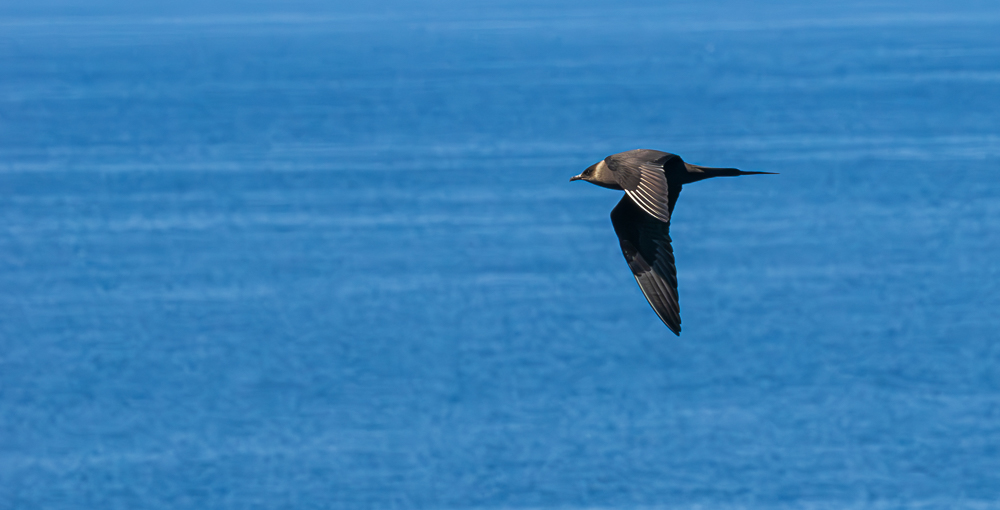
Most of these bird portraits were taken with my 24 – 100 mm zoom lens, not the long zoom that is normally obligatory for bird photography. I did, however, swap lenses to capture one of two arctic skuas which were patrolling around just offshore in an attempt to make unwary seabirds disgorge their food.
Arctic skua – much reduced in numbers following the avian flu outbreak.Basalt columns on Staffa
We only had two hours on Lunga and before long it was time to return to the boat. I was exhilarated; it had been one of the best mornings of my life. By contrast, the island of Staffa, inspiration for Mendelsohn’s piece “Fingal’s Cave” and our second port of call, was rather a disappointment. The geology was extraordinary but time was very limited and visiting the cave was like being on a production line. Boat after boat was disgorging its passengers for half an hour and then leaving.
It was only through the series of mistakes I made that we actually got to Lunga at all. If I had had time to do some research I would probably have taken the shorter and cheaper trip to Staffa only. And if it hadn’t been for our neighbour at the campsite we might never been able to appreciate the wonders of this astonishing seabird colony. Serendipity indeed!
To read more Tales from Wild Wales as they are published, please click the Follow button.
We moved to our present house about 17 years ago. It is high on an east/west ridge with excellent visibility in all directions and I knew it should be a great place to see the northern lights. In fact, prior to moving here I lived in a village a few miles away and drove up here to search for the aurora if it was predicted. I never succeeded. And for various reasons (frequent cloud, entertaining visitors, the sofa being too comfortable etc) I continued to fail to photograph the aurora for many years even after moving up here (see also this post) . It also took me years to realise that the camera can see what the naked eye cannot. It is sometimes said that the camera accentuates the colours of the aurora but in fact it is actually the eye which diminishes them. Let me explain.
The retina contains two types of light sensors, known as rods and cones. Rods are sensitive to light in a more general, black-and-white sense, while cones are sensitive to colour. It is thought that a black-and-white view of the world was useful in terms of our survival as individuals in a dangerous world, while the addition of colour was rather frivolous. Who needs to know what colour that predator is as it creeps around in the shadows? So the cones are less sensitive than the rods, and at low light intensities we see very little colour. Digital sensors (or film) are more objective about our surroundings at low light levels.
Last night the prediction was for a massive and “extreme” solar storm with the aurora likely to be visible all over the UK. I gradually prepared myself and waited until the last of the day’s light disappeared. It seemed to take forever! There was still a hint of daylight in the northern sky at 10.30pm when the camera showed the first greenish glow. It was another fourty minutes before any colour other than green appeared – in this case red – but from then on it was pretty spectacular. The aurora’s darker colours – blue, purple and various reds – were barely visible to the naked eye but the camera showed much of the sky to be full of colour. The display was right overhead for much of the time and could also be seen to the east, west and even the south. I used the minor road running up past the house as a solid base for the tripod. A steady stream of cars coming up from town (and then returning) suggested that news of this massive lightshow had reached the lowlands and people were heading for the hills to see it. It was quite frustrating at times especially when someone parked in a nearby passing place and left the car lightson!
A few words about the photography. At first I blundered around in the dark not knowing if I was coming or going. I settled on an ISO of 1600 and an aperture of f4. I used the camera’s exposure values and underexposed by about one stop. Shutter speeds were in the region of 2 to 8 seconds. The RAW files were, as expected, in need of some tweaking but no more than I would expect a normal landscape image to require. In most cases the black and white sliders in Lightroom were all I used. And here I have to hand it to Adobe…… the noise reduction/sharpening now built into Lightroom does a fantastic job. At ISO 1600 my Olympus m4/3 files of the night sky were really pretty grainy but they cleaned up beautifully in Lightroom.
Now for the negatives. There’s only one……. none of them are sharp. None of them. At first I couldn’t understand why; there is no sign of camera shake or depth of field problems. My little brain must have been turning it over while I slept because in the early hours I woke with the answer. I hadn’t switched the image stabilisation off when I mounted the camera on the tripod. I’ve pondered over this for years and have had long exposures ruined on other occasions. Some claim you can just leave IS switched on at all times, even when using a tripod. Now I’ve learned the lesson the hard way (again) that this is definitely not the case.
Many of the images are useable unless you enlarge them too far, especially where the foreground is of interest. But would it be too much to ask for another display tonight? And would I remember to switch the IS off? And if I did would I remember to switch it back on again afterwards?
Home Sweet Home
Edit: It clouded over so there was no second chance.
To read more Tales from Wild Wales as they are published please click the Follow button.
Family duties took me down to Swansea at the end of March, which gave me the opportunity to spend a day around Port Talbot and its steel works. It seemed like eighteen months since I had last been there (see this post) but on checking my files I discovered that it was three and a half years ago! “Doesn’t time fly” doesn’t really do that justice……
If you live in Wales you will probably have heard the steel works is threatened with closure, yet again, and this time it looks final. Its owners – the Indian multinational Tata – say that the plant loses over £1m a day, and if that is true who can blame them. But it is by far the biggest employer in the area and some 2800 jobs are likely to be lost, while there must be countless other local businesses whose survival depends indirectly on it. It is also the biggest single polluter in Wales, and is responsible for 2% of the UK’s total carbon emissions. Tata say that once the plant is levelled, they will build an electric arc furnace to recycle scrap steel into new steel. This process emits less carbon dioxide but is also less labour-intensive than making virgin steel in a blast furnace. Many jobs will still be lost, and, to be honest , Port Talbot and its environs are already pretty run down. Such are the dilemmas involved in reducing our dependence on fossil fuels.
I had been studying the OS 1:25000 map of the area in great detail before my visit, and had identified some potential new viewpoints. But my first location was the one I discovered on my previous visit, on the hillside directly above Port Talbot town centre. From there one looks south-eastwards towards the works, the nearest point of which is more than a mile away. I was going to need my long lens and a tripod.
Honest light?
Over a period of an hour or so I took a range of images at focal lengths from 250mm – 300mm , that’s x10 to x12 magnification. Weather conditions were quite atmospheric; dry and mostly cloudy with little wind, lending an almost monochromatic air with very subtle colouration to the photographs (see above). It was a good start. I then moved further uphill, but found the visual impact of the works was less powerful the higher I got. My second location involved an steep drive on a minor road above the works and then an easy walk. I was higher still here and even more disappointed. From this height the works had a toytown feel to it. It just didn’t hit home at all.
“Son of Banksy” by Steve Jenks
Driving back through the backstreets of Port Talbot I took a left turn on a hunch and was soon confronted by a colourful mural on two walls of a garage. A man was fixing his car nearby so I went over for a quick chat. It turned out that this garage wall was the exact location of the “Port Talbot Banksy” which suddenly appeared in December 2018. It had been bought by an art dealer and removed for safe-keeping, but remained on display in the town until 2022. The mural that I came across, purely by chance, by the street artist Steve Jenks, has none of the subtlety of the original. But the works features prominently on it, which adds another layer of human connection with the steel industry in Port Talbot.
Golden Hour at the Steel Works
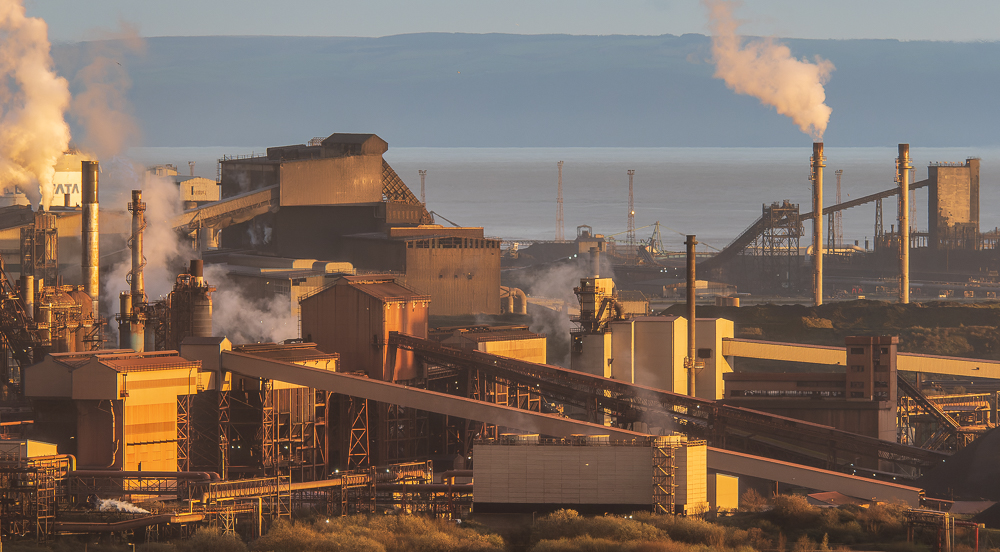
It was late afternoon by now and I could see a slot in the clouds close to the horizon in the western sky. It looked like I might get some golden hour light on the works if I was patient. I returned to my original viewpoint, and the sun crept slowly towards the slot. When it did finally emerge the steel complex was bathed in golden light. Right on cue a thick cloud of orange-brown smoke belched out from the centre of the complex and dissipated into the air above it. It was an exciting moment but………..
……………it felt almost indecent to photograph this filth in such gorgeous conditions. Does the landscape photographer have a responsibility to be honest about their subject matter, or to portray it in the best conditions possible? My day’s photography had asked more questions than it had provided answers. But I’m going to go out on a limb here: this is one of the best photographic locations in Wales.
For now.
To read more Tales from Wild Wales as they are published, please click the Follow button.
Earlier in my career as a photographer I had a whole range of activities which each brought in a certain amount of dosh. Examples include exhibition rental, print sales, calendar sales, book production and sales, and commissioned work. For a number of years I freelanced for the Wales Tourist Board, which was the closest I ever had to a money spinner. But it was a soul-less activity and I felt just like a cog in a machine. Throughout all this time my bread and butter income was through the sale of postcards. But I always felt that with a growing track record like mine I would be able to drop the postcards and work on bigger projects for prestigious clients.
M328 – Cwm IdwalM333 – Craig Cau, Cadair Idris
How wrong I was! The bigger projects dropped away for all sorts of reasons and with some minor exceptions all I’m left with is postcard sales. Sales are nothing like they were at their peak say 15 years ago (about 30%) but they do seem to have bottomed out in recent years. There is a whole host of reasons for this – like the use of mobile phones, the ridiculous cost of postage, and shop closures. For example, in the last 18 months three of my very few outlets in south Pembrokeshire have closed; one is now a cafe, one a toy shop and another sells secondhand books. None are interested in postcards. And yes, you do have to develop a very thick skin……
M329 – MachynllethP184 – Ramsey Island from Newgale
I’m not sure how many people understand how postcards are printed. To cut a long story short, commercial litho printing involves pulling a large sheet of paper/card through a machine. In the case of my postcards, and depending on the machine, the sheet holds 16 or 32 different designs. For the lowest unit price the sheet needs to be full. The drawback is that you end up with the same number of each individual design. And of course some postcards sell much better than others. There are always difficult decisions to be made.
M330 – Steam over the Cob
I had been using the same printer for a number of years and their machine held 32 designs. But I began to get frustrated by some aspects of dealing with them and sometimes with the actual printing quality. I decided to look around for another printer last summer. The company I eventually settled on had a machine which used a sheet holding sixteen designs. I didn’t realise at the time that my main competitor had used them as well, but I suppose that is a kind of recommendation. Anyway, the printing went well, and if anything the print quality was better. Things were looking up! I contacted them over the winter to discuss another order.
M331 – The Mawddach estuaryP185 – Near Abereiddi
There had been changes. They had disposed of their litho machine and installed a digital printer. My experience of commercial digital printing had been very poor but I was reassured that this was not your typical digital machine. Some samples were printed for me from the files that had been used for my last job and they were virtually identical. I couldn’t fault them. The biggest advantage was that it is now possible to have any number of each design printed. So if I needed 1000 of one design and 400 of another that was absolutely fine. The unit cost depended only on the total number of cards printed. So I decided to take a punt.
M332 – The Torrent Walk, Dolgellau
The cards are absolutely fine. Printing quality seems to be as good as the litho printer, and I’m able to tailor the order more closely to what I think will sell. I can’t help wishing these machines had been available many years ago.
To read more Tales from Wild Wales as they are published, please click on the Follow button
The coming of some sunnier weather last week had me chomping at the bit to do some photography. I have never seen an eagle in Wales but a shower of records and photographs on Facebook suggested that the first-winter white-tailed eagle was still in the Llanuwchlyn area (near Bala) on the Sunday. I contacted my friend Jonathan and we decided to meet up there on Monday morning. A car-load of birders confirmed that I was indeed in the correct area – a tributary of the Lliw valley about three miles north-west of the village. It was a cold but sunny day with a smattering of snow on the ground. I had a an “interesting” time turning the van round on a steep, narrow and icy single track lane with few passing places but having done that it was time to go for a walk. By early afternoon it became apparent that the eagle hunt was a lost cause. There was no sign of it and I returned home disappointed. A post on Facebook during the evening showed that it had been seen at 9 a.m. that day about four miles to the east.
Chores kept me at home for a couple of days but on Thursday what did I do? Set off on another wild goose chase, of course! Four waxwings had been reported on the Teifi Marshes near Cardigan. I was determined to travel down by public transport this time but by 8.30 there had been no sign of the 8.15 bus so it was back to the van. It didn’t take me long to find the waxwings and I watched them on and off until mid-afternoon. They remained within a short section of overgrown hedgerow bordering the old railway track, which is now a foot- and cycle-path. A knowledgeable local birder said it was now their eleventh day on the reserve.
My only previous sighting of waxwings had been at Machynlleth in 2012. A large flock was frantically feeding on ornamental rowan berries outside the library on the main street. Perhaps on that occasion they had recently arrived in the UK after an energy-sapping journey across the North Sea. In contrast the Teifi Marshes birds were very relaxed. Now and again one would half-heartedly pull a desiccated hawthorn berry off a twig but it didn’t seem too concerned if it fell to the ground. In an unusually informative description the Collins Bird Guide states :
“In winter can eat frostbitten and semi-fermented berries, which may intoxicate the bird and render it temporarily incapable of flight”
While they were capable of preening and spent some time doing so, perhaps they were otherwise too sloshed to move! They did, however, fly off as a group just before I left for home. It also was evident that they had no fear of humans or dogs, either, so perhaps they had no previous contact with people in their home in the Scandinavian (or Russian) taiga.
I was pleasantly surprised at the quality of the pictures I managed to come back with. The light was variable, from dark and gloomy to bright sunshine. Fortunately there were some periods of bright sunlight obscured by thin cloud. These conditions produced the best results as no harsh shadows were created and reasonably short shutter speeds could be used..
I also dipped in and out of several hides and had particularly good views of a snipe, while one or more water rails caused momentary excitement. But boy…. do they move fast! One of these days I’ll get a good picture of a water rail.
To read more Tales from Wild Wales as they are published, please click on the Follow button.
The view of Yr Wyddfa (Snowdon) from the Cob, near Porthmadog, is one of the iconic landscapes in Wales. For many years I have been trying to capture it to perfection. I had another attempt last week but I’m still not sure I’ve achieved it. I was in position at the south-eastern end of the Cob long before sunrise and had a long wait before I managed to get a few results I was reasonably happy with.
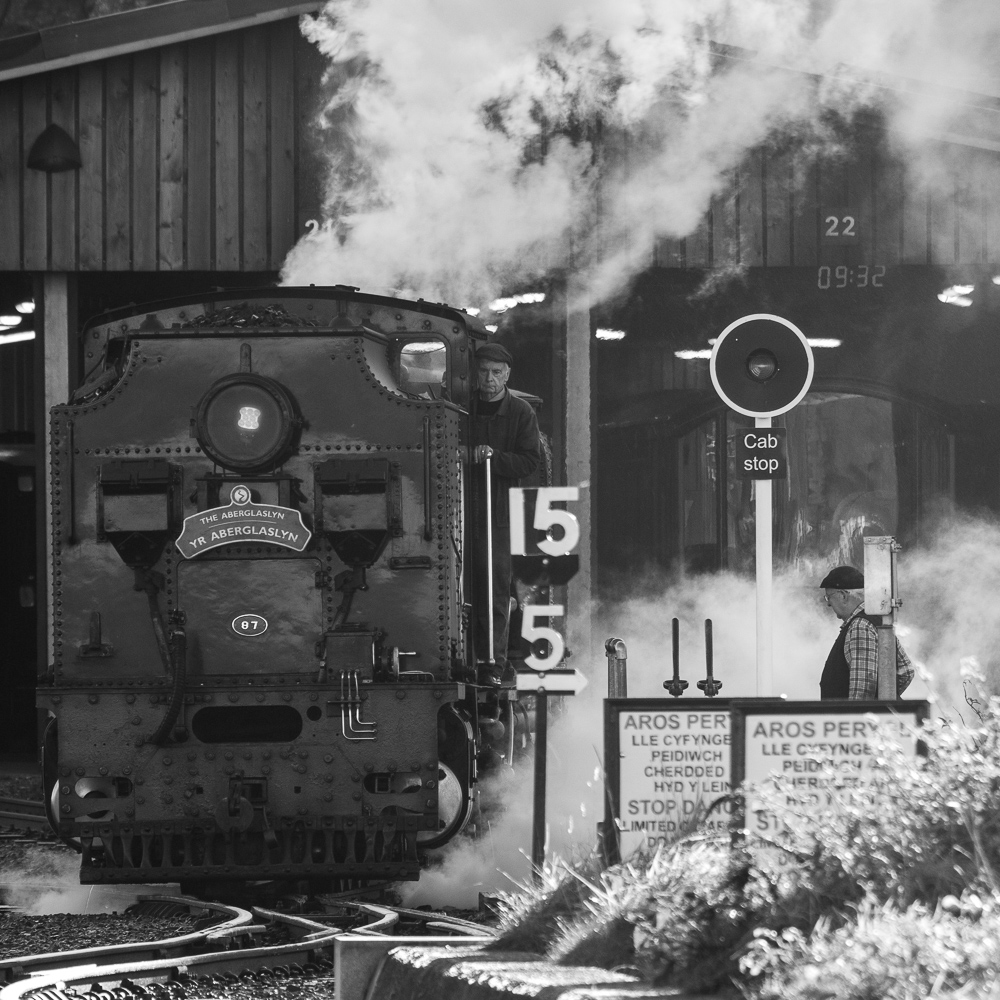
From here one is very close to the Boston Lodge HQ of the Ffestiniog and Welsh Highland Railways. Steam engines are prepared here every morning for service on the lines to Blaenau Ffestiniog and Caernarfon. By now the sun was strong and the activities around the engine sheds were either in deep shadow or strongly backlit. This made some powerful images possible as the trains were put together and then headed off to Porthmadog Harbour station ready to pick up passengers. I love the black-and-white look for steam railways: it reminds me of the last years of steam on British Rail in the 1960’s, when the railway magazines I read were still mostly in b&w.
By this time I was in need of a coffee so I headed off to Porthmadog. Take-away in hand I rushed back to the station just in time to catch one of the morning trains heading off towards Tan-y-bwlch. A strong wind blew a plume of steam across the saltmarshes.
On the nameplate of one of the engines was engraved “Built in 1879”. I told the driver how amazing it was that a machine built almost 150 years ago could still be in operation. He rather burst my bubble by saying that the name plate was probably the only part remaining from the original locomotive. The whole thing has – in effect – been rebuilt around it. The motto of the Ffestiniog could be “re-use, rebuild and recycle”.
I have already written (here) that Llyn Dinas is one of my favourite photo locations in the whole of Wales. On this by now wonderful day for the landscape photographer how could I resist the temptation to drive the ten miles to the lake and see what conditions were like there? I couldn’t and I wasn’t disappointed.
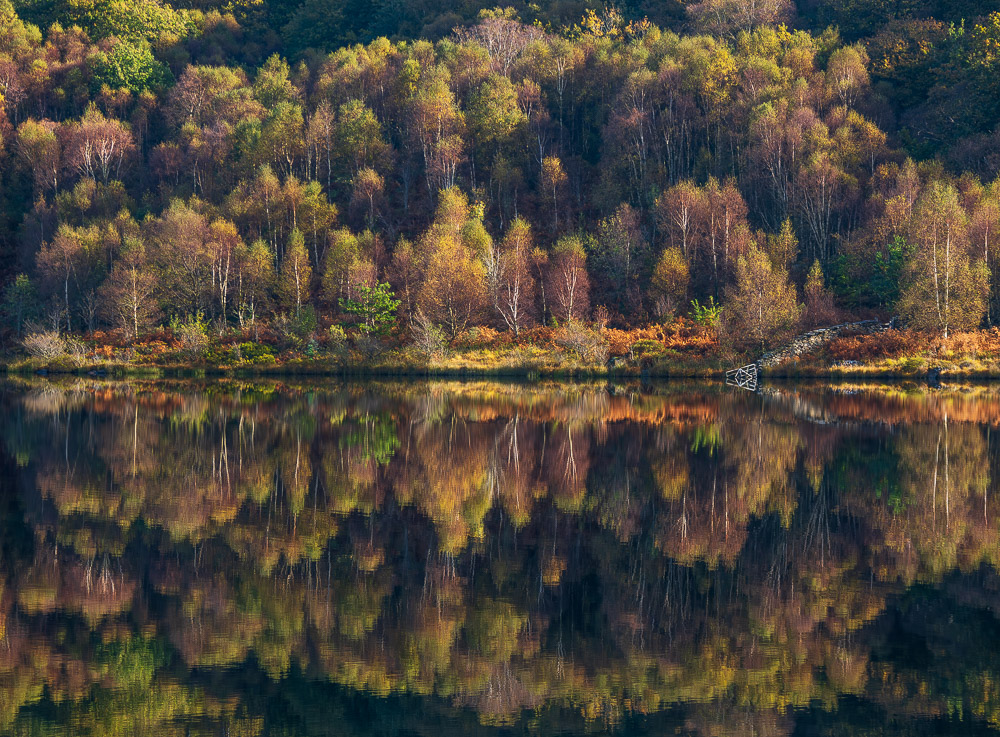
The lake was perfectly still with mirror-like reflections. Birch trees on the far side of the lake had lost some of their leaves, revealing purple twigs and silver trunks and branches. The remaining leaves were in a range of yellows and greens. Between the trees lay dark shadows. It was such a simple photograph to take, but it works so well. The tiny gate on the right-hand side (and its reflection) seem critical to the composition, and the whole thing has a hypnotic, mandala-like effect on me. I could disappear into it.
On such a day it seemed like there was a picture around every corner. But a bank of high cloud was relentlessly moving in from the west and by mid-afternoon it had more or less clouded over completely. Anticipating this I had moved on to the well-wooded Capel Curig area where there are also a number of waterfalls. This kind of subject matter is at its best under light cloud and I found what I was looking for in the village alongside the main A5. These falls are not publicly accessible but a quick hop over a wall gives access to them. Unlike the previous picture this needed very precise attention to detail.
It would be nice to be able to recount how I then retraced my steps back to Llyn Mymbyr where a stunning sunset over Yr Wyddfa awaited me. That would indeed have been the end of a perfect day but it was just too much to ask.
To read more Tales from Wild Wales as they are published please click the Follow button.
It’s usually easier to talk about the weather in the UK than just about anything else. There always seems to be something to say about it. So after the difficult subject I tackled last time, it’s time for some light relief.
It was inevitable that there would be a down side to all the glorious sunshine we had in June (not that relentless blue skies are the photographer’s friend). A cool and changeable July followed, but changeable can be good for the photographer, if it involves cloud, rain and bright sunny days. That for me would be the definition of changeable. July consisted mainly of rain followed by cloud and then more rain. At least there was a chance – dictated by the law of averages – that August would be better. Here we are on the 22nd and how true has that been? Not true at all. At the beginning of the month, the forecasters teased us with talk of an improvement by mid-month, and yes, this time last week warmth and sunshine made an appearance. It lasted less than two days.
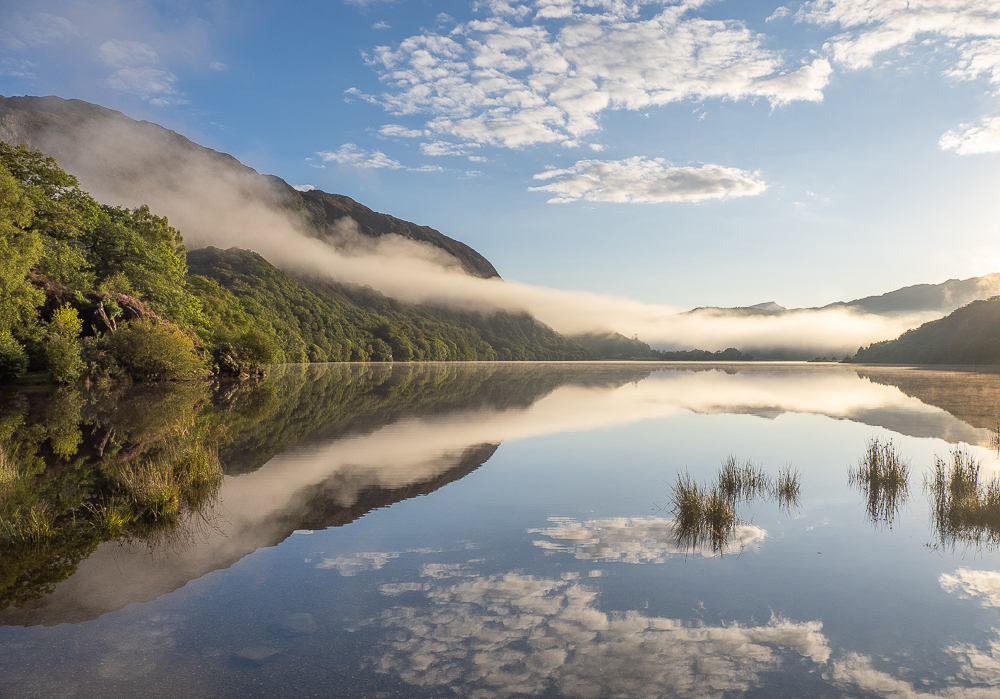
I made a decision to “go for it” even though I knew my trip would only be a short one. I headed up to north Wales for some landscape photography. On these trips I nearly always end up at Llyn Dinas (near Beddgelert) but this time I made the decision to search out some new locations. And where did I end up? You’ve guessed it….. Llyn Dinas. And while I was there I realised why: it is one of the very best locations in Wales for the landscaper – and for several reasons. The lake and its surroundings are perhaps as close to “the sublime” as it is possible to find in Wales. More practically, it is very close to the road – always handy for dawn visits; there are fairly secluded parking areas (for the camper van) nearby- ditto; and surrounded by mountains, its waters have a tendency to be still early on sunny mornings; and finally, it is also prone to valley fog. Last Thursday was one such morning.
Llyn Gwynant
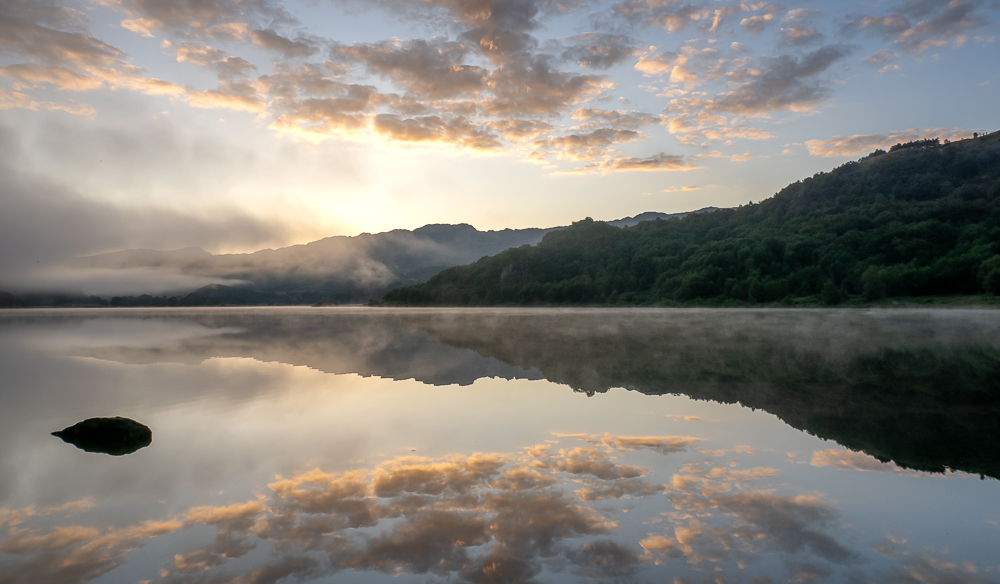
The top photo was taken as soon as I arrived and shows the lake just post-sunrise. The second shows Llyn Dinas at its idyllic best, about three-quarters of an hour later. The sense of calm that the image suggests is slightly misleading, however, as some voracious midges were making life very difficult for the photographer and it felt far from idyllic! I feel that the warmth from the sunlight on the trees adds an extra dimension that is missing in the earlier photo. After a session here I motored the short distance up to Llyn Gwynant by which time the fog was thinning and lifting quickly. I think some lake-side trees have been removed here, opening up a new vista across the water. I took another series of images with a very different feel, including the third one above.
River sculpture
That was almost it for the day, really. I’ve often wondered what other landscape photographers do during the main part of a summer day. So many are only active during the “golden hour” around dawn and dusk. How do they wile away the many hours with the sun high in the sky? Apart from catching up on sleep, that is….. . During the afternoon I walked up the lower section of the Watkin Path into Cwm Llan. It was more of a recce really, but I did come across a charming little “Andy Goldsworthy” style sculpture. Unlike a Goldsworthy, I suspect this one will have involved quantities of industrial strength adhesive to maintain it’s structure. Otherwise the walk was mainly an exercise in avoiding families with noisy children!
To read more Tales from Wild Wales as they are published, please click the Follow button.












 Tales from Wild Wales