You may have heard about Happisburgh…..

If you follow environment issues in the media you’ll probably have noticed that this Norfolk village is currently the go-to location for items about sea-level rise and coastal erosion. Like other communities on the East Anglian coast it has been threatened by the sea for hundreds of years. Some – like the nearby Whimpwell and the better-known Dunwich – have long since disappeared beneath the waves. Jane and I had booked a week’s holiday in the Norfolk Broads for the first week in May, and I noticed that Happisburgh was only a few miles away. I thought the village might provide some interesting subject matter for the photographer.

I had no idea what to expect visually other than the “Road Closed” sign that features in all the media. Arriving late in the morning I clambered across a pile of earth blocking an old field gateway to reach the cliff top. Directly below me a flock of sand martins were excitedly excavating nesting burrows in the sandy escarpment facing the sea. They barely noticed me at all and only made themselves scarce when a kestrel cruised by. This photo-op felt like a real bonus; the only drawback being the strong and distracting shadows of the birds created by the sun beating down from a clear blue sky. The sand martins were frantically landing and taking off again; you could see tiny showers of sand falling from burrow entrances, and a close examination of the photographs shows a pattern of scrape marks made by their claws on the cliff-face.

By the time I got down to the beach it was about 1pm. and the sun was high in the sky, creating some very harsh light: definitely not the time of day for the landscape photographer to be at work! All sorts of debris lay on the sand; bits of tarmac complete with double-yellow lines, a manhole with the cover missing, sections of brick wall and reinforced concrete. Electric cables trailed from the cliff top and pipework stuck out at strange angles. A brick septic tank was perched precariously close to the cliff top. And it all looked rather disappointing in the unforgiving light.

But a short distance further on – wow! Here were the skeletons of sea defences and two large rectangular concrete blocks resting on metal girders that emerged from the sand. I had no idea what they were but they looked bizarre; and wispy cirrus clouds in a deep blue sky added to the surreal nature of the scene. Normally successful landscape photography requires shadows to help give a three-dimensional quality to a scene. But here the almost complete lack of them seemed to add to the dreamlike quality of my surroundings. It was a one day in a hundred day.

Returning to the village I had a chat with the ladies at the “Sarnies by the Sea” sandwich shack. I said I had heard of Happisburgh for all the wrong reasons, but how did they feel? One said that she felt very bitter that the authorities were happy to let her village fall into the sea “like all the others”. This was the reaction of most of those I talked to, and you have to sympathise with them. One resident’s house had been valued in 2008 at less than the cost of a loaf of bread. Another villager explained that the concrete blocks are the foundations for a metal staircase which ran from the cliff-top down to the beach. It opened in 2003. The extraordinary speed with which the coastline is retreating, and the very low-lying nature of its hinterland, explains why official policy for this stretch of coast is “managed retreat”.

Unfortunately by this time the sand martins were nowhere to be seen. Perhaps nest-burrowing is a morning only job for them? I did find their activities illuminating, though. If a fragile creature like a sand martin can burrow into the cliffs using only their tiny claws what chance does the land have against such a formidable opponent, fuelled by climate change, as the North Sea?

NB : For more details about Happisburgh and coastal erosion there see the comprehensive Village website.

/http://happisburgh.org.uk/

The photograph on its homepage is worth studying. I’m not sure when it was taken but since then the caravan site on the far left-hand side has been relocated completely and I estimate that land equivalent to the outermost three rows of caravans has now disappeared.

To read more Tales from Wild Wales as they are published, please click on the Follow button

Not too choosy……

Following on from my last post about birds in the landscape, here’s another example. One day recently I stopped in my local village for some diesel. As I opened the van door I heard a collared dove calling overhead. It was in a bucket under the petrol station canopy. Wow! I excitedly told the petrol station staff who were a bit non-plussed. Hadn’t I noticed before?

It turned out that the dove had tried to nest in a pot-hole on the ground last year, and then transferred its attentions to the top of the sign – without the bucket. The twigs it brought in for the nest just blew away. The garage owners took pity on the poor thing and strapped a wooden base to the top of the sign and then balanced the bucket of sand on top of that. The doves took to it immediately. Last year it raised a youngster and apparently this year it has already reared one young. On my last visit, it called, and its mate called back from a nearby garden.

They obviously don’t waste any time, these collared doves, and they’re not too choosy either.

To read more Tales from Wild Wales as they are published, please click the Follow button.

Software pros and cons.

Feral pigeons, Aberystwyth : noise reduction and sharpening in DXO Photolab

For many years – from v3.1 to v6.14 – I was a 100% Lightroom man. I had begun my digital photography life with Paintshop Pro (I think it was) before graduating to Photoshop and then fairly soon afterwards to Lightroom. My digression into Photoshop was an expensive mistake because I found it unintuitive and difficult to use. Lightroom was a whole lot better. Then Adobe moved Lightroom into a subscription only package with Photoshop, and by 2017 it became impossible to update the software without signing up to a subscription.  I stuck with the final outright purchase version (LR6.14) despite its slowly developing shortcomings. For a longer version of this process, see this post.  

It seemed that Lightroom could do everything that I needed a software package to do. But slowly I became aware that other companies were producing alternatives to it, particularly in the realms of sharpening and noise reduction. Once Adobe’s subscription model became set in stone, there was an additional impetus for software developers to produce real, genuine, “Lightroom alternatives” that could be purchased once and updated once every year or two (at a price, of course) if the user wished.  Capture One was long-established, but it was joined by DXO PhotoLab, On1, Luminar, and others, and Topaz was developing some excellent NR and sharpening tools.

My move from full-frame Canon to micro four-thirds format Olympus proved a bit of a turning point. Because of its small sensor size m4/3 has limitations, particularly at higher ISO’s; digital noise can become obtrusive. At long focal lengths, correct focusing has always been a difficult skill to master. The bird photographer is always likely to be pushing the boundaries of their equipment and I’m no exception. But I noticed some strange “clumping” of detail in wide-angle landscape images taken at the Olympus’ “base” ISO of 200. I thought it must have been the lens or the sensor, or user error of some sort. After a while I decided to take the plunge with Topaz Denoise AI, specialist denoising software which sharpens images as well. After processing an image in Lightroom you send it to Topaz which successfully cleans it up.

My go-to camera for almost three years – the Olympus EM1 mk2 – was fully supported by Lightroom v6.14, but I knew that once I upgraded it I would no longer be able to use that software. In preparation for that day I invested in DXO Photolab, software which claimed to be a fully featured Lightroom alternative. It seemed at the time to be the most “grown-up” of the new-kids-on-the-block –   it didn’t, for example, make it any easier to replace skies, which is anathema to me. There was always going to be a learning curve with new software but I fairly quickly found it was lacking several features I was used to having.   You couldn’t combine different files to create panoramic images, or blend a number of files at different exposures to overcome high levels of contrast. And bizarrely, once you have processed a file and closed down Photolab, your processing history is lost. You can’t go back to it.

Eventually I set the software up to only pre-process selected files, and then exported them back to Lightroom for further processing. In fact I’m using it in the same way as DXO’s PureRaw software, which had I known then what I know now, would have been a better choice in the first place. Potentially this works really well – the sharpening and noise-reduction is excellent, and you get a lovely clean file to work with. In extreme cases, it is possible to add even more sharpening in Lightroom because DXO’s NR is so good. The clumping of detail which I mentioned in the third paragraph just doesn’t happen. Its main drawback seems to be that it also adds contrast, which you don’t necessary want in bird photography, and the colour balance can be altered on export. Perhaps there are workarounds for this, though.

In the years after Lightroom became subscription-only Adobe continued to develop it. I heard of its new masking tools which enable the user to select specific sections of an image and work specifically on those. My purchase of an Olympus OM1 (the company’s new flagship model) in summer 2022 made life more difficult for me again. I was either going to have to jump ship from Lightroom entirely, or return to it completely by enrolling in the subscription programme. I decided to swallow my pride and do the latter. To be honest, I’m glad that I did.

While the cost of a standard subscription is £9.98 a month, if you pay in advance and buy from Amazon on Prime Day or Black Friday, that figure is reduced to £6 p.m. I’d say that is a pretty good deal and you still have Photoshop sitting on your hard drive if you want it. It is now easy to roughly select an “object” in Lightroom and software will outline it accurately.  It also very easy to select the sky.  In fact I worry that processing a file is now almost too easy! Fortunately or otherwise LR’s “content-aware healing” doesn’t work very well in my experience so far, so there’s still difficulties to overcome. Thank goodness for that!

Nothing ever seems to be straightforward, though. As mentioned above I’m using Photolab to pre-process certain files before returning them to Lightroom. I’ve come across a fairly serious problem in that more recently in many cases the export back to LR doesn’t take place successfully. It either fails completely or returns a corrupted file that has a regular pattern of coloured lines running across it. PureRaw doesn’t work either. I’ve taken this up with DXO technical support but they have not yet come up with a solution. In fact they seem to have forgotten about it altogether. Meanwhile someone on the DXO user forum has suggested that it is actually a Windows problem and suggested an easy fix.  I’ve followed his instructions and my fingers are well and truly crossed.

To read more Tales from Wild Wales as they are published, please click the Follow button

Two nights in a quiet place.

If I am in the Porthmadog area I have a favourite place to park the van overnight. It is a delightful spot on the banks of the estuary, overhung by oak trees, and no ………. I’m not going to tell you where it is! From there it is a short drive to the Cob, the causeway that runs across the Glaslyn estuary just south of Porthmadog, from which one can look inland to the Snowdon massif. This is surely one of the most iconic landscapes in the whole of Wales but strangely enough not a big seller as far as postcards are concerned. I’ve always wondered why: perhaps people just don’t notice it as they hurry along the main road across the causeway.

I’ve spent two nights at this quiet spot in recent weeks. One morning at the end of August I woke early, had a very quick breakfast, and drove straight to the Cob. I’m sure that one of these mornings I will catch the view from there to Yr Wyddfa in perfect conditions, probably with a low fog across the marshes in the foreground, but this was not going to be it. A bank of high cloud obscured the rising sun. After a short wait I drove on to Borth-y-gest, a village set around a small harbour just west of Porthmadog.

Arriving at the main car park about 8 a.m., and the only vehicle there, I put my head back against the headrest and promptly fell asleep. About ten minutes later I woke up and was aghast to find a parking ticket attached to my windscreen! The parking warden could easily have tapped on my window and asked me to leave; instead he must have crept silently up to the van, stuck down the ticket and made a quick getaway. Talk about a hit and run incident……..

Well, Borth-y-gest is an idyllic little place so after the initial shock had worn off I decided to make the most of a now sunny morning. I need to do a new postcard of the area so set off downstream along the banks of the estuary to see what I could find. The tide was high but receding and the best photograph of the morning came on my return to the harbour (above). It’s a classic “picture-postcard” image, perfectly lit, with good colour saturation; it won’t win any prizes but it will suit my purposes perfectly.

I spent another night at my secret place last week. Not so secret, I now realise: I’ve never had to share it but this time found a rather large motor-home already in occupation. Acorns falling onto the van roof and rolling groundwards woke me several times during the night and I was surprised to also hear light rain falling. I hoped that did not bode ill for the following day.

In fact it was still raining on and off at dawn but it looked like the sun was about to rise into a clear blue sky. These looked fantastic conditions for the photographer and I didn’t even bother with breakfast. There was nothing doing at the Cob (again) so headed straight for Borth-y-gest. Parking more carefully this time, I walked along the coastal footpath overlooking some tiny beaches and the still (but rising) waters of the estuary to the mountains beyond. A rainbow appeared out to the west, but it wasn’t until I began my walk back to the village that the most spectacular conditions were revealed. Brilliant “Godbeams” could be seen across the estuary as intermittent rain and cloud drifted seawards. They were even reflected in the waters of the estuary (See main pic).

It has been suggested that these were “crepuscular rays”; but strictly speaking this term refers to a similar phenomenon that occurs close to sunrise and sunset. Not wishing to split hairs, though, they are formed in the same way. I have always believed that if you follow the path of these rays upwards they will converge at the actual position of the sun, and this shows quite clearly in the photograph. And yet the sun is actually so far away (93,000,000 miles) that its rays on reaching us are virtually parallel. This appears to be an anomaly, to say the least. One website suggests –

“Next time you see sunrays, imagine them for what they really are, miles long columns of sparkling sunlit air highlighted by the darkness of adjacent unlit voids. Let the mind fly around and through them to give them solid form that replaces the flattish way we normally see the sky”

I still can’t get my head around it so if anyone can explain it in plain English, please feel free!

Later in the day I made for the hills above Harlech on the south side of the estuary. By mid-afternoon the atmosphere had completely cleared and the light was crisp and transparent. I took a series of images back towards Porthmadog and Moel Hebog (above). My quiet place is there, somewhere…….

Postscript : I successfully challenged my parking ticket.

The quote is from : https://atoptics.co.uk/atoptics/rayform.htm

To read more Tales from Wild Wales as they are published, please click the Follow button

From the postcard to the minimalist.

But what about the photography, I hear you ask.

A photographer for many years now, the novelty for me of going out with the camera just for fun has long since worn off. Over time my photographic activities have become more focussed on a particular project, and since returning from Mallorca that project has been to add to my collection of possible postcards for future years. The most successful of such visits this summer was the classic location of Llyn Mymbyr, west of Capel Curig, at the end of May.

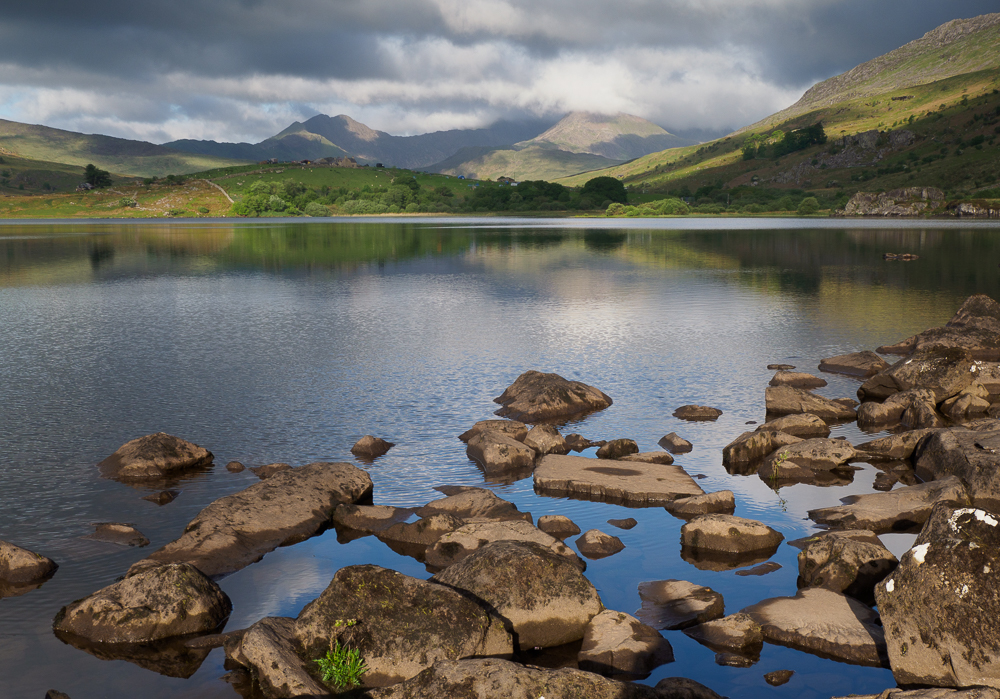
From the east end of the lake one can gaze across placid (or more likely choppy) waters towards the Snowdon Horseshoe. Halfway along, debris – brought down from the mountains by a long since disappeared torrent – almost cuts the lake in two, giving the lake its alternative name of Llynnau Mymbyr (Mymbyr Lakes). It is easy to walk to the channel joining the two waterbodies , giving views to Snowdon in one direction and back towards Capel Curig to the other. Being so close to the road the location is very popular with photographers, but it would also be well worth a decent walk to get there.

I had a feeling that something special might happen, and it did – eventually. The first morning was good, some nice light, good clouds and decent reflections. But perhaps I should have woken earlier……….. I may have missed the best conditions. I had business elsewhere during the day but returned for the evening. Again, conditions were good but not too exciting. As it was Bank Holiday weekend the campsite at the west end of the lake was busy with cars and motorhomes which provided an irritating mid-ground in front of the Horseshoe. Only in a wide-angle view would any of these images these be useable. I took my tripod around to the far side of the lake for a better angle and used a ND filter and long exposures for a different “look”, but the results were not quite what I was hoping for.

From the postcard……

The following morning I woke early and conditions looked great: blue sky overhead but fog at ground level. I walked down to the lakeside and even at 5.40 a.m I wasn’t the first photographer around. In one of my first pictures you can see a figure crouched in the reeds by the water’s edge.

….to the minimalist

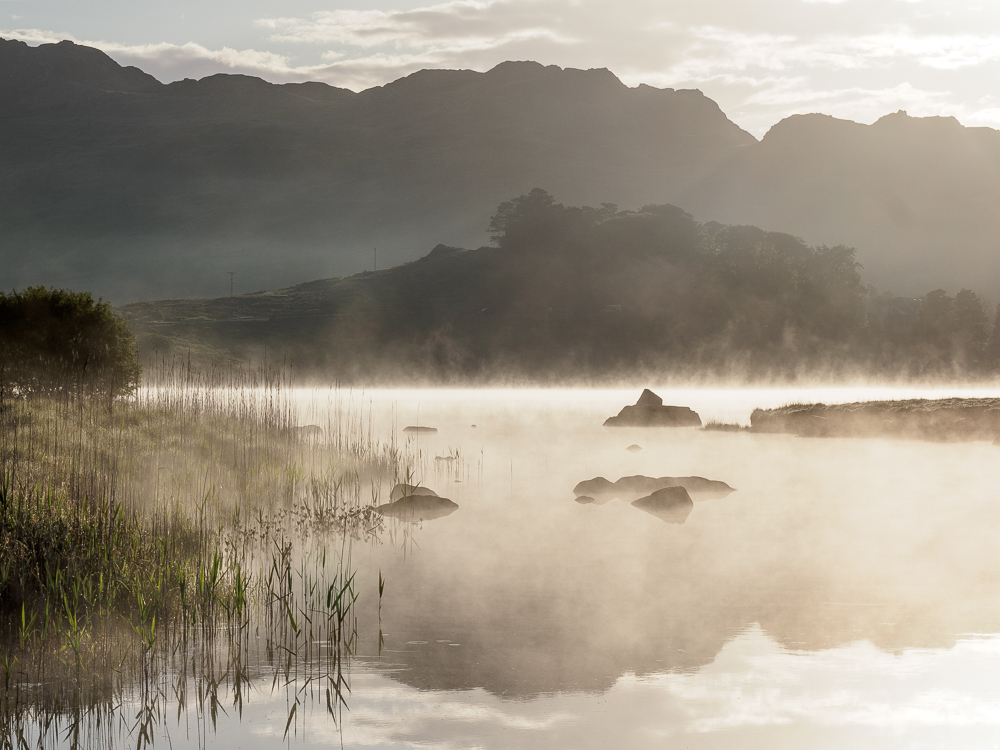
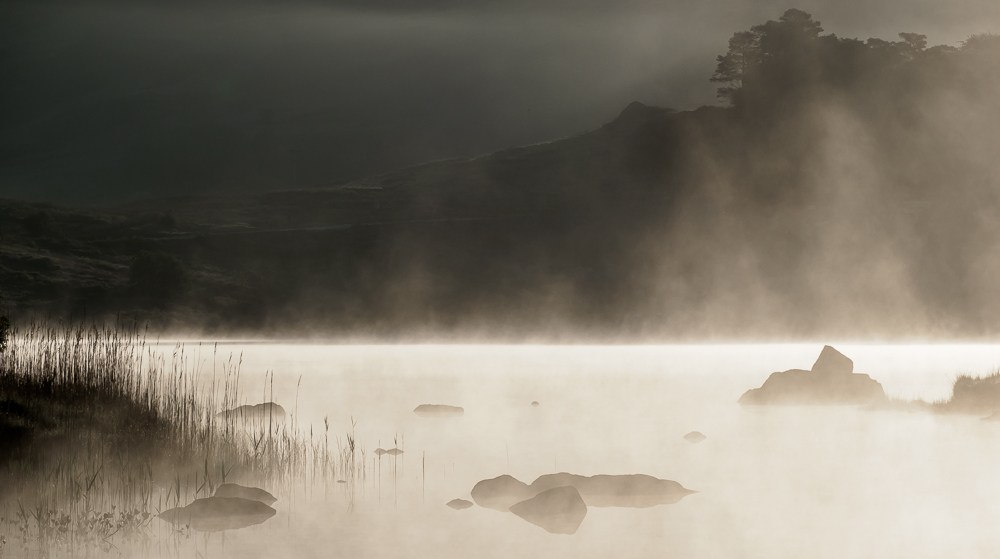
What a morning it was! The sun was already above the horizon, backlighting every feature of the landscape to the east. Mist was rising gently from the still waters of the lake. If these conditions happen at all, they are usually short-lived, but I was able to spend a good hour taking pictures in quite a relaxed fashion. I used a whole range of focal lengths from 25mm to 400 mm using both my main lenses, and got a tremendous selection of images….. if I say so myself…… ranging from the “postcard” to the minimalist.

It was the landscape photographer’s dream morning, and I was elated. But what of the other guy who appears in my first pictures? Within ten minutes he had gone. Shortly later I heard the sound of a drone flying above the lake and by the time I returned to my van in the layby his van had disappeared. I wonder how many locations he was visiting that morning, and how satisfying each one was?

To read more Tales from Wild Wales as they are published, please click the Follow button.

Raptor nut (Part 1)

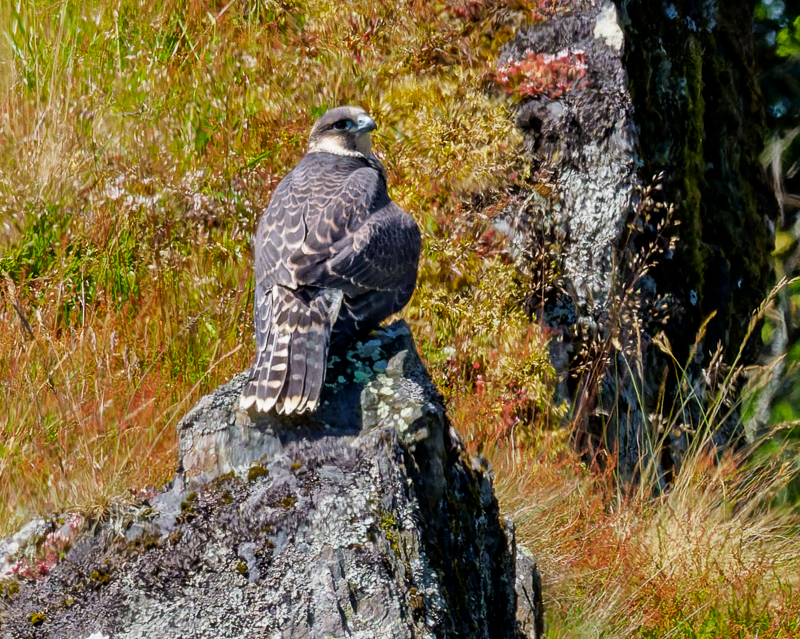
Juvenile peregrine. I got the impression this was a male.

There’s always been something special for me about birds of prey. In my “youth” (ok, I was about 30) I did several summer contracts for the RSPB which usually involved raptors and I seemed to identify with them. I spent more time with peregrines than any other species and I still seem to have an affinity with them. But I also spent many weeks with white-tailed and golden eagles on Mull, and with various species in Wales, Scotland and England. Not to mention gyr falcons and peregrines in Greenland! So you could say that since then I’ve been a bit of a raptor nut. I’d rather spend four hours watching a peregrine eyrie – even if virtually nothing happens – than four hours counting waders on an estuary.

Over the last two springs and summers I’ve been keeping my eye on several raptor eyries – from a distance, of course. It started in early 2021, during lockdown, when I discovered a pair of peregrines on a cliff within cycling distance of my home. This was exciting for me because until then I was under the impression that inland peregrine eyries had long since been abandoned in Ceredigion. I followed them through to mid-summer and saw at least one juvenile in the vicinity of the cliff. On an early visit this year I saw both adults visiting the same ledge together, which bade well for the current breeding season.

This year, following a tip-off, I found another pair nesting in an old raven nest on another cliff even closer to home. By that time the three youngsters were already well-developed and on my second visit it looked like two of them might jump and flap off the nest at any moment. One can only imagine the sense of excitement and trepidation that these young birds experience as they prepare to take their first flight. I had found a comfortable perch for myself on the opposite side of the gorge where my presence didn’t seem to worry their parents. On my third visit, a few days ago, as I approached the gorge on foot , I saw that two of the now fledged youngsters were actually using the my own perch for themselves! So I hung back and let events take their natural course. There was plenty of activity as the juveniles raced around after each other and their parents, screaming raucously. There’s nothing more stimulating to the senses than peregrines at full throttle!

I began to make plans to return to the site with my picnic chair and pop-up hide, but the truth is that I am getting very poor results from my current photographic equipment, and I don’t know why. (The image above is very much the exception.) I’ve ruled out my long lens (a Panasonic 100-400 zoom), so it looks like the problem lies with the body – an Olympus EM1 mk 2, which is now almost three years old. I’m wondering if the “in-body image stabilisation” (IBIS) is faulty or whether my settings have become corrupted in some way. Unfortunately I am a bit of a technophobe so all this is rather a challenge. But needless to say, and incredibly frustratingly, any attempt at long range bird photography is having to take a back seat for now.

In summer 2020 – again following a tip-off from a friend – I heard that merlins were nesting in a dramatic, cliff-enclosed cwm a little further away. I was not familiar with this species, so I visited the site, and was excited to see a female merlin flash by on the walk in. It all seemed very promising. Reaching the cwm I noticed several small raptors perched on erratic rocks on the grassy hillsides around the lake. I decided they were merlins but then noticed that, in the air, one of them seemed to be hovering like a kestrel. And then…….. oh….. that one’s hovering like a kestrel as well……….. Eventually the penny dropped. They were kestrels. It was all a bit puzzling. I read “The Merlins of the Welsh Marches” , by David Orton, and that whetted my appetite even more for merlin experiences.

Cliff-nesting merlins are unusual; merlins nesting anywhere in Ceredigion are unusual. In fact, merlins in Ceredigion are unusual, full stop! But last summer I managed to locate this pair’s nest on a heathery ledge part way up a low cliff above the lake. I visited the cwm several times with a few trusted friends and we all enjoyed some exciting raptor action. They are such lively, feisty little birds, especially the tiny, blue-grey male, that in a sense they almost put peregrines to shame. I visited the cwm again this spring and noticed that the merlin pair were present and showing an interest in a section of cliff high, high above the lake. Would they be nesting there this year?

To read more Tales from Wild Wales as they are published, please click the Follow button.

Peregrinations (part one).

Female dipper at Aberaeron

Over the last few weeks I’ve been exploring parts of the Ceredigion coast with the aid of an excellent bus service. I leave my van in the out-of-town-supermarket car park in Aberystwyth and hop on the bus. It’s a relaxing way to arrive at your destination, and stepping out of the bus in New Quay or Aberaeron on a sunny morning can feel like being on holiday!

I’ve never had much success photographing dippers, but there is a pair on the river at Aberaeron which is semi-accustomed to the presence of walkers passing by. I spent one morning there recently where I was able to photograph both birds at close range. The male has an unpleasant growth on his right ankle but that doesn’t seem to have affected his ability to supply his mate (and possibly youngsters) with larvae from the river bed. The female is a very fine specimen indeed.

I wouldn’t like anyone to think that I come back from a visit like this with memory cards full of perfectly composed, focussed and exposed images of birds like this. Quite the contrary. I’m often frustrated at the results I manage to achieve and I really don’t understand why some appear so mushy – especially those taken with my long zoom lens. Is it equipment failure or user error? I’d love to know. But I usually manage something to be proud of.

Checking me out …… peregrine near Aberaeron

After another visit I walked along one stretch of coast to the north of Aberaeron before catching the bus back home. It was delightful on a warm spring afternoon to be out in the fresh air with birds singing and the first wild flowers in bloom. Walking above some sheer cliffs I suddenly saw what I had been hoping for – a dark shape appearing above the waves and very obviously checking me out as it flew past. A peregrine! It repeated the maneouvre several times before disappearing back out of sight. Photographing fast-moving birds birds in flight has never been my forte but I was as prepared as I could be for this eventuality. Following the bird as it flew back-and-forth a few times, I attempted to keep it in focus, and I largely succeeded. I think the main reason for my success on this occasion was that the birds stands out so clearly against the background. There is very little chance that the autofocus will be confused. But it was still an anxious time until I opened the files up on the PC!

To read more Tales of Wild Wales as they are published, please click the Follow button

Firestarter.

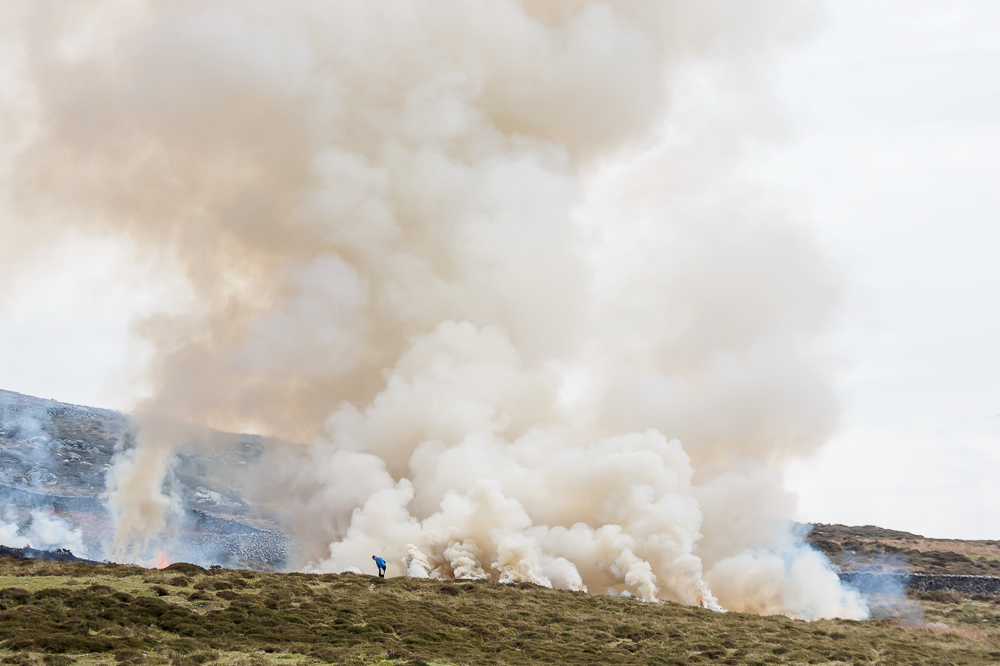
Conflagration on Mynydd Mawr, with the village of Y Fron in the foreground.

Apparently this time of year is widely known as the burning season. This year, in particular, after ten days of continuous sunshine and desiccating southeasterly winds our natural vegetation is now tinder dry.

Last Wednesday morning I set off into north Wales on the last of this winter’s postcard delivery trips. I didn’t have a very full timetable of calls so by lunchtime I was in Porthmadog. I decided to have a leisurely sandwich and birdwatch by the artificial tidal lagoon on the edge of the town. As the water was high few birds were to be seen there but there was a nice selection of waders on Traeth Mawr nearby. Turning back towards the van I noticed a pall of smoke drifting over from the north. I phoned a good friend who lives in Nantlle, about ten miles in that direction as the crow flies. He was very concerned about a fire in the hills nearby that he believed had been set by a farmer the previous evening. It had been burning out of control ever since. I wondered if the smoke I had seen was the product of that fire.

After a final call in Beddgelert I continued northwards. A huge mass of smoke was rising vertically in the still air from the summit of Mynydd Mawr, and then drifting northwards. The mountain looked like an active volcano. But it didn’t really fit the description of the fire I had heard about. Turning westwards at Rhyd Ddu towards Nantlle, the fire was to my right whereas the fire he had described would have been on my left. Entering the village I could see a few wisps of smoke rising from the crags and moorland south of Llyn Nantlle while the main fire was now raging behind me. There were two separate fires.

Mynydd Mawr from Nantlle

My friend – an ecologist by training and with many years of professional experience – was outraged to see the second fire. He had just returned from Argentina where he had had a bout of Covid, and probably wasn’t in the best frame of mind to see both sides of his beloved Nantlle valley being consumed in a conflagration! We walked a short distance to get a better view of it. It was his opinion that both fires had been set by the respective landowners/farmers. Upland vegetation is burnt like this to kill the older, more woody stems of heather, producing more younger shoots, and more grass; in other words better grazing for sheep. But over long periods of time repeated burning and grazing prevents heather from regenerating and results in upland vegetation being restricted to coarse grasses that can resist fire but have little wildlife value. It is one of the reasons why there is now so little heather moorland in Wales.

Mynydd Mawr again……

I was anxious to get more photographs of the fire so headed off in the van towards the village of Y Fron, at a higher altitude than Nantlle. Cresting the brow of a hill the fire in all its destructive reality was visible – see the main photograph above. Four fire engines were present and I had a quick chat with one of the firemen. It was while they were attempting to tackle the original fire to the south of Nantlle that they noticed this second fire take hold. “Whatever can you do about it?” I asked. He spread both arms in front of him, fingers on both hands conspicuously crossed. He said it could have been started by bored teenagers or careless walkers, but I think we both knew who the culprit was. He said that farmers are allowed to perform controlled burns but that they “sometimes got out of hand”. I spent a few more minutes taking photographs before leaving the area.

Near Pant Glas……

I spent the night in the van on the open shoreline of Foryd Bay ; it is one of my favourite places in Wales. But around breakfast time another pall of smoke began rising into the sky to the south. I had enough time to investigate the source of the smoke and fairly quickly located it near the hamlet of Pant Glas. I parked up and walked towards the fire; a figure was visible, moving around near the base of the flames. Through my binoculars I could see him carrying some kind of fire-lighting implement that every so often he would dip into a plastic container of brown liquid. This was a job for my long telephoto lens! I could see he was slowly, methodically and calmly lighting fires in the dry vegetation, without a care in the world. He was completely oblivious to my presence and I took a whole series of photographs. I don’t know how far this fire spread but the BBC Wales News website referred to a wildfire “at Pant Glas” on that day.

Firestarter………

Normally farmers can ignore the guidelines for “controlled” burning because they know no-one will ever see them. The most unprincipled can light destructive fires in the expectation that they WILL rapidly get out of control and be all but impossible to extinguish. But the expenses involved in the Fire Service attending these wildfires, including the cost of helicopter hire, are, unfairly, borne by the public purse. I have sent a batch of photos like the one above to North Wales police, and I believe that the identity of the man lighting this fire would be identifiable from them. How seriously the authorities will take them is another matter, because all too often unscrupulous farmers are given the benefit of the doubt.

Update : A petition asking the Welsh Government to ban so-called “controlled” burning has been started; please click on the link below to sign it.

https://petitions.senedd.wales/petitions/245129

To read more Tales from Wild Wales as they are published please click on the Follow button
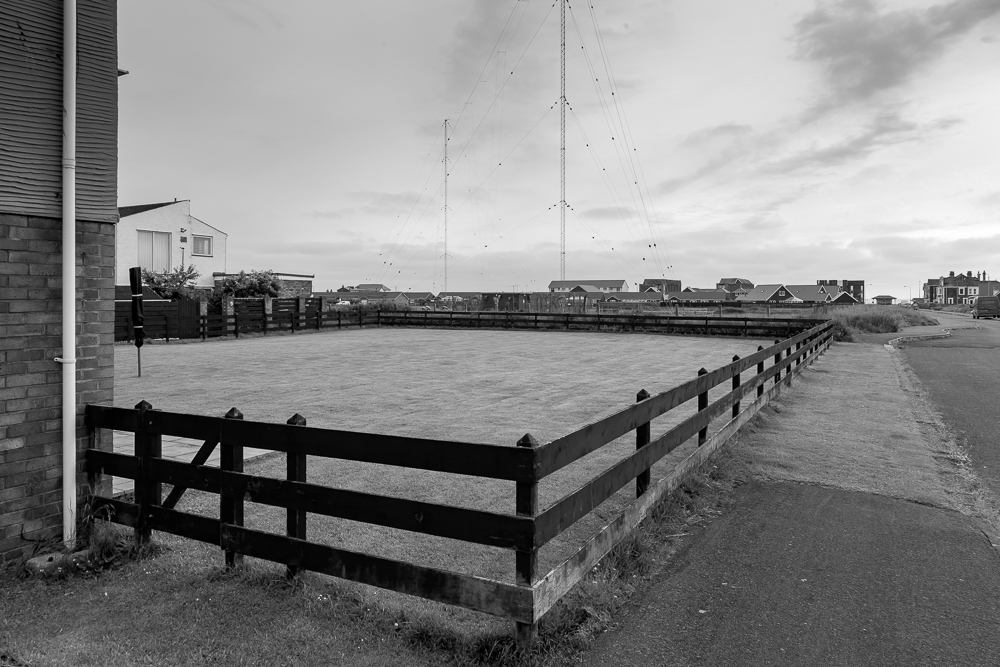
Something of value.

During a thirty year career photographing the landscape and more than a decade ago adding wildlife to my repertoire, I’ve also been maintaining a bit of a sideline.

Dead seabirds (mostly common scoter), Freshwater East, Pembrokeshire. February 1996. I spent a couple of days in Pembrokeshire after the Sea Empress oil tanker ran aground. Some of the photographs appeared on TV at the time.

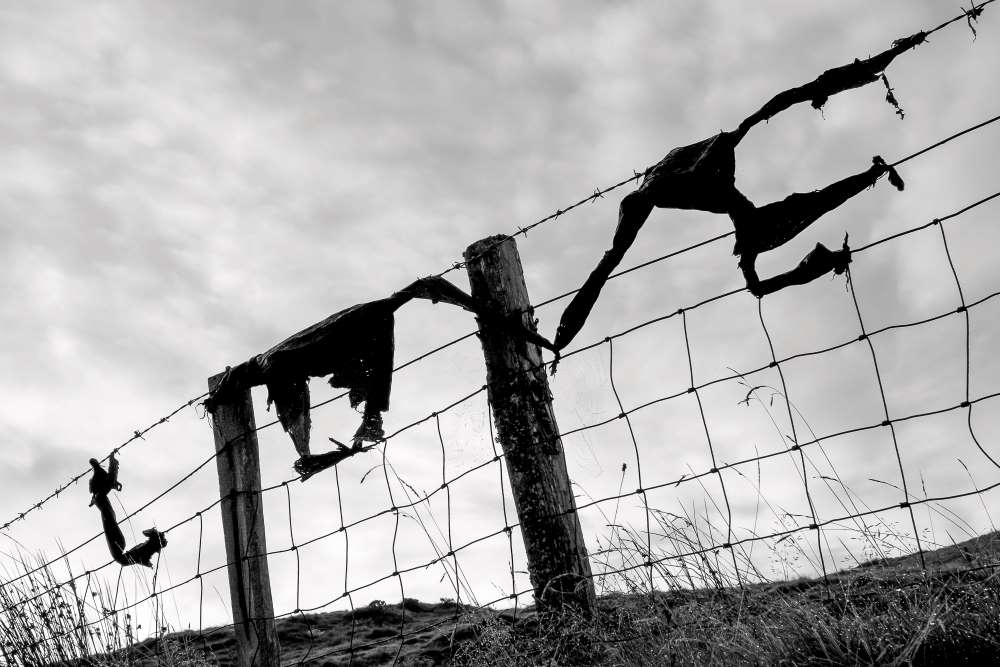
While out in the landscape I’ve sometimes come across quirky, incongruous or downright ugly scenes which tell us more about our relationship with the landscape than most of my (or anybody’s) actual “traditional” landscapes do. As an early example, in the early days of Fuji Velvia (the late 1980’s) , I remember taking a picture of a pile of bright blue plastic pipes close to a reservoir in the wilds of the Ceredigion uplands; it’s probably still in a filing cabinet somewhere. At first I called these images “human landscapes” although I don’t feel that that description now does them all justice. Many are informed by my environmental concerns in a broad sense and some actually say more about us than the landscape. Some ask more questions than give answers.

Near Bangor, Gwynedd. July 2019. An exception to the rule: having seen this phone mast from the driver’s seat of my van, I revisited it some months later and searched out the best spot to photograph it from.

Throughout my life in photography I’ve been a big fan of the brilliant Joe Cornish and his contemporaries as well as the almost unique world-view of the late Fay Godwin; both have their place in the world of outdoor photography. Fay Godwin, it seems to me, began her photographic career specialising in traditional black-and-white landscapes. But as her consciousness developed about the damage we are inflicting on nature, so her images became more closely aligned to her environmental concerns. She disliked the description of “landscape photographer” that people gave her, despite the fact that she worked mainly in the landscape; she preferred the term “documentary”. I understand exactly what she meant; it’s unfortunate that in the photographic world the term landscape means only one sort of landscape.

Near Trefenter, Ceredigion. March 2021

Going back to my own human landscapes, I’ve often been able to sneak them into my books and exhibitions while no-one was looking. I can imagine that many viewers’ reactions would be along the lines of “But Wales is such a beautiful country, why photograph that?” It has long been an ambition of mine to put them all together and exhibit them. Over the years it’s been known variously as my ” Black and White Project”, my “Retrospective of Sorts” and my “Homage to Fay Godwin”. As a prelude to this (I hope), at the end of last year, I put together a one-off photobook of more than fifty of them.

Pembroke castle and Oil Refinery, December 2009

How this eventually came about is worth a mention. I’d been putting it off for years. I had had some very dispiriting criticism of the project from a photographer in the Joe Cornish tradition who I had previously admired tremendously. I whittled the selection down to about a hundred, including plenty of new work but some already published in colour. I converted them all to black-and-white, and had some cheap test prints made, but still couldn’t put them together. Then while browsing on the internet one day I saw a promotion from an online company offering £100 off one of their top-of -the-range photobooks. I responded immediately and was sent a coupon valid for 30 days. This was the impetus I needed, and within a couple of weeks I had the finished product on my desk. Compiling it was the most fun in photography I had had for years! The quality of the book was excellent except for one thing; it had been designed online and the mid-grey front cover with white and black lettering looked fine on-screen. But in reality my name in black was almost invisible against the grey unless you saw it at a certain angle to the light. I pointed this out to the printers and they offered me a full credit for the cost, amounting to £118.23p, most of which I hadn’t paid in the first place!

Tywyn, Gwynedd. (June 2010). Taken while researching locations for Wales at Waters Edge

The content of the book, when I saw it, was really quite an eye-opener. I realised most of images had been seen almost out of the corner of my eye, while I was actually intent on taking other photographs. Mostly other landscapes, sometimes wildlife and surprisingly often while I was driving from A to B and just saw something. Many of them are at places where I stopped, took a picture and moved on. I know I will never be back there again. I’m sure I’m not the only photographer who sees a fantastic landscape from the driver’s seat of a car, stops, walks back and the finds the potentially world-beating image has completely disappeared. My snapshots are quite different to traditional landscapes, however, where the quality of the light is critical and a significant amount of pre-planning is usually required. In many cases individual images have limited value on their own but in the company of a few dozen others, the photographer’s vision becomes more clear.

Near LLanwchllyn, Gwynedd. September 2008. This could be described in terms of the media, or the message, or both. Not everyone gets both………

The good luck didn’t stop at the refund for the cost of printing the book, either. The National Library of Wales in Aberystwyth has quite a large collection of my colour work already. Just after Christmas I was strolling along the sea-front in Aberystwyth when I met its curator of photography, Will Troughton. After a bit of a general chat he asked me if I was working on anything at the moment. My usual response these days to that question is “well, er, no …….. not really…….” but fortunately I remembered to mention the retrospective/Godwin/b&w project. He expressed an interest and I arranged to meet him, book in hand. A couple of days after seeing it he phoned to say that he had “found some money” and would like to buy a selection of prints. The importance of the sale is not so much in the cash, but rather the recognition that I still produce photographic work of some value.

To read more Tales from Wild Wales as they are published, please click Follow

Long past sunset.

Long past sunset……. peat and boulders in the submerged forest. (5 seconds at f13)

The weekend before Christmas there was a break in the relentlessly cloudy and wet conditions that continue to plague us here in west Wales. While this allowed me to do some garden chores – getting a new load of logs under cover, for example – I was also able to visit the submerged forest between Borth and Ynyslas, about eight miles from here. My first visit was “on spec” after a birding walk on the Dyfi estuary. It was immediately apparent that a very large expanse of peat, together with hundreds, if not thousands, of tree stumps had been exposed after recent storms.

It was about half an hour before sunset and the tide was coming in, washing over the peat and through the stumps as it did so. From previous experience – see this post – I quickly worked out that timing would be better the following day as the advancing tide would be about fourty minutes later. Nevertheless I hung out there for a while and took a few pictures before the sun set.

Sunset over the submerged forest

I was back again the following afternoon. Although it had been a warm still day further inland, here near the mouth of the Dyfi estuary a cold easterly breeze was blowing. The light was extraordinary. The intensely clear sky was cloudless, bathing my surroundings in blue light, which I found quite unpleasant. The dark brown peat seemed to soak up whatever light hit it and become almost black. The breeze created countless ripples running at right-angles to the sun which put paid to any hope of any reflections. It was only when the sun neared the horizon that any relief came, in the shape of incoming waves breaking and being backlit with sunset colours.

Blessed relief from blue light!

Although my Olympus kit has remarkable image stabilisation, when one is considering exposures in the order of several seconds a tripod is indispensable. So this time I had my tripod with me and as the sun disappeared I set it up on a solid section of peat. I took a few long exposures but the tide advances very quickly here and before long the submerged forest was once more submerged! I determined to return the following evening.

The day of my third visit skies had been cloudless again but there was little wind; water levels were that much lower and there were still walkers on the beach. I explored a little but discovered that pleasing compositions were difficult to find. This figure seemed to add a sense of scale and I knew that I could easily clone him out if I felt he intruded on the timeless nature of this landscape.

A two image stitch in Lightroom

The sun had sunk below the horizon before waves began to encroach upon the forest. When they did I took a series of images at shutter speeds of up to eight seconds. On an incoming tide one needs to work quite fast to avoid getting wet feet (or worse) and I had time for just a few exposures. It was actually the last one (main photo) that I found most satisfying, and the tree stumps are only a minor element within it. I happened to notice that a few rounded boulders lay within the peat and that they were “rimlit” by the extremely bright post-sunset sky. I quickly moved the tripod over to place them in the foreground and pressed the shutter.

After processing them I posted the above image online. There followed a discussion on whether it was more effective with or without the figure – it was probably about 50/50. Further, and more interestingly …….. is a landscape with a human figure actually still a landscape at all?

For more technical information on the Submerged Forest, see this article by John Mason, a local geologist.

To read more Tales from Wild Wales as they are published, please click on the Follow button